Two sides that never truly met
Alexander III of Macedon (356-323 BC) inherited from his father, Philip II, a Greece already subdued. The Battle of Chaeronea in 338 BC had settled the question: Athens and Thebes lost, the Macedonians won. Athens was not destroyed. Philip preferred restrained leniency, and Alexander kept the same line.
The city kept its laws, its courts, its daily political life, and its theatre. What it lost was the most important thing: the right to shape foreign policy and declare war. During Alexander's thirteen-year reign (336-323 BC), Athens lived as a watchful subordinate: wealthy, intellectually alive, politically muted. Alexander himself barely set foot in Athens. As crown prince he seems to have visited at least once with Philip. As king he passed through the wider region, but never settled there. The capital of his empire was wherever his camp stood, and in the end that meant Babylon.
Demosthenes: the voice that did not stop
The orator who refused to forget
Demosthenes (384-322 BC) spent decades striking at Macedonian influence. His Philippics and Olynthiacs are masterpieces of political attack: direct, urgent, prophetic. He warned that Philip would swallow the Greek cities one by one, and he was right. After Chaeronea and Alexander's accession, he kept resisting from within Athens. When Alexander died in 323 BC, the Lamian War broke out, an uprising of Greek cities led by Athens against the successors. Athens lost. Pursued by Macedonian agents, Demosthenes drank poison in the temple of Poseidon at Calauria in 322 BC rather than be captured.
Aristotle: the bridge between two worlds
Aristotle (384-322 BC) was born in Stageira, in a region under Macedonian influence. He studied for twenty years at Plato's Academy in Athens. Then, from about 343 to 340 BC, he took charge of the education of the heir in Pella: Alexander himself.
When Alexander came to the throne, Aristotle returned to Athens and founded the Lyceum in 335 BC, outside the walls. It was not only a school. It was a research centre, with teaching, a library, and scientific collections. His connection to the Macedonian court made him suspect in Athenian eyes. When Alexander died, the anti-Macedonian mood became explosive. Aristotle was accused of impiety, on a charge that seems staged, and left for Chalcis "so that the Athenians should not sin twice against philosophy." He died there in 322 BC.
Athens in the years of Alexander
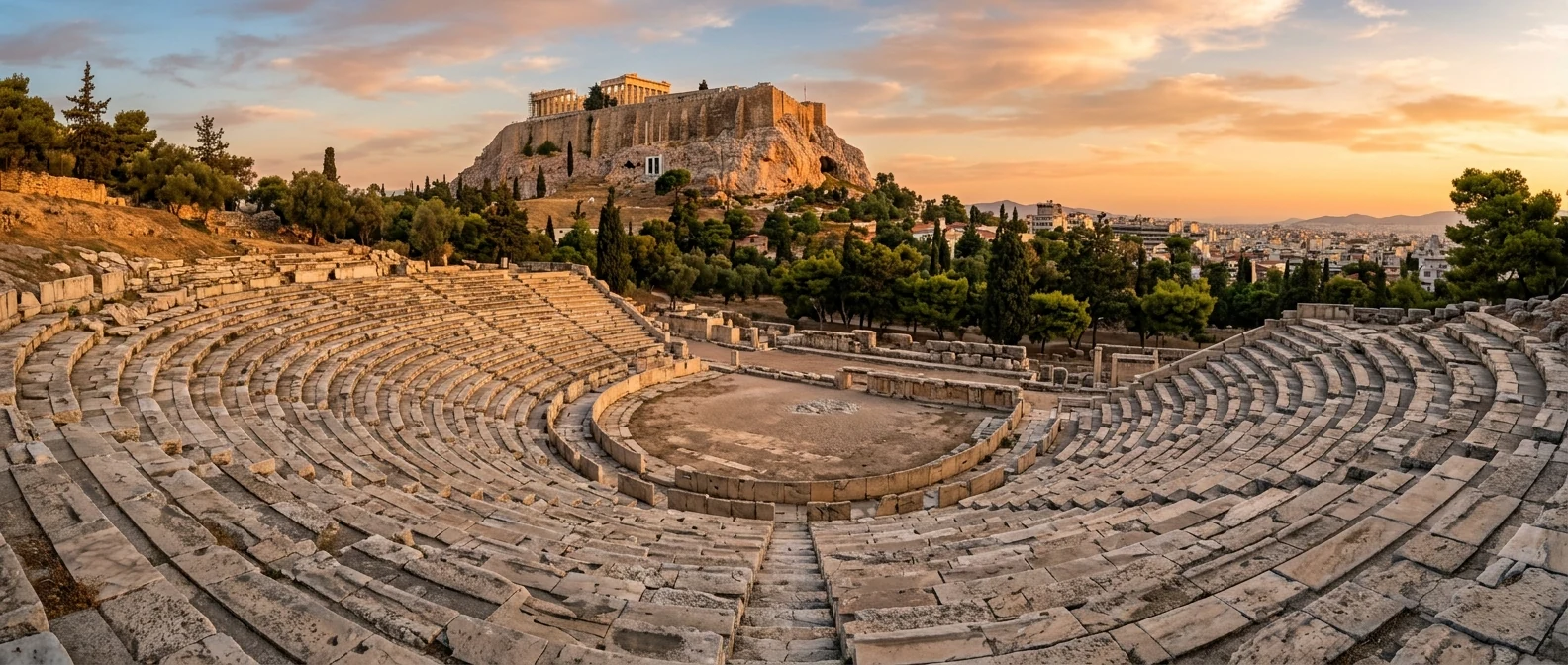
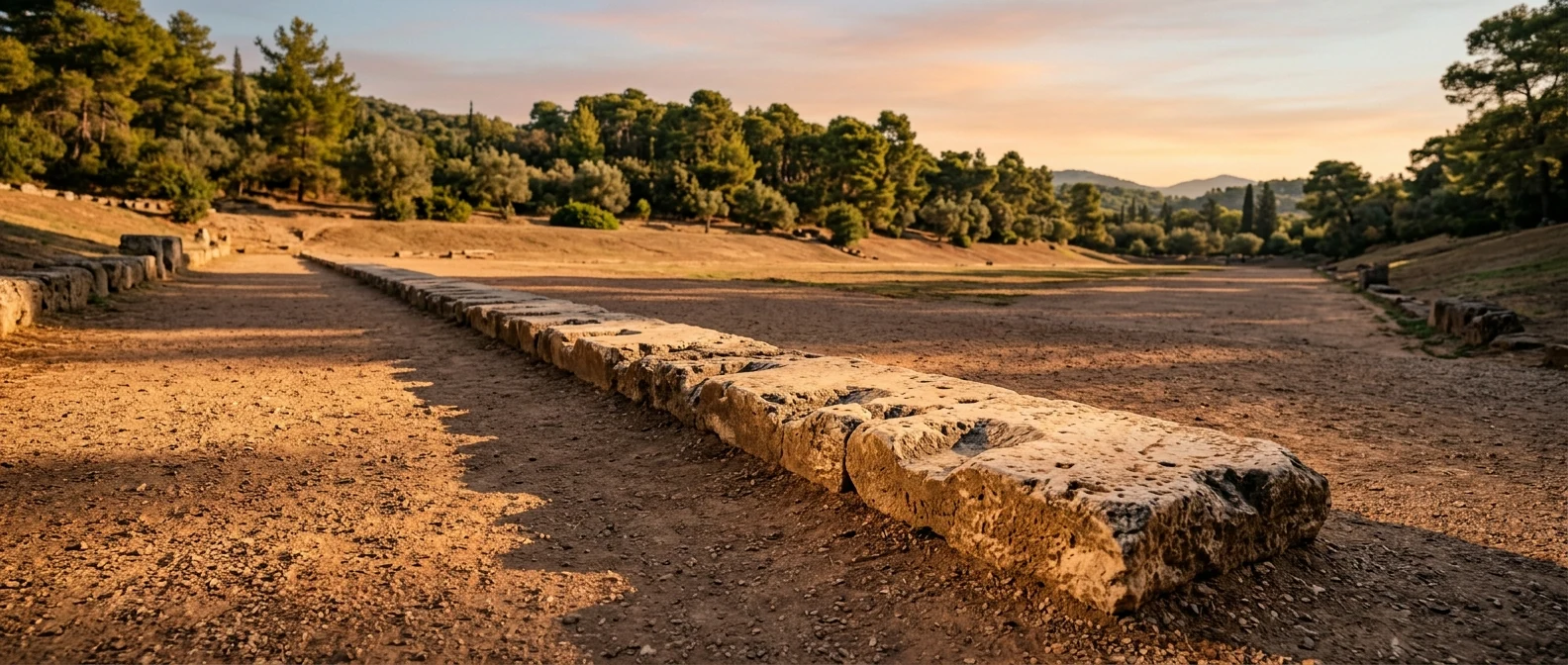
- Lycurgus of Athens served over the public finances from 338 to 326 BC. He rebuilt the city's finances after Chaeronea, rebuilt the Theatre of Dionysus in stone, and completed the Panathenaic Stadium in its earlier form.
- The Macedonian garrison at Mounychia, in what is now Piraeus, worked as a symbolic occupation. Small in size, large in meaning.
- The theatre continued to flourish. Menander staged his first comedies around 321 BC.
- Philosophy was at its height. Plato had died in 348 BC, but the Academy continued under Speusippus and Xenocrates. The Lyceum drew students from across the Greek world.
📊 At a glance
338 BC
Battle of Chaeronea. Philip defeats Athens and Thebes. Macedonian domination is imposed.
336 BC
Alexander becomes king. Athens remains subordinate.
335 BC
Aristotle returns to Athens and founds the Lyceum.
323 BC
Alexander dies in Babylon. The Lamian War follows. Athens loses.
Alexander's real stops in Greece
- Corinth, 336 BC: he is confirmed as hegemon of the League of Corinth, the coalition of Greek cities under Macedonian leadership for the coming Persian campaign.
- Thebes, 335 BC: the city revolts after a false rumour of Alexander's death. He returns and destroys it. Athens is frightened. Demosthenes had supported the revolt. Alexander demands that Athens hand over him and other anti-Macedonians. Athens negotiates and yields.
- Athens: Alexander never enters as conqueror or resident. He sends ambassadors, accepts honours, and keeps his distance.
- Sparta: it never fully submits. While Alexander is in Asia, King Agis III revolts in 331 BC. Antipater crushes him.
When Athens honoured Alexander, half-heartedly
A cult nobody really believed in
In the last years of his life, Alexander asked Greek cities for divine honours. Athens debated the matter in 324 BC. Demosthenes is said to have remarked, with irony, that "if Alexander wants to be a god, let him be a god." The city passed the decree, but without conviction. As soon as Alexander died, the cult was quietly dropped. The episode shows the narrow line Athens was walking: comply just enough to survive, never with enthusiasm.
What changed permanently
- The end of Athenian foreign policy. It never truly returned. Even after Macedonian decline, Athens remained subordinate to whichever Hellenistic kingdom dominated.
- The beginning of the Hellenistic age. Greek language and culture spread across Alexander's empire. Athens became one cultural centre among several. Alexandria, Antioch, and Pergamon now drew the attention as well.
- Philosophy continued. Zeno of Citium founded Stoicism in Athens around 300 BC, and Epicurus had already founded the Garden around 307 BC. Athens remained the philosophical capital of the Mediterranean for centuries.
- Radical democracy ended. In 322 BC, under Antipater, property qualifications were introduced for participation in political life. The broad democracy of the 5th century did not return.
Where to meet this period in Athens today
Aristotle's Lyceum
On Rigillis Street, near Syntagma and the Byzantine Museum. Excavated in 1996, open to the public since 2014. Free entry.
Theatre of Dionysus
On the south slope of the Acropolis. Lycurgus rebuilt it in stone in exactly this period. Menander's comedies were first staged here.
National Archaeological Museum
Sculpture and finds from the Hellenistic period, including works from the age of Alexander and the successors.
Pnyx
This is where the Philippics were delivered. Hill west of the Acropolis. Free access, and one of the clearest places to feel the political resistance of the period.
📚 Key historical sources
- Arrian (2nd century CE) — Anabasis of Alexander. The most reliable surviving narrative.
- Plutarch — Life of Alexander, Life of Demosthenes, Life of Phocion.
- Diodorus Siculus — Book 17 covers Alexander's reign.
- Demosthenes' speeches — primary source for Athenian anti-Macedonian politics.
- Aristotle's surviving works — written and edited at the Lyceum during the years of Alexander and after.
The paradox
Subordinate, but essential
Politically diminished, Athens in the age of Alexander still remained the intellectual centre of the Hellenistic world. Aristotle's Lyceum, Plato's Academy, Zeno's Stoa, and Epicurus' Garden all operated in the same city across these decades. Wealthy Greeks and rising Hellenistic elites sent their children there to study. The Parthenon still stood. The Theatre of Dionysus still filled. Athens had lost its empire, but it kept its mind.
Frequently asked questions
Did Alexander ever visit Athens as king?
Probably briefly, but not as a resident. After Chaeronea he was in Corinth and elsewhere in Greece. He never stayed in Athens.
Did Athens contribute to Alexander's army?
Reluctantly and in a limited way. Athens contributed naval forces to the Persian campaign as a member of the League of Corinth, without enthusiasm.
How did Athens react to Alexander's death?
It revolted in the Lamian War (323-322 BC), under Hyperides and others. It lost to Antipater. Demosthenes died to avoid capture.
What survives of the Lyceum today?
The archaeological site on Rigillis Street. Excavated in 1996, open to the public since 2014, and within a short walk of Syntagma.
Why did Athens never warm to Alexander?
The loss of independence, the Macedonian garrison near Piraeus, Demosthenes' decades of warning, and the pride of a city that remembered its 5th-century power all mattered.
Was Aristotle pro-Macedonian?
He had taught Alexander and remained politically cautious. After Alexander died, the anti-Macedonian climate became dangerous, and Aristotle left for Chalcis.
Sources:
— Kathy