The Athenian house
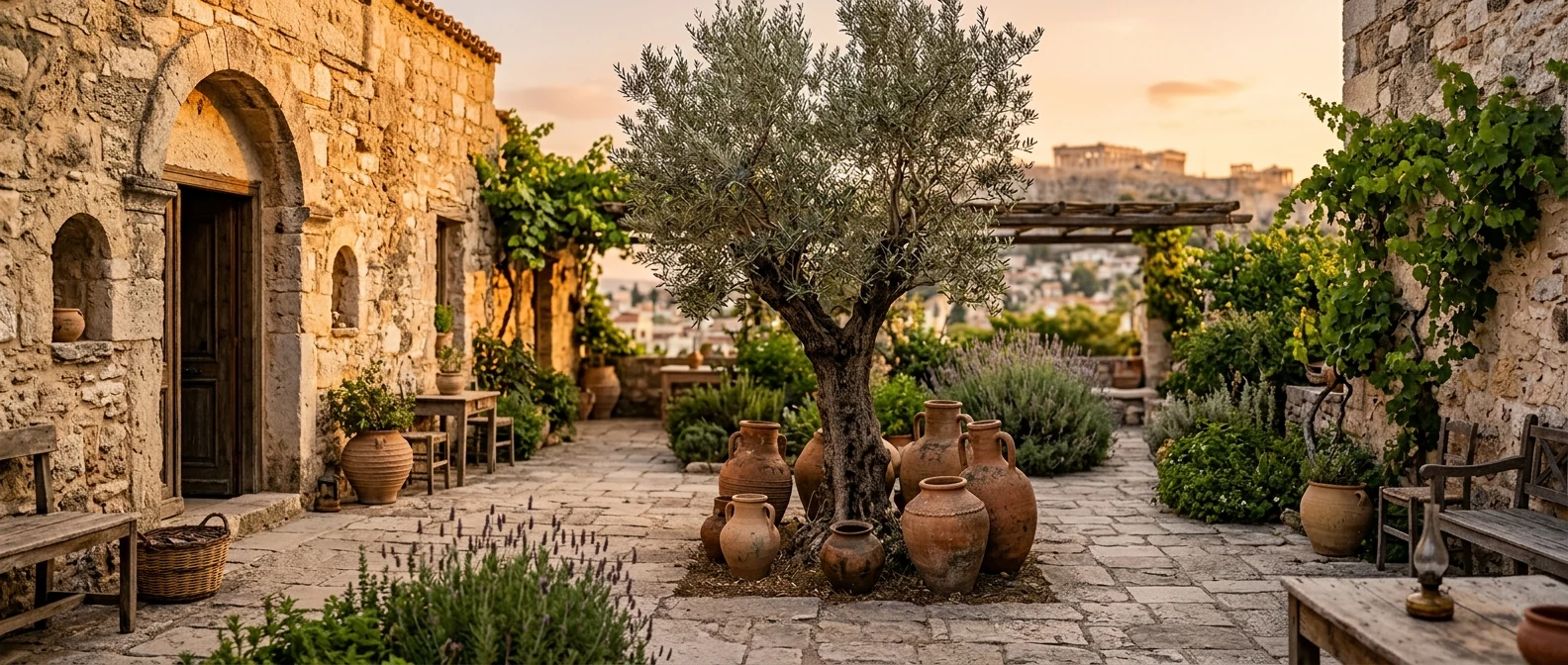
The average house in the 5th century BC was low, built of mud brick, usually one or two storeys, around a small open courtyard. The walls could be fragile enough that thieves broke through them; Athenian law even distinguished the "wall-breakers" from ordinary thieves. The roof was tiled, the floor packed earth or simple slabs. Richer houses had more rooms, painted plaster, and in some cases decorated floors. Poorer people lived more tightly packed in popular districts such as Kollytus.
The courtyard (aule) kept the house alive. It was open to the sky, often with an altar of Zeus Herkeios, protector of the household. Around it lay the andron, the more carefully arranged room for symposia, the gynaikonitis, usually farther inside or upstairs, the small kitchen with portable braziers, and storerooms with pithoi for grain, wine, and oil. At the central fire stood Hestia, not as decoration but as a daily religious presence.
The three meals of the day
Akratísmos (breakfast)
Barley maza dipped in watered wine. Sometimes olives, figs, or cheese. Light, quick, and enough to start the day.
Áriston (midday)
Bread, cheese, olives, salted fish, and raw or cooked vegetables. Often eaten quickly, without the weight of the evening meal.
Deípnon (evening)
The main meal. Soup or stew, fish, rarely meat, bread, vegetables, fruit, and wine. A family meal.
Sympósion (men's drinking party)
Followed dinner when there were guests. Wine, music, conversation, philosophy. Strictly male.
What they actually ate
- Grain: barley dominant; wheat for the wealthy. Made into máza (barley cake) or ártos (wheat bread). Athens imported much of its grain from the Black Sea.
- Olives and olive oil: the cornerstone. Eaten whole, pressed for cooking oil, and used for lamps and cosmetics.
- Wine: a daily drink for everyone, including children, watered down. Wines from Chios, Lesbos, and Thasos were especially prized.
- Fish and seafood: anchovies, sardines, tuna, octopus, squid. Athens lived close to the sea, and the market received products from the Saronic Gulf every day.
- Vegetables and legumes: lentils, chickpeas, broad beans, onions, garlic, leeks, cabbage, fennel.
- Cheese: mainly goat's cheese, both fresh and aged.
- Honey: sweetener. Mt. Hymettus honey (still produced today) was famous.
- Meat: rare in daily life — eaten mostly at religious sacrifices + festivals. Sheep, goat, pig common; cattle for major events.
- Fruit: figs, grapes, pomegranates, apples, pears. Dried fruit for winter.
The symposium and the male culture of wine
The Athenian sympósion
The symposion, from the idea of "drinking together", was one of the main social spaces of adult men. After dinner, the men reclined on klinai in the andron, often wearing garlands, while a slave mixed wine and water in a large krater and filled the cups. Conversation could move from politics and poetry to gossip. Hetairai, educated companions, might be present; wives did not belong in this space. Plato's and Xenophon's Symposium preserve the literary image of this culture. Drinking undiluted wine was considered barbaric.
Clothing
- Chitón: a linen or wool tunic, draped and pinned at the shoulders. Worn by men and women.
- Himátion: outer cloak/wrap, especially for going out. Wool for warmth, linen for summer.
- Petáso: wide-brimmed travel hat for men (sun protection).
- Footwear: leather sandals (sandália) most common. Many Athenians went barefoot at home + within neighbourhood.
- Colour: plain undyed cloth for everyday use. Dyes such as saffron, purple, or red for festivals and displays of wealth.
- Jewelry: gold and silver pieces for women, including earrings, necklaces, and cloak pins. Men wore rings too, often as signets for sealing documents.
📊 At a glance
~250-300,000
Athens + Attica population at 5th-century peak (incl. metics + slaves).
~30-50,000
Adult male citizens — those with full political rights.
3:1 ratio
Approximate barley:wheat ratio in poor diets. Wealth determined grain.
Hestia
Hearth goddess. Central fire of every household. Most basic Greek religion.
Family and household
- The nuclear family: husband, wife, children, and in many households slaves. Modest houses might have one to three; rich ones more.
- Kinship ties: strong. The oikos was both a political and an economic unit.
- Patriarchy: the husband, the kyrios, was the legal head. Wife, children, and slaves stood under his authority.
- The woman's sphere: mainly domestic, including household management, weaving, food, and children. Respectable women rarely appeared in public without company.
- Marriage: arranged, women typically 14-18, men 30s. Dowry system. Divorce possible but socially difficult for women.
- Children: infant mortality was high. The children who survived were essential for care in old age and for the family cult of the ancestors.
The day of an average Athenian
A 5th-century day
- Dawn (5:00-6:00): waking up. Light breakfast. Brief prayer at the hearth and the courtyard altar.
- Morning (6:00-10:00): business in the Agora, buying, selling, and banking. Or work in farming, craft, or trade. Public duties such as jury service or assembly meetings.
- Midday (10:00-13:00): light lunch. Quick rest in summer heat.
- Afternoon (13:00-16:00): more work or, for citizens with leisure, the gymnasium and the palaestra.
- Late afternoon (16:00-18:00): bath at a public bathhouse. Conversation in the Agora. Errands.
- Evening (18:00-21:00): family dinner. Symposium if guests.
- Night (21:00 and after): sleep. Once the sun went down, the streets grew dark and most people preferred to be home.
The day of an Athenian woman
- The house as the main space: household management, weaving, supervision of slaves, and child-rearing.
- Public appearance limited: religious festivals (women had distinct festivals like Thesmophoria), funerals, family events.
- Markets: poorer women shopped themselves; wealthy sent slaves.
- Weaving: every Athenian woman wove. Textiles were primary household labour + economic output.
- Religious roles: significant. Priestesses of various cults; women-only festivals.
- Education: minimal formal; some literacy; hetaírai often well-educated.
Bathing and hygiene
- Public bathhouses (balaneía): popular social places, with hot and cold water, oil for the skin, and strigíles to scrape away oil and sweat.
- Oil and scraper: the standard cleaning method. Soap was not yet in use.
- Perfumes and ointments: scented oils were widely used.
- Athletic culture: exercise in the gymnasium kept men fit. Wrestlers oiled themselves and were dusted before bouts.
Furniture and interior
- Simple and movable: chairs (klísmos), stools, low tables, and beds that also served as dining couches.
- Storage chests for clothes and valuables.
- Lamps: olive-oil lamps (clay or bronze) lit interiors after dark. Light dim + golden.
- Sleeping: simple straw mattresses on wooden frames. Pillow + woollen blanket.
- Decoration: painted wall plaster (later mosaics for wealthy), pottery for daily use.
Slaves and servants
- Many households, especially middle-class and wealthy ones, had slaves. Rich houses could have many. Total slave numbers in Attica are often estimated at 80,000-100,000.
- Work: domestic tasks, cooking, fieldwork, mining, craft production, and even teaching children. The silver mines at Laurion were among the harshest places to work.
- Treatment: varied. Domestic slaves were often woven into family life; mine slaves were treated as expendable.
- Manumission: possible. Freed slaves became metics, never citizens.
The Agora as the daily square
- The centre of public life. Many Athenian men passed through it on most days.
- Shopping: bread sellers, fishmongers, vegetable stalls, butchers, especially after sacrifices.
- Banking and trade: money-changers and scribes had stalls there.
- Civic life: jury duty, assembly, public announcements.
- Socialising: meeting friends, gossip, philosophical discussion (Socrates famously wandered here).
What their day did not include
- Coffee: it only reached Greece in Byzantine and Ottoman times.
- Tomatoes, potatoes, citrus: imports from the New World and later periods. None belonged to the classical kitchen.
- Sugar: not yet. Honey was the only sweetener.
- Distilled spirits: invented later, in the Arab and medieval worlds. Only wine and beer.
- Forks: they ate with hands, knives, and spoons.
- Books in the modern sense: literature was kept on papyrus scrolls. Reading was usually done aloud.
Frequently asked questions
Did Athenians eat meat often?
Rarely in daily life. Mostly at religious sacrifices and festivals. Fish, cheese, and legumes provided most regular protein.
How dirty was Athens?
By modern standards, very. Wastewater in the streets, no organised rubbish collection, and strong summer smells. Public latrines existed, but household waste often went straight outside.
Did everyone drink wine?
Yes, including children, watered down. Wine with water was often safer than water alone in many places. It was a daily staple.
How big was an average house?
About 50-100 square metres for a modest household. Wealthy homes could be 200-500 square metres. Excavations around the Athenian Agora show the house plans.
What was the population of Athens?
At the peak of the 5th century, about 250,000-300,000 in the city and Attica together, including slaves and metics. Adult male citizens probably numbered 30,000-50,000.
Did Athenians work 9-to-5?
No fixed schedule. Work followed light, season, and need. Citizens with property could spend more time in the Agora and in politics; poorer people worked longer.
Sources:
— Kathy