
Direct, not representative
Athenian democracy (demokratia, the rule of the people) differed radically from modern democracies. There were no representatives, no parliaments, no political parties, and no elected presidents. Citizens voted directly on laws, war, peace, treaties, and foreign policy. They served in the courts by lot and held many public offices by lot. The principle was simple and demanding: the city was governed by its citizens, not by a permanent political class.
This could work because Athens had a relatively small citizen body, around 30,000 to 50,000 adult male citizens, and because participation was not a full-time profession. The system began with the reforms of Cleisthenes in 508/507 BCE and reached its mature form in the middle of the 5th century, especially in the age of Pericles. With interruptions and crises, it lasted until Macedonian domination in 322 BCE, about 185 years.
The basic institutions
Assembly
All adult male citizens. It met around 40 times a year on the Pnyx and decided laws, war, treaties, and major policy by show of hands.
Council of 500
Five hundred citizens were chosen by lot each year, 50 from each of the ten tribes. The Council prepared the agenda for the Assembly and handled daily administration.
Law courts
Courts could have juries of 201, 401, 501, 1,001, or 1,501 citizens, always odd numbers to avoid ties. Jurors were chosen by lot and paid for service.
Magistrates
About 700 annual officials served each year. Most were chosen by lot, while only specialist posts such as generals and treasurers were elected.
Who counted as a citizen
- An adult male, from the age of 18.
- With two citizen parents, after Pericles' law of 451 BCE restricted citizenship to children of two Athenians.
- Born free, not enslaved or freed.
- Excluded: women, regardless of origin, enslaved people, metics or resident foreigners, and children.
- The active citizen body: around 30,000 to 50,000 men, perhaps 10 to 20 percent of the total population of Attica.
- Citizenship was tightly controlled and only rarely granted to outsiders.
Selection by lot
Why lot, not election?
The Athenians considered elections aristocratic, because they favoured the well-known, the wealthy, and the already powerful. Lot, by contrast, was seen as the democratic method: every citizen had an equal chance to serve. Most magistrates and all jurors were chosen by lot, often through a stone device called the kleroterion. Only positions that required expertise, such as generals, treasurers, and some financial officials, were elected. Pericles, for example, was repeatedly elected as a general, especially from 443 to 429 BCE.
Pay for participation
- Jury pay: two obols a day at first, later three. For poor citizens this was important, roughly half a labourer's daily wage.
- Assembly pay: introduced around 400 BCE, beginning with one obol and later reaching three.
- Council pay: five obols for each day of service.
- Theorikon: the state also paid poorer citizens so they could attend festivals.
- Why it mattered: it meant poor citizens could take part without losing all their income. Without payment, political life would have belonged mainly to the wealthy.
A day at the Assembly
- At dawn, citizens climbed the Pnyx west of the Acropolis.
- A quorum of 6,000 was required for some major decisions, such as ostracism or the grant of citizenship.
- A purification rite followed, with piglets sacrificed and ritual curses pronounced.
- Heralds announced the agenda, which had been prepared by the Council.
- "Who wishes to speak?" Any citizen could address the meeting, not only habitual politicians.
- Debate took place from the platform.
- Voting usually happened by show of hands and was counted by officials.
- Decisions on war, treaties, building projects, and trials of generals could all be taken directly there.
At a glance
508/507 BCE
The reforms of Cleisthenes, usually treated as the beginning of democracy.
~30-50,000
The adult male citizen body, the electorate of the city.
~6,000 quorum
The minimum attendance on the Pnyx for especially important decisions.
~700 magistrates
Annual public offices, most of them assigned by lot.
Ostracism
Exile by potsherd
Once a year the Assembly could decide whether an ostracism would be held. If the answer was yes, citizens scratched the name of a fellow citizen on a potsherd, an ostrakon. If at least 6,000 votes were cast and one person received the plurality, he had to leave Athens for ten years. He did not lose his property or citizenship and could return afterwards. The procedure was used around twenty times in the classical period and served as a way of easing political crises before they turned into execution or civil conflict.
The law courts
- Annual jury pool: 6,000 citizens enrolled each year and were drawn daily for particular cases.
- Jury size: from 201 to 1,501 jurors per case, always in odd numbers. More important cases used larger courts.
- No professional lawyers: accusers and defendants usually spoke for themselves, though they could pay speechwriters such as Lysias.
- Timed speeches: the water clock, the klepsydra, limited how long each side could speak.
- Two votes: first on guilt or innocence, then on the penalty, with each side proposing an option.
- No appeals: jury verdicts final.
- Famous trials: Socrates (399 BCE — 501 jurors, found guilty 280-221).
The Council of 500
- Five hundred citizens were chosen by lot each year, 50 from each of the ten tribes created by Cleisthenes.
- Each tribe served for one tenth of the year as the executive committee, in rotation.
- The Council met daily in the Bouleuterion of the Agora.
- It prepared the Assembly's agenda, drafted decrees, received foreign ambassadors, and supervised officials.
- Terms lasted one year, and a man could serve only twice in his life, which enforced rotation.
The generals
- Ten generals were elected each year, one from each tribe.
- They could be reelected, unlike most other offices. This reflected the need for military experience.
- Pericles rose to prominence through repeated election as general. Formally he had no special executive power; his influence came from rhetoric and leadership in the Assembly.
- They were accountable: at the end of their term, like other officials, they underwent a public audit called euthynai. Failure could bring fines, exile, or even death.
Limits and criticisms
- A small electorate: women, enslaved people, and metics were excluded. Only about 10 to 20 percent of the total population took part.
- A changeable crowd: the Assembly could vote hastily and then regret it. After Arginusae in 406 BCE, six victorious generals were executed, and the city reversed its decision too late.
- Vulnerability to demagogues: skilled speakers such as Cleon and Hyperbolus could sway the Assembly.
- Plato and Aristotle were critical: Plato thought democracy could collapse into tyranny, while Aristotle preferred a mixed constitution.
- Slavery and imperialism: democratic Athens also ruled the Delian League as an empire. There was democracy at home and domination abroad.
The end of democracy
- 404 BCE: Sparta defeated Athens and the Thirty Tyrants were installed. Democracy was suspended for a short time.
- 403 BCE: democracy restored.
- 338 BCE: after the battle of Chaeronea, Macedonian hegemony reduced Athenian autonomy, though democracy still continued.
- 322 BCE: after the Lamian War was lost, Antipater imposed oligarchy. Democracy effectively ended.
- Short revivals followed in the 3rd century BCE, but the substance had gone.
Where you can still encounter Athenian democracy today
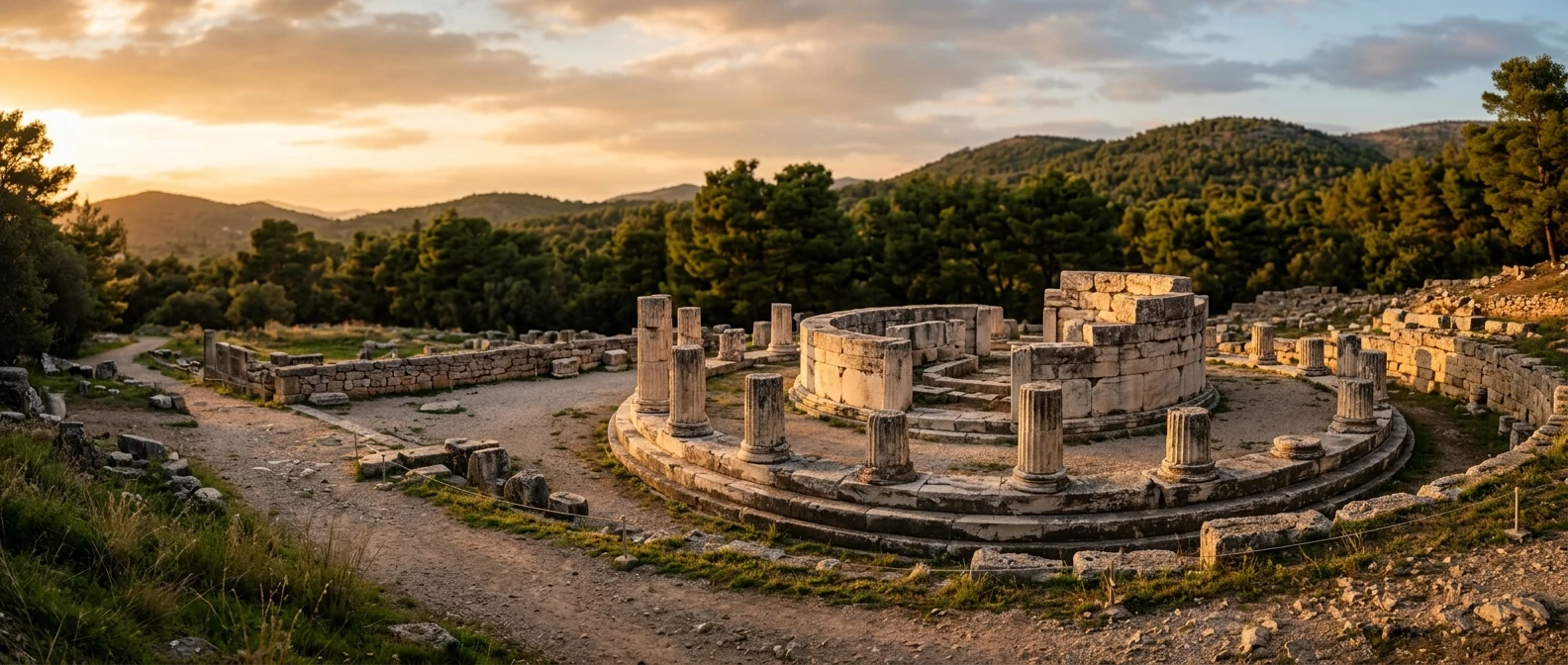
- Pnyx hill: where the Assembly met. It is open and free to visit, and the speakers' platform is still partly preserved.
- Ancient Agora: the site of the Bouleuterion, the Tholos where the prytaneis ate, and the Stoa Basileios where Solon's laws were displayed.
- Agora Museum: a kleroterion, ostraka with politicians' names, jury ballots, and bronze juror tags.
- Acropolis Museum: civic art from the democratic period.
FAQ
How was Athenian democracy different from a modern one?
It was direct rather than representative. Most offices were assigned by lot, not election. The electorate was small, made up only of male citizens, participation was paid, and ostracism could temporarily exile a citizen.
Was it really egalitarian?
Among male citizens, yes. But it excluded most of the population. By modern standards it was highly restricted; by ancient standards it was radically participatory.
Why select by lot?
The Athenians regarded lot as the democratic method because it gave every citizen the same chance and reduced the advantage of famous or wealthy men.
How was Pericles a "leader"?
He held no special constitutional office. His influence came from repeated election as a general and from persuasive speaking in the Assembly. His power was rhetorical rather than institutional.
Did democracy work?
The answer is mixed. It lasted for about 185 years and coincided with major cultural and intellectual achievement. But it also made disastrous decisions, such as the Sicilian Expedition and the execution of the generals after Arginusae. Ancient critics such as Plato thought it was dangerous.
What happened to Athenian democracy?
Macedonian conquest in 322 BCE ended democracy in any substantial sense. Later the Romans allowed Athens a degree of self-government, but real power belonged to Rome.
Sources:
— Kathy