Eleusis in one paragraph
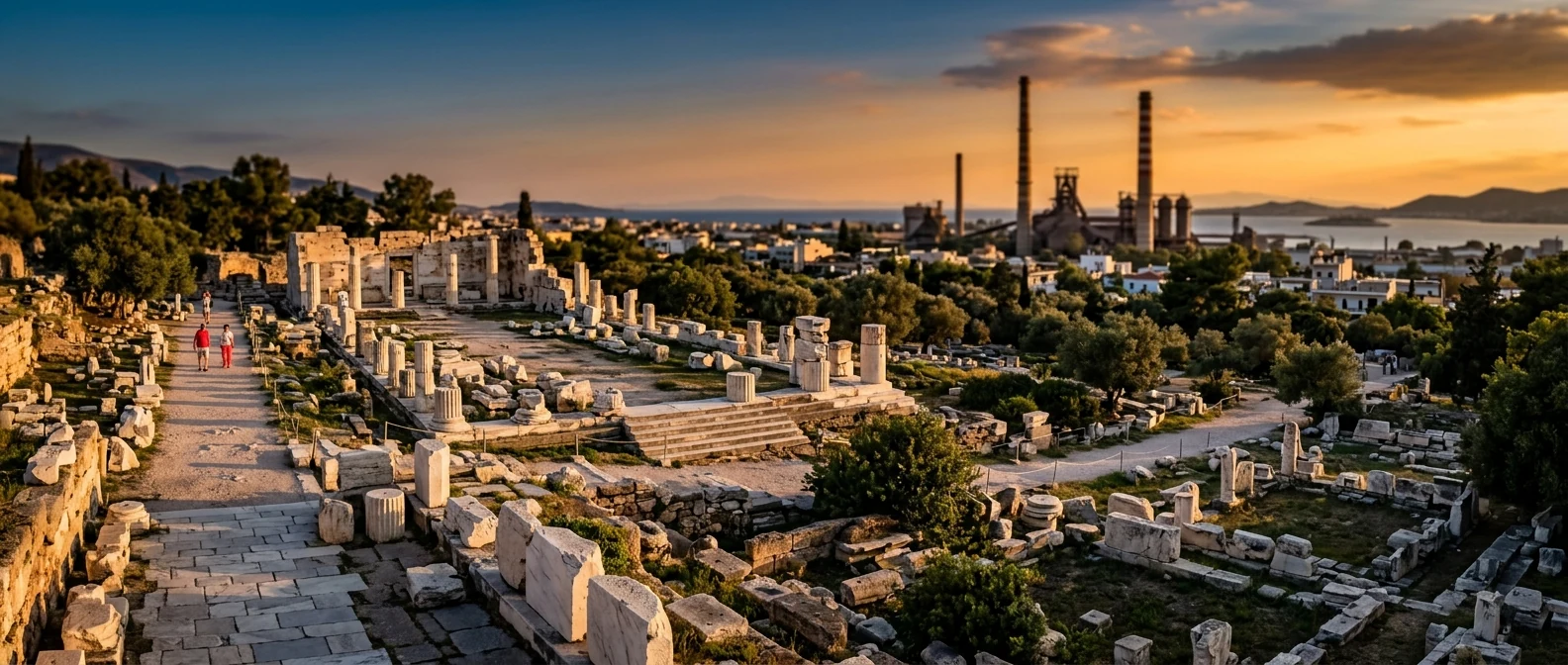
Eleusis lies around 21 km west of Athens, on the coast of the Saronic Gulf. In antiquity it was the sanctuary of Demeter and Persephone, where the Eleusinian Mysteries took place. In the 20th century it became a heavy industrial city, with cement works, refineries, shipyards, and port installations. In 2023 it held the title of European Capital of Culture. The archaeological site sits inside the modern town rather than outside it, and that is a large part of the experience.
How to get there
City bus
The simplest route is usually metro to Agia Marina and then a bus toward Eleusis, such as line 876 when it is running that pattern. Allow around 45-60 minutes from the western end of the metro. Check the exact line and stop in OASA Telematics before you leave.
Suburban Rail
Some services pass through Magoula, near Eleusis, but you usually still need a second ride by bus or taxi. It is not the simplest option for a first visit.
Rental car / taxi
Around 25 km from central Athens. The ride usually takes 25-40 minutes depending on traffic. If you use a taxi or ride app, arrange the return in advance if you plan to stay late.
Organised tour
Less common as a standalone trip than Sounion or Delphi. It appears more often in combinations with Daphni Monastery.
The sanctuary of Demeter and the Mysteries
The Eleusinian Mysteries were an initiation ritual celebrated for many centuries, and their content stayed strictly closed to initiates. The procession began in Athens and followed the Sacred Way, around 22 km, to Eleusis. Initiates fasted, drank the kykeon, a ritual drink of barley and mint, and entered the Telesterion, the great hall where the central part of the initiation took place. The surviving sources suggest that the ritual was connected with Demeter, Persephone, descent and return, the fertility of the earth, and the hope of a better fate after death.
The archaeological site today
- Foundations of the Telesterion: the central hall where the Mysteries took place, with a monumental square plan.
- Greater Propylaea: the monumental Roman entrance of the 2nd century CE, with a strong sense of procession and transition into the sacred space.
- Lesser Propylaea: the earlier inner gateway.
- Ploutoneion: the sacred cave linked with the Underworld and the myth of Persephone.
- End of the Sacred Way: the road from Athens ended here.
- Roman triumphal arches: built under Hadrian in the 2nd century CE.
- Archaeological Museum of Eleusis: next to the site, with sculpture, offerings, and objects that help explain the sanctuary. The ticket covers both the site and the museum.
The industrial city
Why Eleusis looks the way it does
From the 1920s onward, Eleusis developed as an industrial city: cement works, refineries, shipyards, and chemical plants left a strong mark on the landscape. The skyline is not a "pure" archaeological picture. It is a coexistence of:
- the ancient sanctuary and Roman entrances in the center,
- chimneys and industrial buildings of the 20th century,
- cranes and port installations,
- contemporary art spaces linked with the 2023 Capital of Culture program.
That is why Eleusis works better as a layered city rather than as only an archaeological site.
European Capital of Culture 2023
Eleusis was European Capital of Culture in 2023. The program brought contemporary art installations, performances, the reuse of industrial buildings, and better visitor signage. Some actions were temporary, but several places remained active. The Old Olive Mill continues to work as a cultural and exhibition space depending on the current program.
At a glance
~21 km
From central Athens via E94 motorway. ~25-45 min depending on traffic + transport.
~1500 BCE - 392 CE
Approximate operational range of the Mysteries — almost 2 millennia.
€6
Usual combined ticket for the site and museum. Confirm hours and prices before you go.
2023
European Capital of Culture year, with projects in industrial and public spaces.
Where to eat
- Waterfront tavernas in Eleusis: fish and grilled food, often at more everyday prices than in tourist areas of Athens. Around 15-25 euros per person.
- Megara, around 10 km west: a coastal town with fish tavernas and sea views. Around 25-35 euros per person.
- Porto Germeno and Aigosthena: on the northern side of the Corinthian Gulf, around 1 hour away by car, with fish tavernas and the old fortress as a driving extension after Eleusis.
- Cafes in the modern town: several choices close to the site.
The Sacred Way
The ancient procession of 22 km
The Sacred Way began in Athens, in the Kerameikos area, and ended at Eleusis, at a distance of around 22 km. Initiates covered it in procession, with stops at sanctuaries and places of ritual importance. Today's Iera Odos avenue keeps the name of the ancient route. Daphni Monastery stands along this logic of the route and combines well with Eleusis if you have a car.
A realistic day plan
Eleusína half-day (4-5 h)
- 09:00: Bus or drive from Athens.
- 09:45: Arrive Eleusína. Coffee + walk to site.
- 10:00-12:30: Archaeological site + museum (€6 + 2.5 h).
- 12:30-13:30: Walk through modern Eleusína: industrial-cultural areas, Old Olive Mill if open, waterfront.
- 13:30-14:30: Lunch at waterfront taverna (€15-€25).
- 15:00: Bus or drive back to Athens.
Full day with Daphni Monastery (8-9 h, by car)
- 08:30: Drive Athens → Daphni Monastery (15 min).
- 09:00-10:30: Daphni Monastery — 11th-c. Byzantine mosaics, UNESCO site. Free entry.
- 11:00: Drive on to Eleusína (15 min).
- 11:15-13:30: Site + museum.
- 13:30-15:00: Walk + lunch at waterfront.
- 15:30: Drive west to Megara or Pórto Germenó for afternoon coastal extension.
- 17:30: Return to Athens.
Practical tips
- Walking shoes: the site has uneven stone, slopes, and no shade.
- The site has limited signage in English: a guide or app helps a lot.
- Photography: the Greater Propylaea read better when the sun is not too low behind the buildings.
- Check the opening of the Old Olive Mill: it is more variable after 2023 and can sometimes be limited to certain days.
- Prepare for contrast: Eleusis does not have the polished image of Plaka or Sounion. It is rougher and more layered.
Why visit Eleusis
- The Mysteries: one of the major secret cults of the ancient Greek world, in the place where they actually happened.
- The industrial and ancient coexistence: a side of Attica that does not appear in the classic tourist route.
- Fewer people: most visitors do not come this far, so the visit is often quiet.
- Roman Propylaea: a strong entrance into the site, with a clear sense of ritual approach.
- A nearby trip: half a day, lower cost, and relatively simple transport.
How to get there from Angel Athens (Ioulianou 50)
From Ioulianou 50, walk around 3 minutes to Victoria station. Take Line 1 to Monastiraki, change to Line 3 toward Agia Marina, and from there take a bus toward Eleusis, such as the 876 when it serves the route. Allow around 1 hour and 15 minutes door to door, but check the exact routes in OASA Telematics. By car, the route via Iera Odos or the Athens-Corinth road usually takes around 30-45 minutes without heavy traffic.
Frequently asked questions
Worth a visit if I'm only in Athens 3 days?
Probably not if it is your first time in Athens. With only three days, the Acropolis, the Acropolis Museum, Plaka, and one trip such as Sounion or Aegina usually come first. Eleusis fits better on a fourth day or for someone with a specific interest in ancient religion and industrial history.
Combine with Daphni Monastery?
Yes, especially if you are driving. Daphni is a UNESCO site and fits well with the logic of the Sacred Way. Together with Eleusis it makes a full day without being exhausting.
Family-friendly?
For older children and families interested in history, yes. It is not as immediately appealing as a beach day, and the industrial backdrop does not work for everyone.
Best month?
April, May, September, and October are usually the most comfortable months. In summer the open site becomes very hot and has little shade.
Photos of the Mysteries — what's depicted?
Reliefs and finds show processions, Demeter, Persephone, and ritual symbols. The exact content of the initiation remains uncertain, because initiates did not leave a clear surviving record of it.
How much time do I need?
For the site and museum, allow around 2.5-3 hours. With lunch and a walk through the town it becomes a half day. With Daphni, it becomes a full day trip.
How long for the visit?
Site + museum 2.5-3 h. Add lunch + town walk for half-day; combine with Daphni for full day.
Sources:
— Kathy