Why Corfu is different
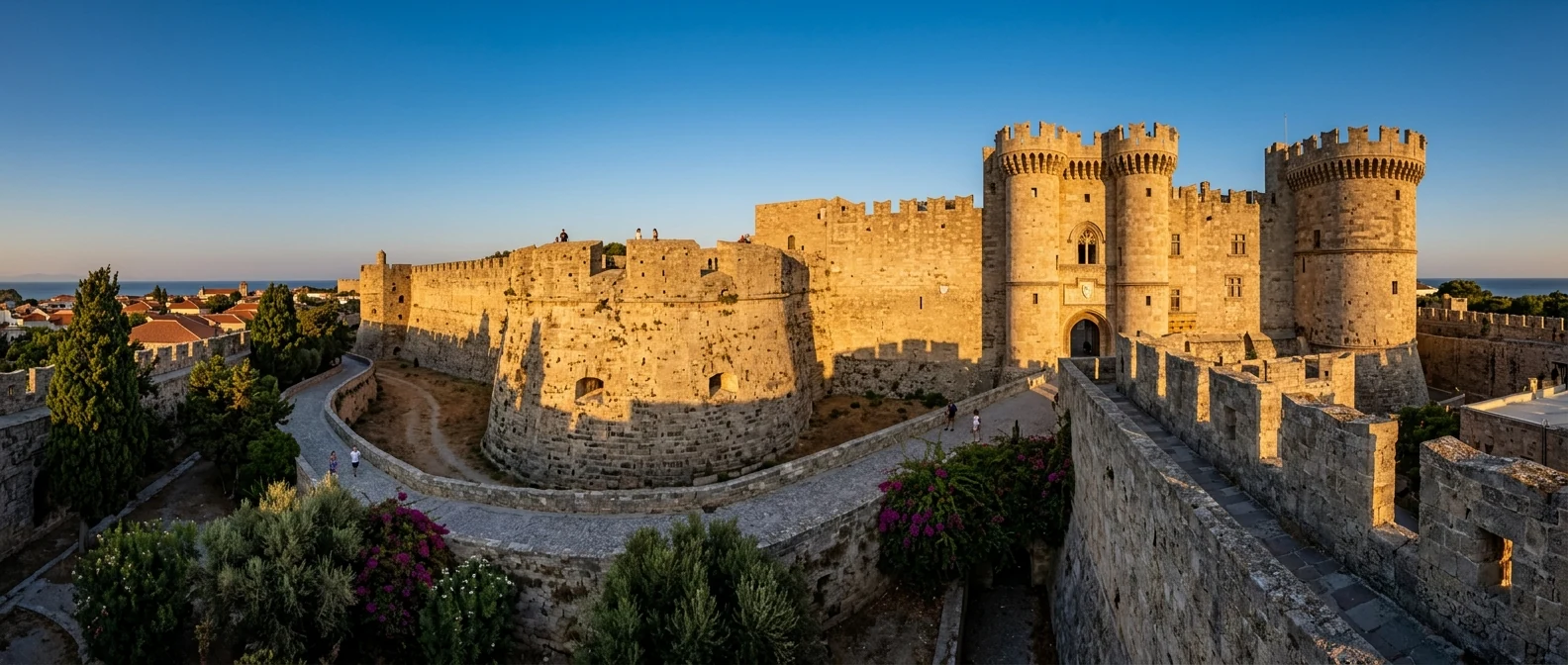
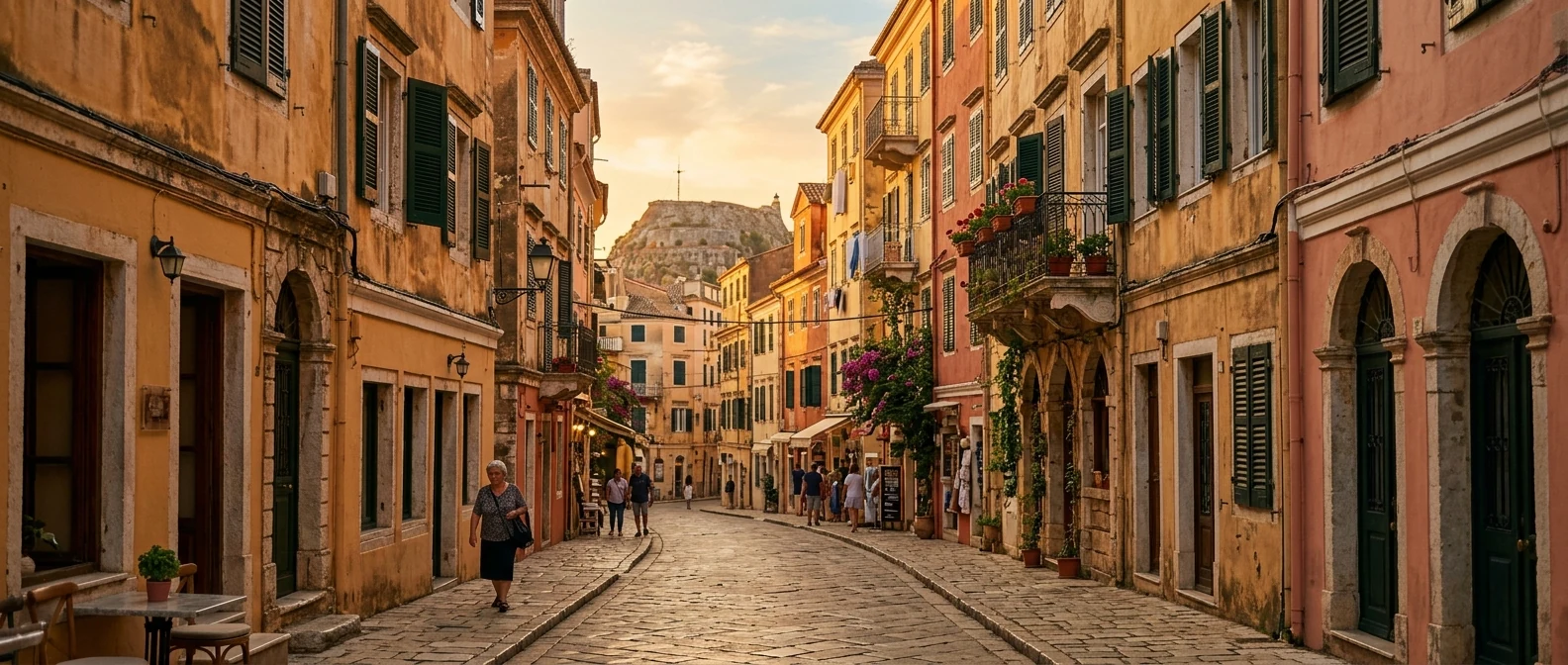
Corfu, known internationally as Corfu and in Greek as Kerkyra, is the second-largest Ionian island after Kefalonia. It sits opposite Epirus and close to southern Italy, and that position explains much of its history. From 1386 to 1797 the island remained under Venice. The Ottomans besieged it three times, in 1537, 1571 and 1716, but never took it. French, Russian and British periods followed, and the British protectorate lasted from 1815 to 1864, when the Ionian Islands joined Greece. You still feel that history in the streets: ochre and pink facades, green shutters, arcades, fortresses, and Catholic and Orthodox churches standing close together. The Old Town entered the UNESCO list in 2007.
The Old Town
- Old Fortress: standing on a rocky headland, guarding one side of the town.
- New Fortress: the other defensive anchor of the Venetian city.
- Spianada: the large open square between the fortresses and the old parade ground.
- Liston: the arcaded side of the square, now lined with cafes.
- Campiello: the maze of lanes, small squares and turns behind the main promenade.
Saint Spyridon
Saint Spyridon
The Church of Saint Spyridon was built in 1589 and keeps the relics of Corfu's patron saint. The town honours him with processions four times a year. It is not just another stop on a sightseeing list. It is a living centre of the city, especially at Easter.
The beaches by coast
South — long sandy beaches
Issos and Halikounas are open, spacious and easier for families. Kavos, at the southern tip, is a different scene: youth parties, loud music and little sleep.
West — the more dramatic side
Glyfada, Pelekas, Myrtiotissa and Paleokastritsa have cliffs, stronger landscape and beautiful water. Paleokastritsa is worth time, not just a quick photo stop.
North — a more open feel
Kassiopi, Kalami, Acharavi and Sidari feel more spread out. Canal d'Amour is famous, but in summer it fills early.
East — closer to town
Dassia, Ipsos, Barbati and Nissaki are closer to town and work well for shorter outings.
The numbers that help
593 km²
Island area. The second-largest Ionian island.
1386-1797
Venetian rule. The period that shaped the town most clearly.
906 metres
Pantokrator, the highest point on Corfu.
2007
The year the Old Town entered the UNESCO list.
Corfu food
- Sofrito: thin slices of beef with white wine, garlic and vinegar.
- Pastitsada: rooster or beef in a rich red sauce with thick pasta.
- Bourdeto: fish in a spicy red sauce, usually with scorpionfish.
- Kumquat: brought to the island in the 19th century and turned into liqueur, sweets and the usual souvenir bottles.
- Tsitsibira: Corfu's local ginger beer, a British inheritance that became local.
- The overall style: the cooking has Italian memory, but it is fully Corfiot in character.
Beyond the town
- Achilleion: built in 1890 for Empress Elisabeth of Austria, known as Sisi. It is more interesting as a European reading of Greek antiquity than as a fairy-tale palace. Check access restrictions or works before you go.
- Mon Repos: a 19th-century British residence and the birthplace of Prince Philip in 1921. Its park is a quieter break from the centre.
- Kanoni, Vlacherna and Pontikonisi: the most recognisable Corfu view, though the area around it is now quite touristy.
- Angelokastro: rising above a steep western cliff. It was a medieval fortress and still needs some walking.
- The west side in general: around Lakones and Paleokastritsa, the views explain why fortification mattered so much on this island.
Getting around the island
- The Old Town is easy to do on foot.
- For the rest of the island, a car makes life much easier.
- The distances are not huge, but the roads are not fast. A route that looks short on the map can still take 40 to 60 minutes.
- Green Buses connect the town with villages and beaches, while Blue Buses cover the nearer routes.
- Taxis work, but the cost rises quickly on longer distances.
From Athens to Corfu
- From Athens, the simplest option is the flight. Ioannis Kapodistrias Airport (CFU) receives flights from Athens and many direct flights from Europe in the season. The Athens-Corfu flight takes about 1 hour.
- From Ioulianou 50 in Athens, the route to Athens Airport is practical: a short walk to Victoria, Line 1 to Monastiraki, then Line 3 to the airport. Allow about 1 hour, depending on waiting time.
- The land route also exists: bus or car to Igoumenitsa and then a ferry to Corfu.
- Check the timetable before deciding, because total travel time changes with the departure and the wait at the port.
When to go
- Corfu is one of the greenest Greek islands because it gets a lot of rain.
- Winter can be wet, and many tourist businesses close.
- Spring brings flowers, mild temperatures and fewer people. Late May to mid-June is one of the best periods.
- July and August are hotter, busier and usually more expensive.
- September and early October often keep the sea warm and the roads calmer, though October needs a closer eye on the weather.
Easter, music and cricket
- Easter on Corfu has its own ritual. On Holy Saturday, the botides — large clay pots — are thrown from balconies and smashed in the streets.
- It is not a show built for photographs. It is an urban custom that survived and became a shared city moment.
- The island's philharmonic bands give the town a very distinct tone.
- Cricket, brought by the British, is still played on the Spianada.
- Together, those details say more about Corfu than a simple list of beaches: European influences, local discipline and a public space that stays alive.
Mistakes that cost time
- Expecting the Cyclades: Corfu is Ionian, greener, wetter and more Venetian, with a different kind of light.
- Staying only in the Old Town: the town is excellent, but the island needs at least one day toward the west or the north.
- Going to Kavos without realising what it is: if the goal is a quiet holiday, the area you stay in matters.
- Underestimating the roads: there are many bends, smaller roads and pauses that happen on the way.
- Overplanning the day: Corfu does not work well as a twelve-stop schedule.
Three days in Corfu
- Day 1: Old Town, Old Fortress, Spianada, Liston, Saint Spyridon and Campiello. In the evening, stay in town. Corfu changes when the light falls into the lanes.
- Day 2: Paleokastritsa, Lakones and Angelokastro if you feel like walking. The west side gives the clearest sense of the Corfu landscape.
- Day 3: nearby southern stops or the north. For a closer day, Achilleion, Mon Repos, Kanoni and Vlacherna. For a longer outing, Kassiopi, Sidari, Cape Drastis and the more open roads.
Frequently asked questions
Is Corfu a good choice for a first Greek island?
Yes, if you want an Old Town, green landscape, food with a local identity and good infrastructure. No, if you are looking specifically for the Cycladic image of white houses and dry scenery.
How many days do you need?
Three days is the minimum. Five to seven days gives a better balance between the town, the west coast, the north and one quieter day.
Do you need a car?
Not for the Old Town. For beaches, villages, and western or northern Corfu, yes. The buses help, but they do not cover spontaneous stops comfortably.
Which area works for families?
Issos and Halikounas give you sand and space. Dassia and Ipsos have infrastructure and easier access. The steeper western beaches need more care with small children.
Is Corfu expensive?
The Old Town and the better-known resorts rise in summer. Villages and less exposed areas stay more reasonable, especially in June and September.
When is the best period to go?
Late May to mid-June and early September. The island usually has good weather, less pressure and a more natural rhythm then.
Sources:
— Kathy