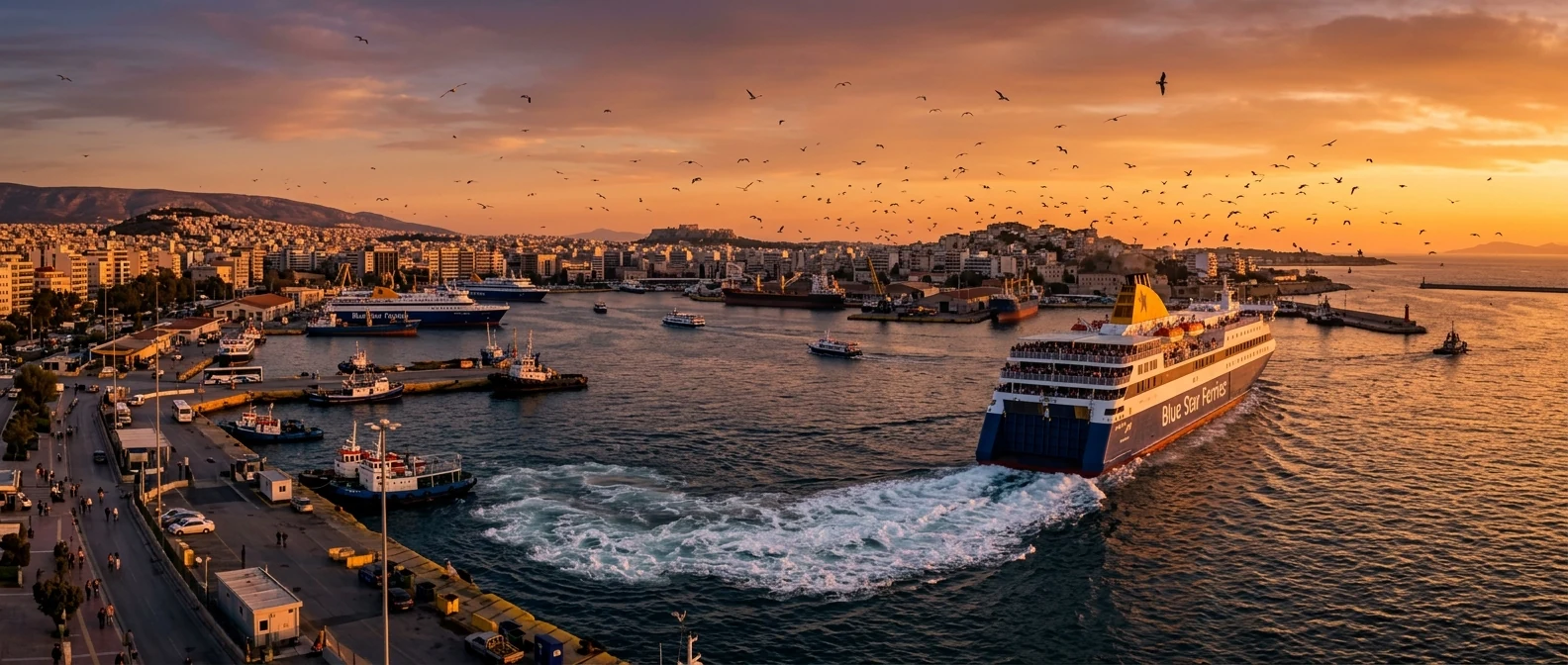
🪪 Piraeus at a glance
📍 The three ports of Athens
Piraeus is the main port for the Cyclades, Crete, the Dodecanese, the North Aegean and the Saronic Gulf. Ferries leave from here for Santorini, Mykonos, Naxos, Paros, Milos, Rhodes, Kos, Chios, Lesvos, Samos, Heraklion, Chania, Aegina, Hydra and Spetses. Athens also has two smaller ports on the east coast of Attica: Rafina, closer to the northern Cyclades, and Lavrio, mainly for Kea.
🗺️ Where the ferries from Athens go
The green dashed lines show the main routes from Piraeus, the blue one from Rafina and the orange one from Lavrio. Some of the islands we cover on the blog are shown in red. The lines are only indicative: ferries make stops that change with the season.
| Harbour | Destinations | How to get there |
|---|---|---|
| Piraeus | Cyclades, Crete, Dodecanese, North Aegean, Saronic Gulf | Line 1 from Victoria to the end of the line |
| Rafina | Andros, Tinos, Mykonos and other Cyclades islands | KTEL bus from Pedion tou Areos or from the airport |
| Lavrio | Kea and some routes to the Cyclades | KTEL bus from Pedion tou Areos |
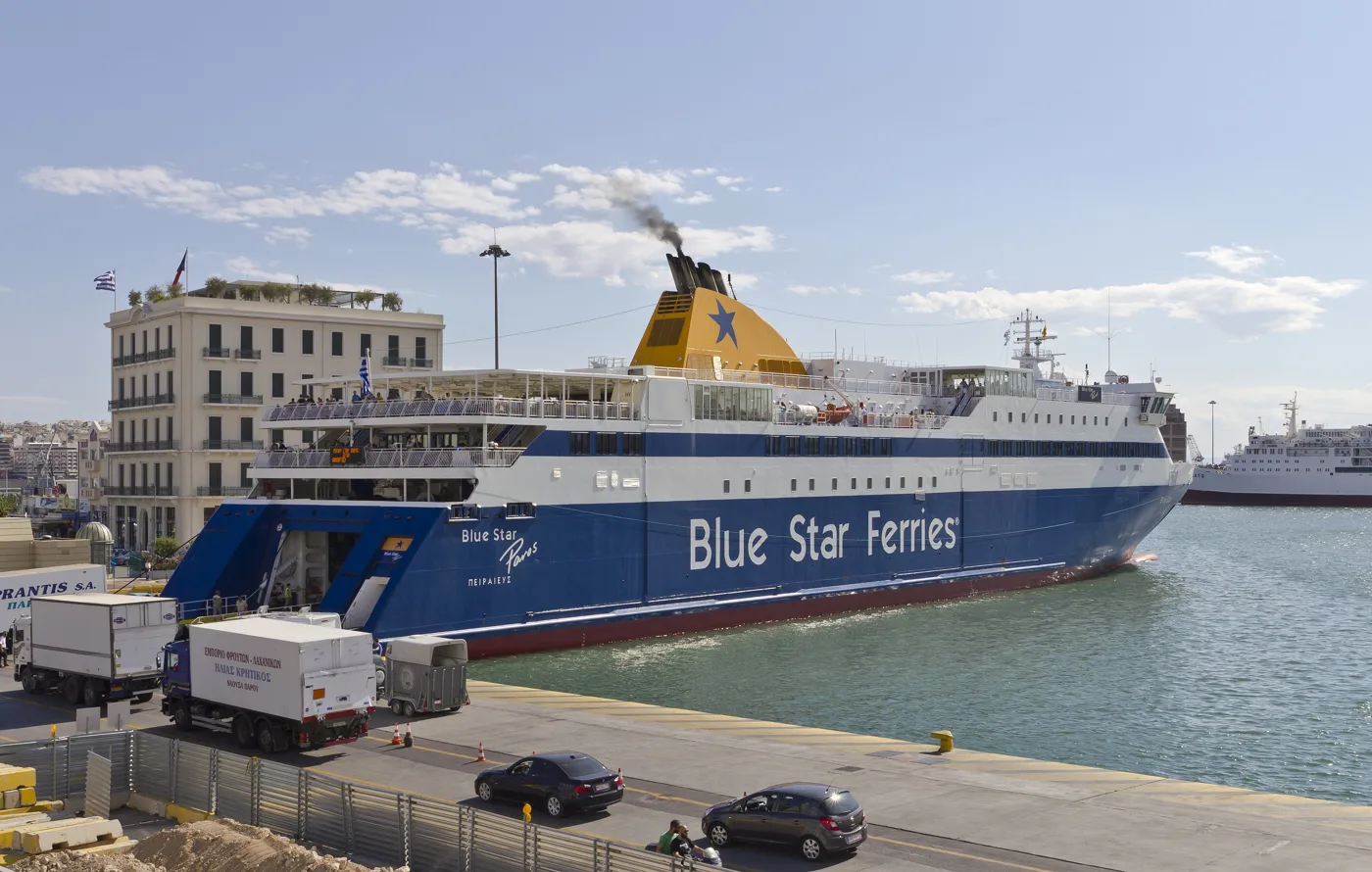
The largest port in the country.
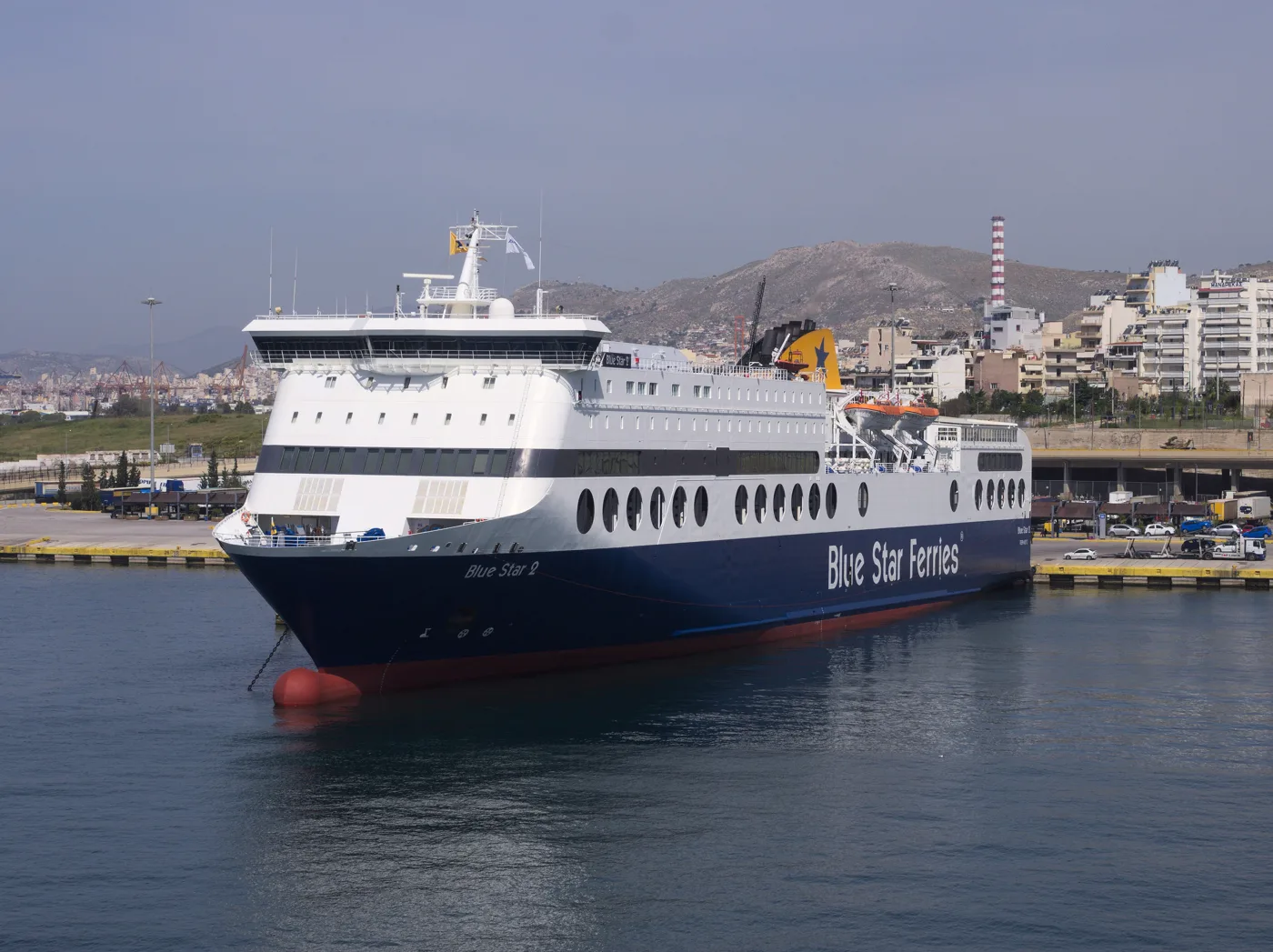
The big ships take cars too.
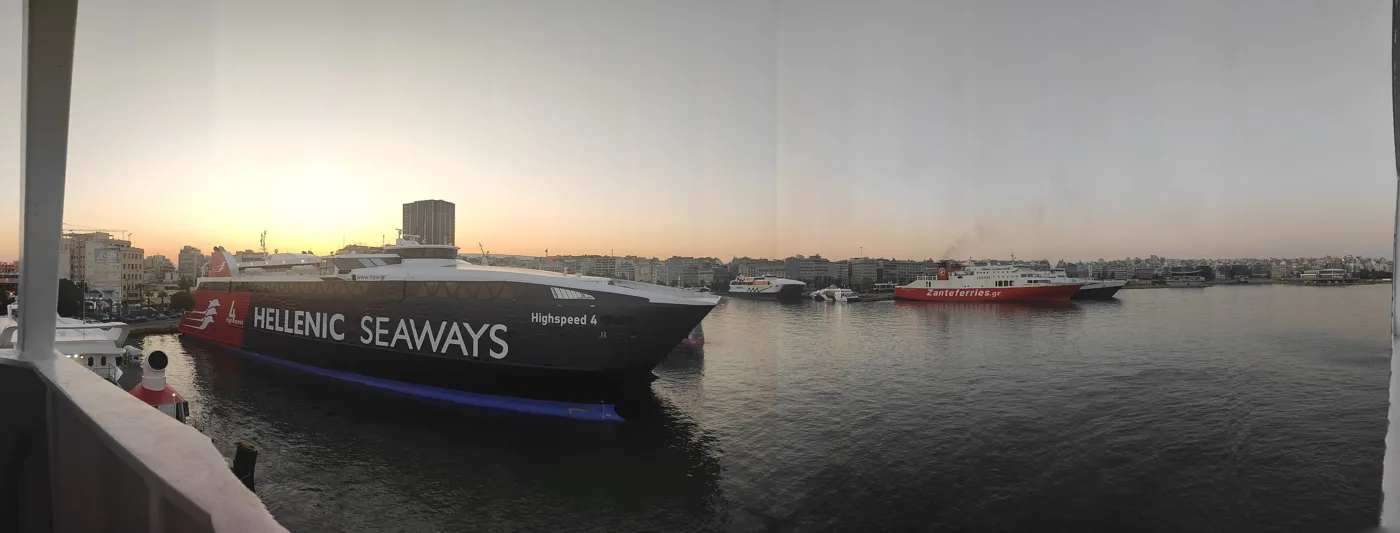
Faster, more sensitive to the wind.
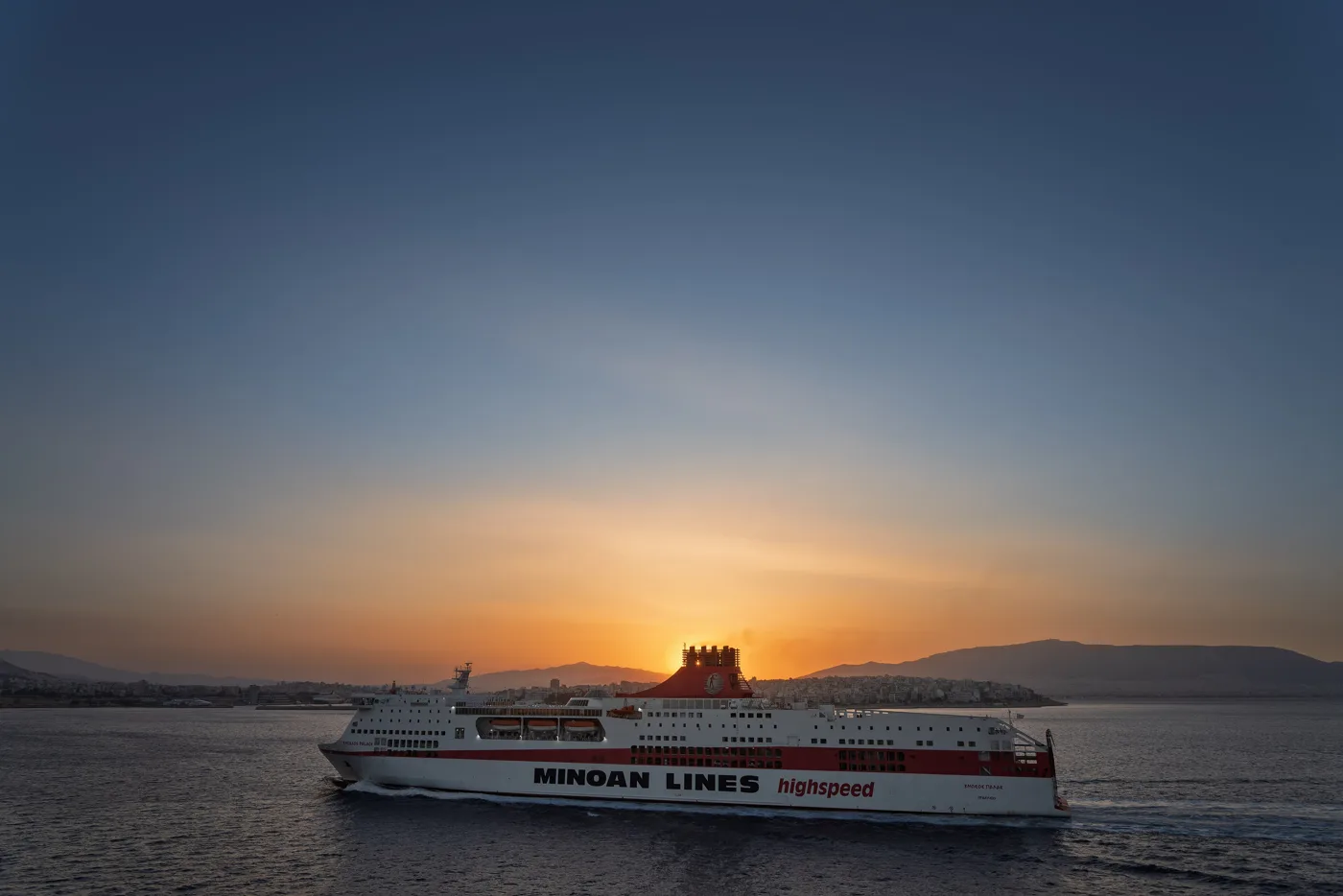
For Crete, usually with a cabin.
Photos: A.Savin (CC BY-SA 3.0), C messier (CC BY-SA 4.0), Leeturtle (CC BY-SA 4.0), Mustang Joe (CC0) · Wikimedia Commons
🚇 From Ioulianou 50 to Piraeus
From Ioulianou 50, Piraeus is very easy. Walk about 3 minutes to Victoria station and take Line 1, the green line, to the end of the line, with no change. The ride takes about 30 minutes. Piraeus station comes out right opposite the port.
But don't count only the metro. From the station to your gate it can be a few minutes or 20–30 minutes, depending on the gate, your luggage and the heat. A taxi from the centre makes sense if you have a lot of luggage, small children or a very early departure, but in traffic it can take longer than the metro.
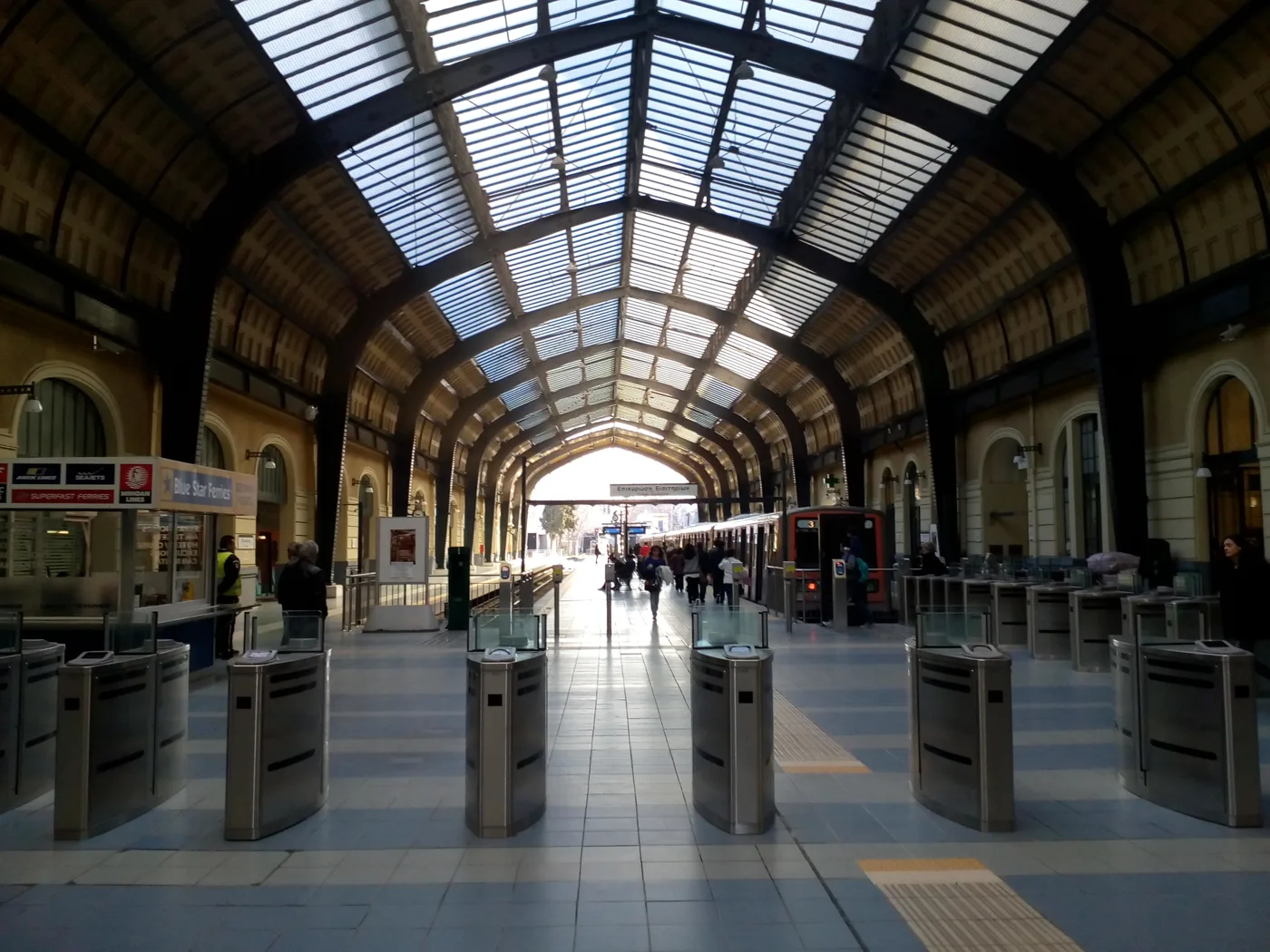
The end of Line 1.
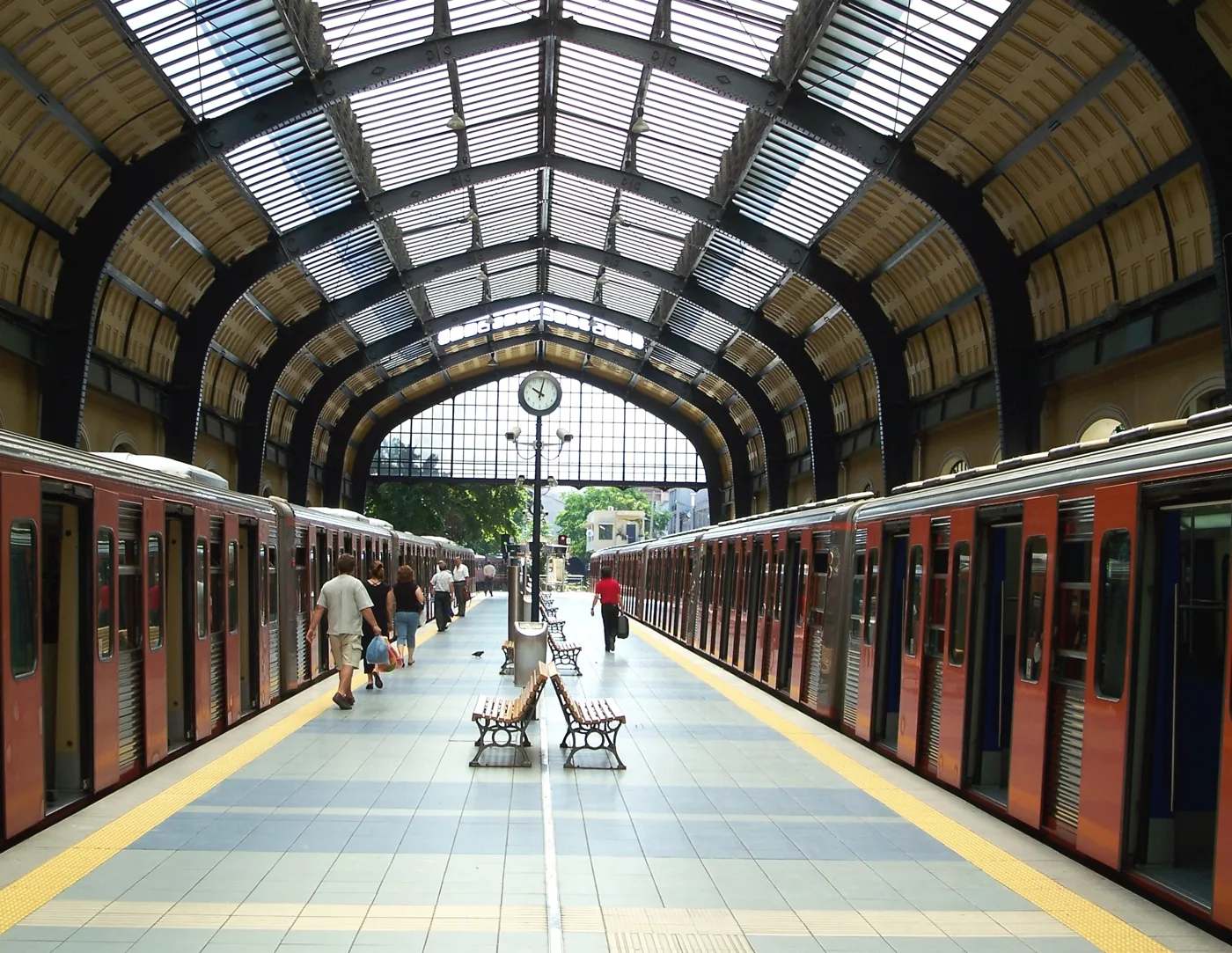
From here you come out opposite the port.
Photos: Andrew David Boyle (CC0), Badseed (CC BY-SA 3.0) · Wikimedia Commons
🚪 The gates without stress
The port of Piraeus is divided into numbered gates, from E1 to E10. The gate is printed on your ticket, and it is the first thing you check. Each gate usually serves certain islands, but this changes: the final answer is always your ticket and the ferry company.
🚪 The station and the gates of Piraeus
The metro station is at the north-east corner of the port. The gates for the Saronic Gulf and the Cyclades are close by. The gates for Crete and the Dodecanese are on the west side, much further away. The red dashed line shows the walk to E9 and E10. Positions are approximate.
| Gate | Usually for | From the metro |
|---|---|---|
| E1 | Dodecanese | The furthest one, take the port bus |
| E2, E3 | Crete; E2 also the North Aegean | Far, better by the port bus |
| E8 | Saronic Gulf | A few minutes on foot |
| E7, E9, E10 | Cyclades; E9 also Samos, Ikaria | About 10 minutes on foot |
For the far gates, such as those for Crete and the Dodecanese, don't walk with suitcases in the heat. A free bus runs inside the port, starting near the metro station and stopping at the gates.
🎫 Tickets
Tickets are easy to book online, either from the ferry companies themselves or from websites that compare routes. Check the date, time, port, gate and type of ship carefully. Most tickets are now electronic, with a QR code that is scanned at the entrance of the ship, together with your ID card or passport.
In July and August the routes to Santorini, Mykonos, Naxos and Paros fill up, especially at weekends and around 15 August. If you travel with a car or want a cabin, book weeks ahead. Deck tickets for the big ferries are easier to find, but the last minute is not a plan for a peak day.
Keep the QR code as a screenshot or saved on your phone. At the port, when thousands of people try to open the same app, the internet often freezes.
⛴️ Conventional or fast ferry
Conventional ferries are big, steady at sea and cheaper. They take cars, have open decks where you can sit outside, and cabins on the long routes. Fast ferries, usually catamarans, cut the time almost in half, but they cost more, you sit mostly inside and in the meltemi they roll more. If you get seasick easily, faster is not always better.
| 🚢 Conventional ferry | 🚤 Fast ferry | |
|---|---|---|
| Time | Slower | Almost half the time |
| Price | Cheaper, especially on deck | More expensive |
| In the wind | Steadier, cancelled less often | Rolls more, cancelled more often |
| Outdoor space | Large open decks | Little or none, you sit inside |
| Car | Yes | Usually yes on the big ones, not on the small ones |
| Cabins | On the long routes | No |
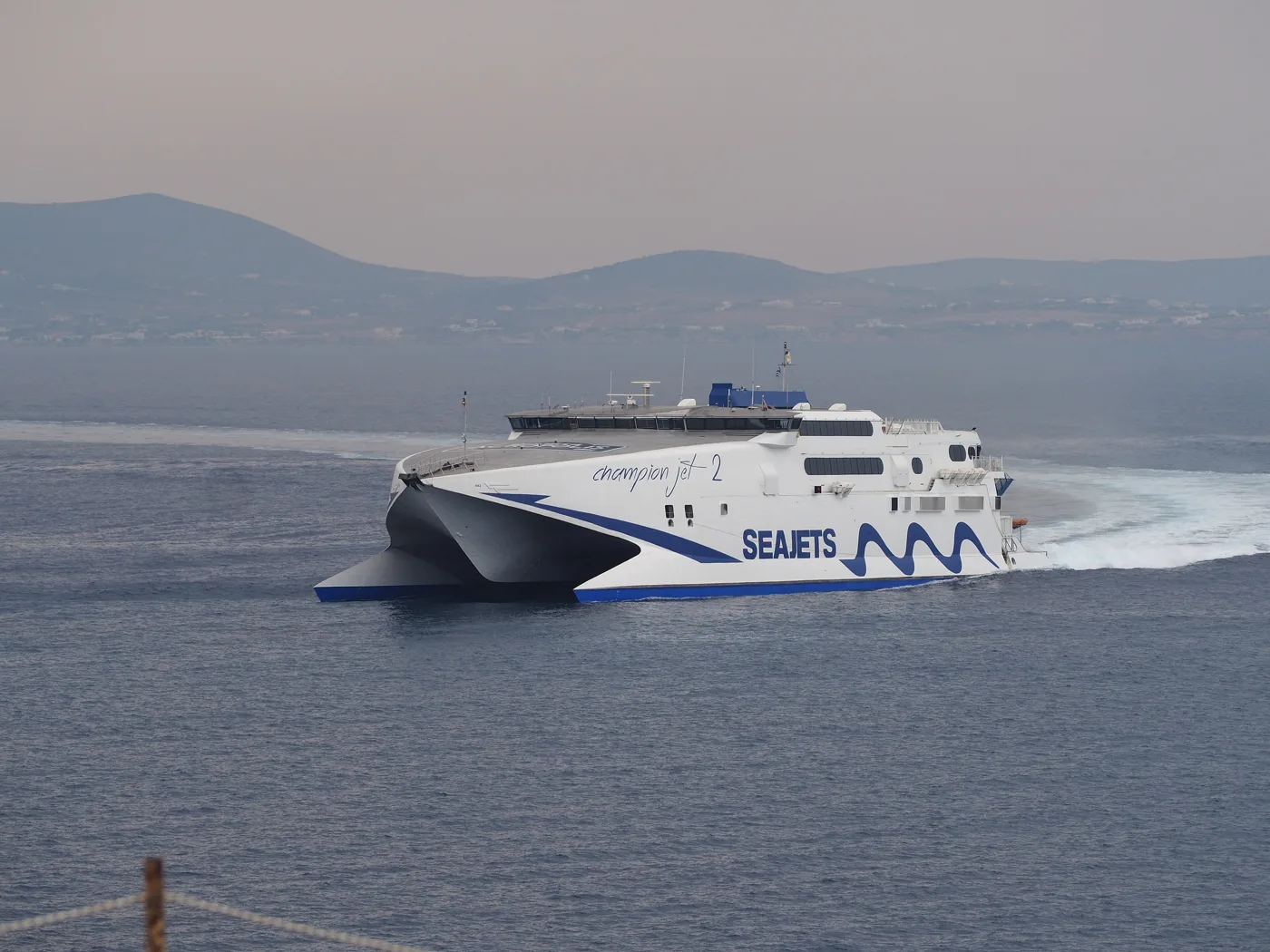
The fast boats to the Cyclades.
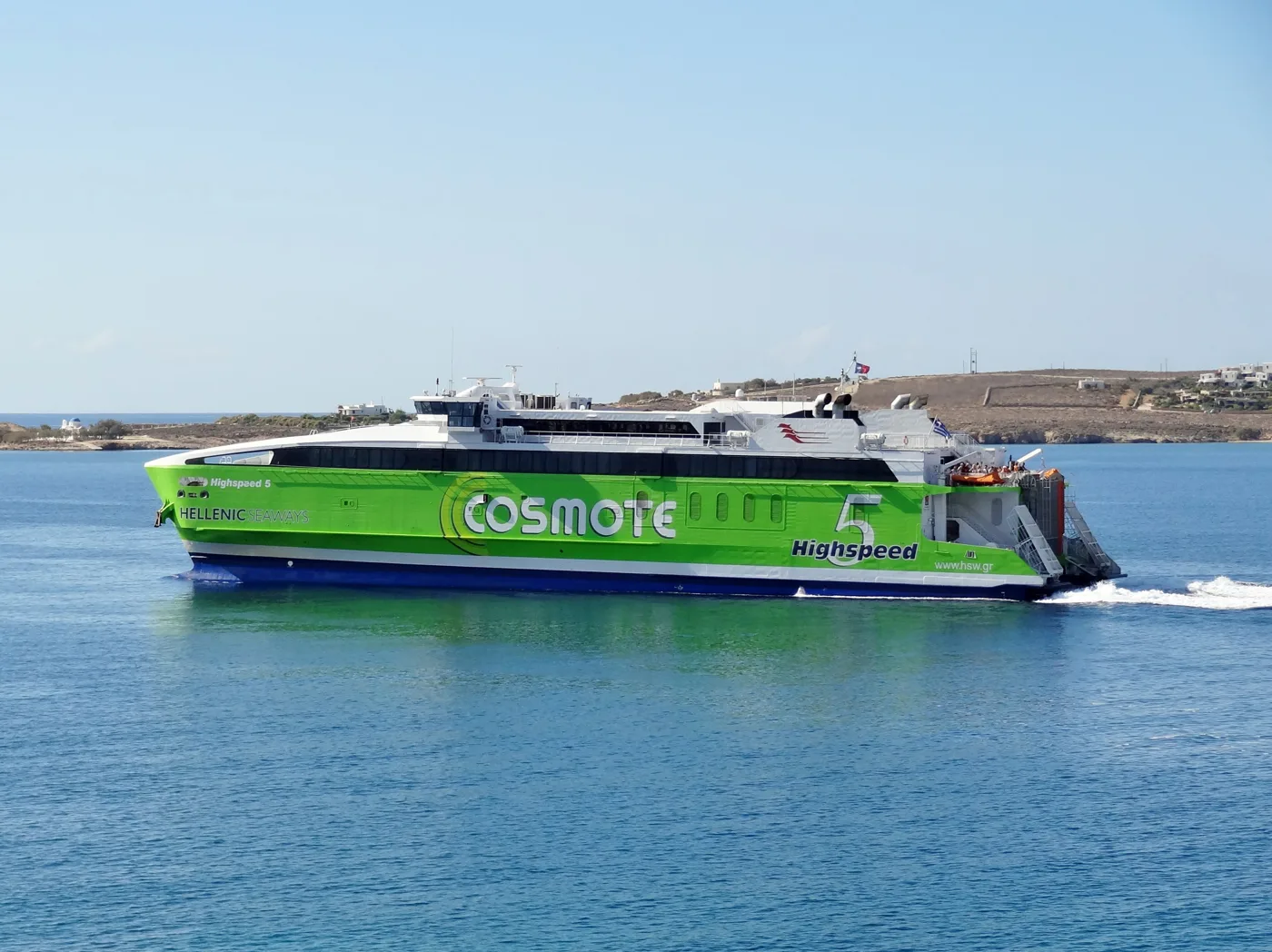
Shorter time, little deck space.
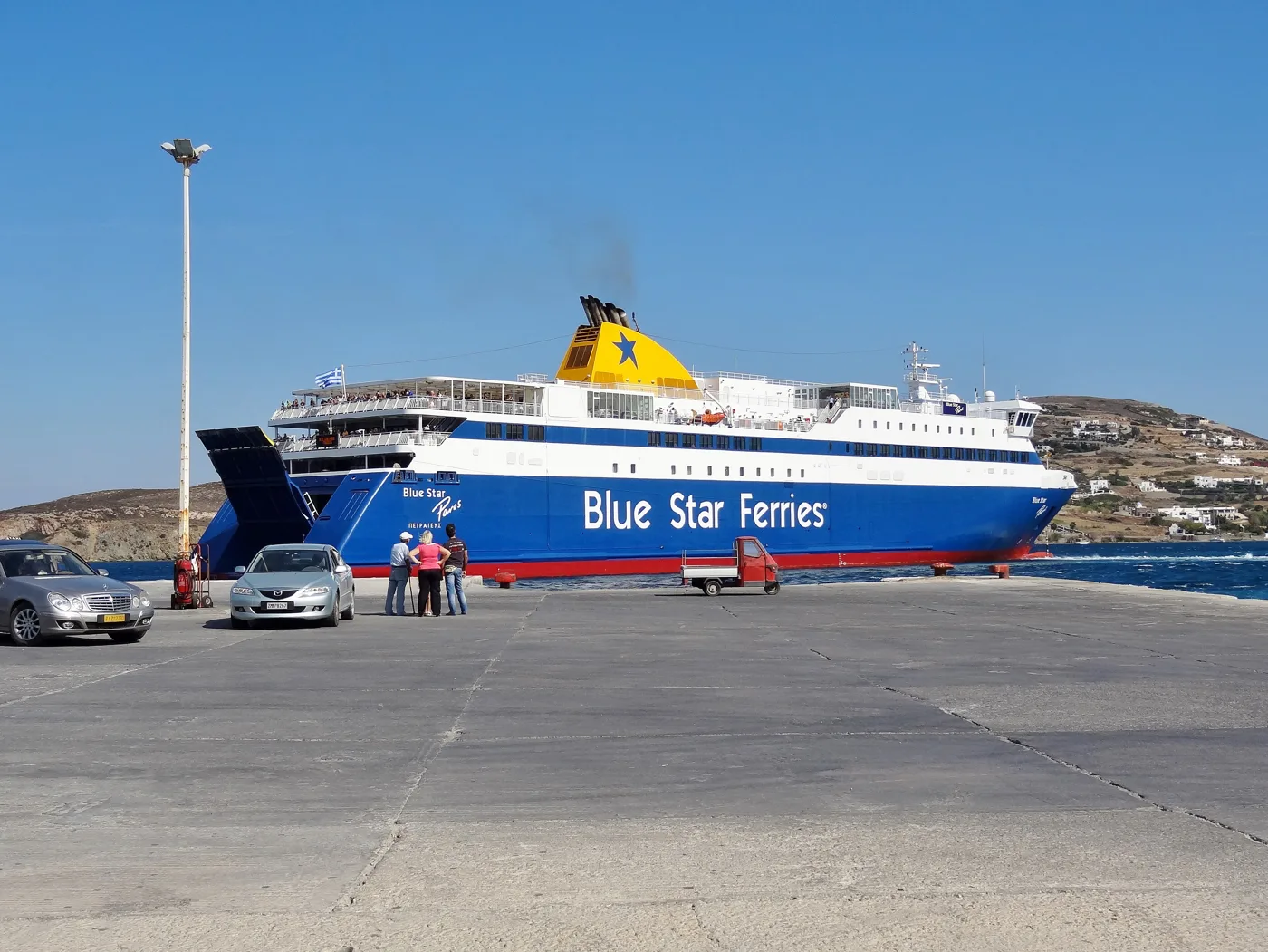
Steady at sea, with large decks.
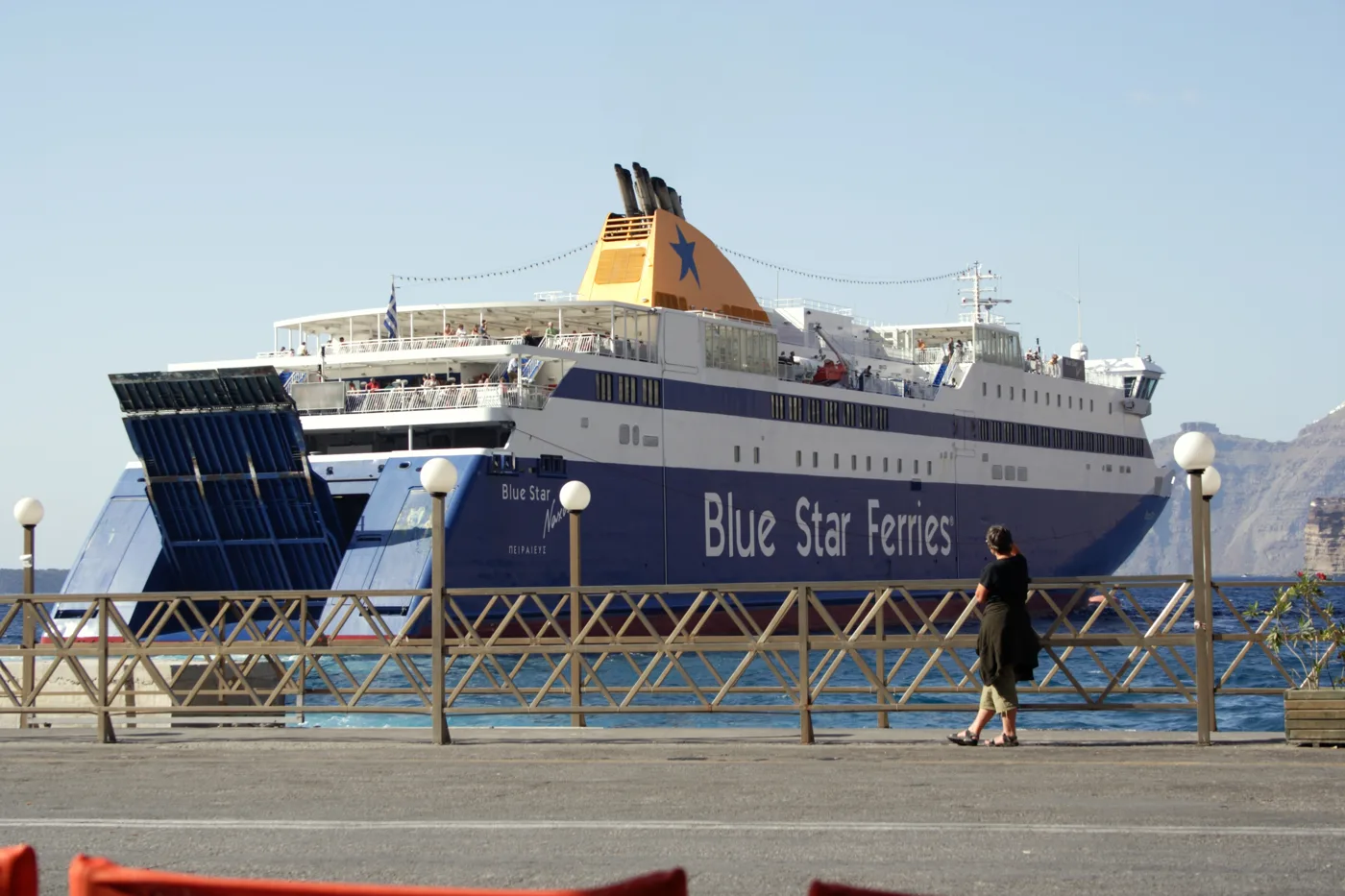
The port of Athinios below the caldera.
Photos: Hugh (CC BY 2.0), Olaf Tausch (CC BY 3.0), Zde (CC BY-SA 4.0) · Wikimedia Commons
⏱️ 14 min read
Times vary with the ship and its stops. One ferry to Santorini may stop at Paros, Naxos and Ios, another may go more directly. Here are indicative times to help you plan:
| From Piraeus to | Fast ferry | Conventional |
|---|---|---|
| Aegina | About 40 minutes | About 1–1.5 hours |
| Hydra | About 1.5–2 hours | — |
| Mykonos | 2.5–3.5 hours | 4.5–5.5 hours |
| Paros | 3–4 hours | 4–5 hours |
| Naxos | 3.5–4.5 hours | 5–6 hours |
| Milos | 2.5–3.5 hours | 4–7 hours |
| Santorini | 5–6 hours | 7–8 hours |
| Crete | — | 8–10 hours, usually overnight |
| Rhodes | — | 13–18 hours |
💺 Deck, seat or cabin
On conventional ferries you choose what kind of ticket to buy. The deck ticket is the cheapest and is enough for short routes, but on peak days the seats fill up fast. On a 7–8 hour trip, a numbered seat makes a big difference to your mood. For the overnight ferries to Crete and the Dodecanese, a cabin is usually the best money you will spend: you sleep and arrive rested in the morning.
| Seat | What it is | Best for |
|---|---|---|
| Deck | No numbered seat, you sit wherever you find a place | Short and medium routes |
| Airline-style seat | A numbered seat in an indoor lounge | Day trips of 4–8 hours |
| Business class seat | A quieter lounge, more space | Long routes, when you want quiet |
| Cabin | A closed room with beds and usually a bathroom | Overnight ferries to Crete and the Dodecanese |
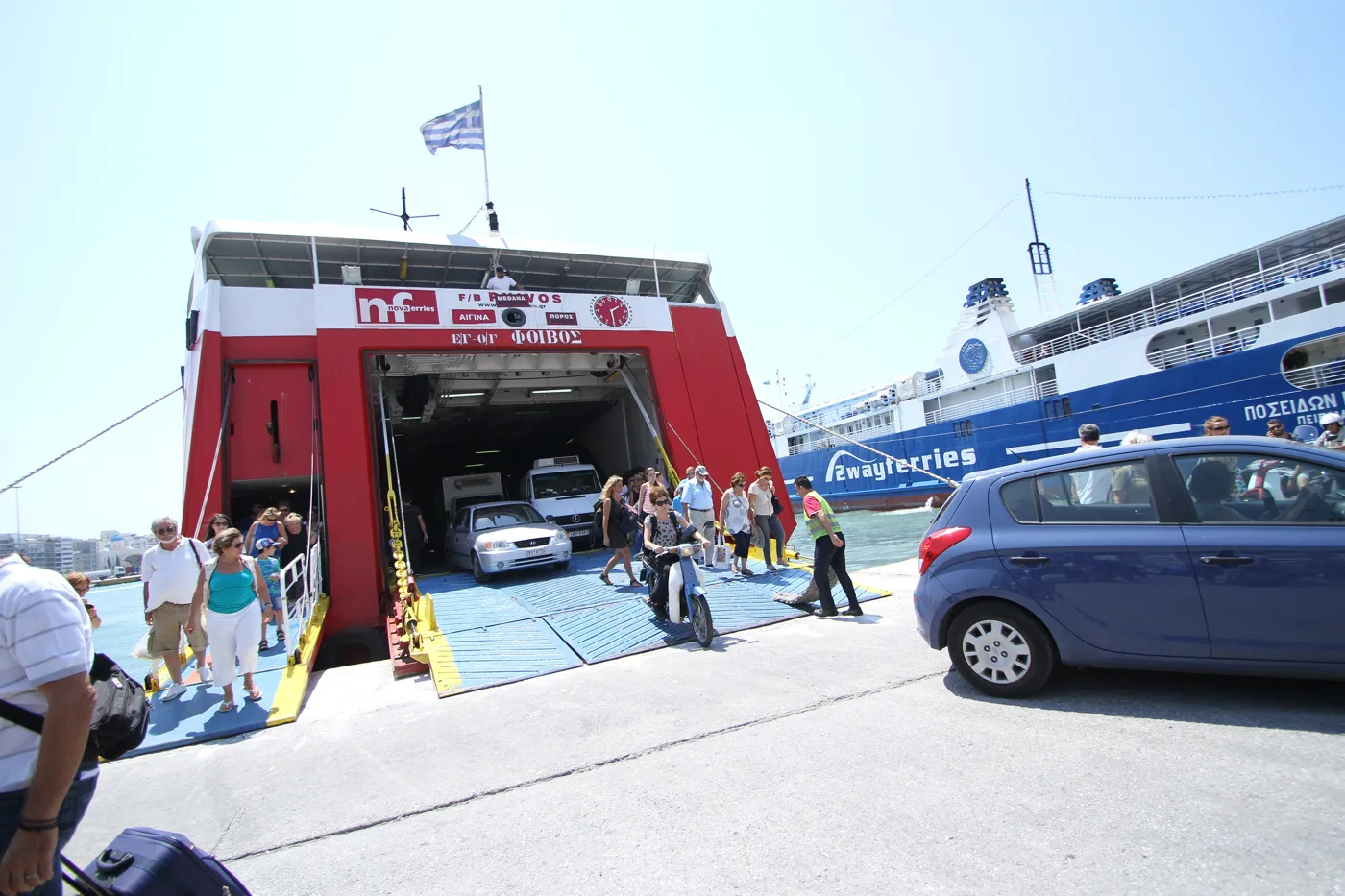
Up the ramp, together with the cars.
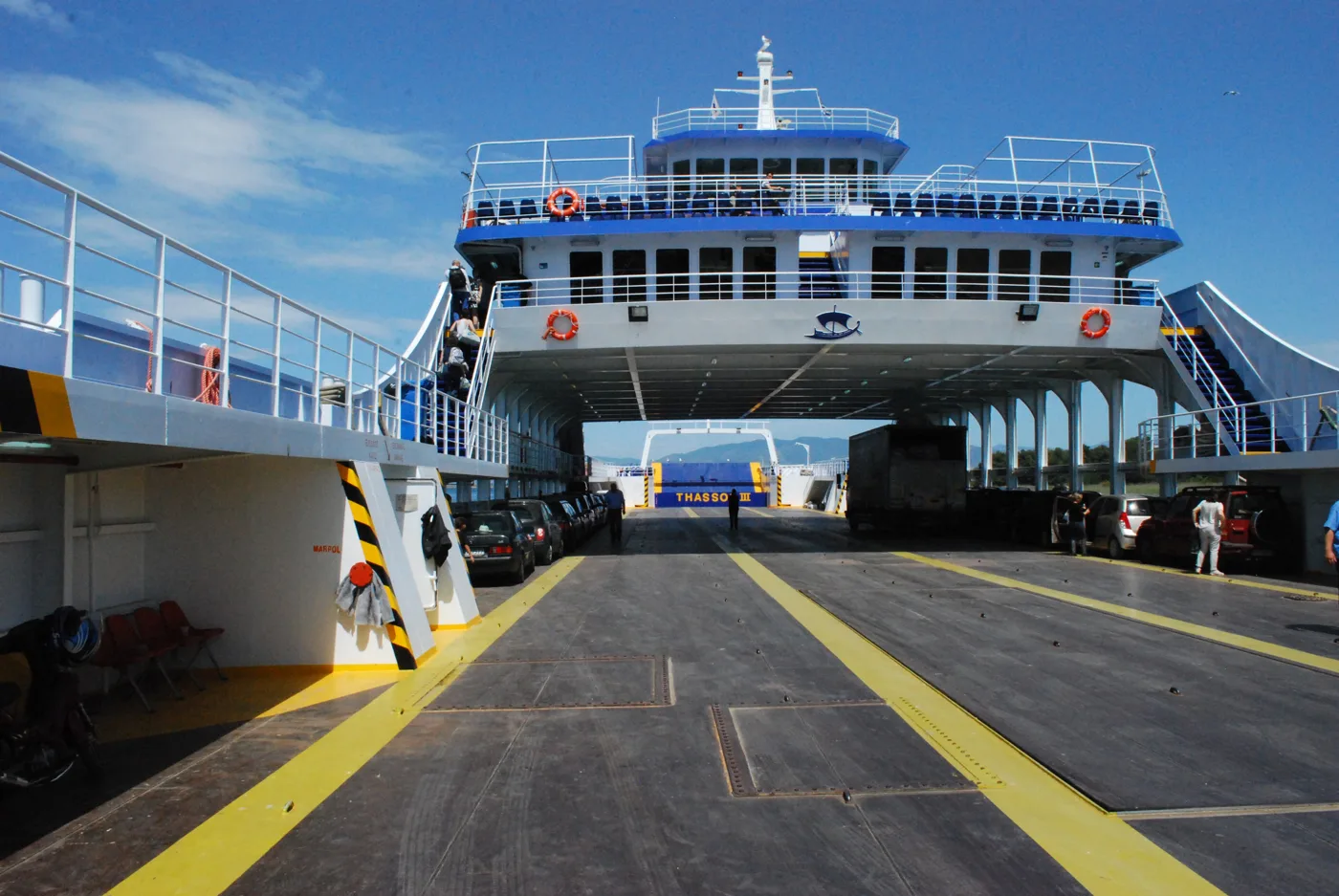
This is where you leave your car and suitcases.
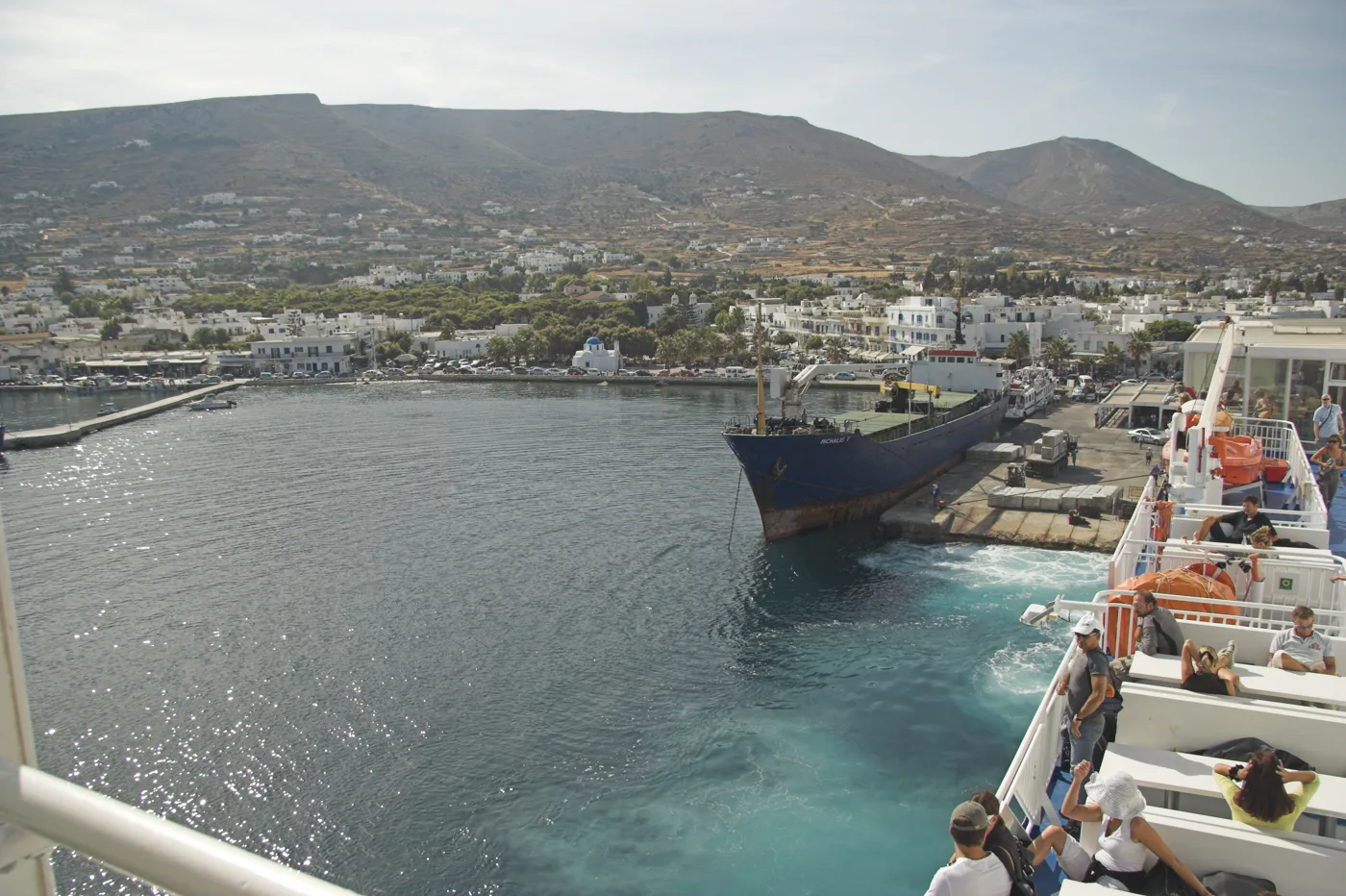
The best spot when you arrive.
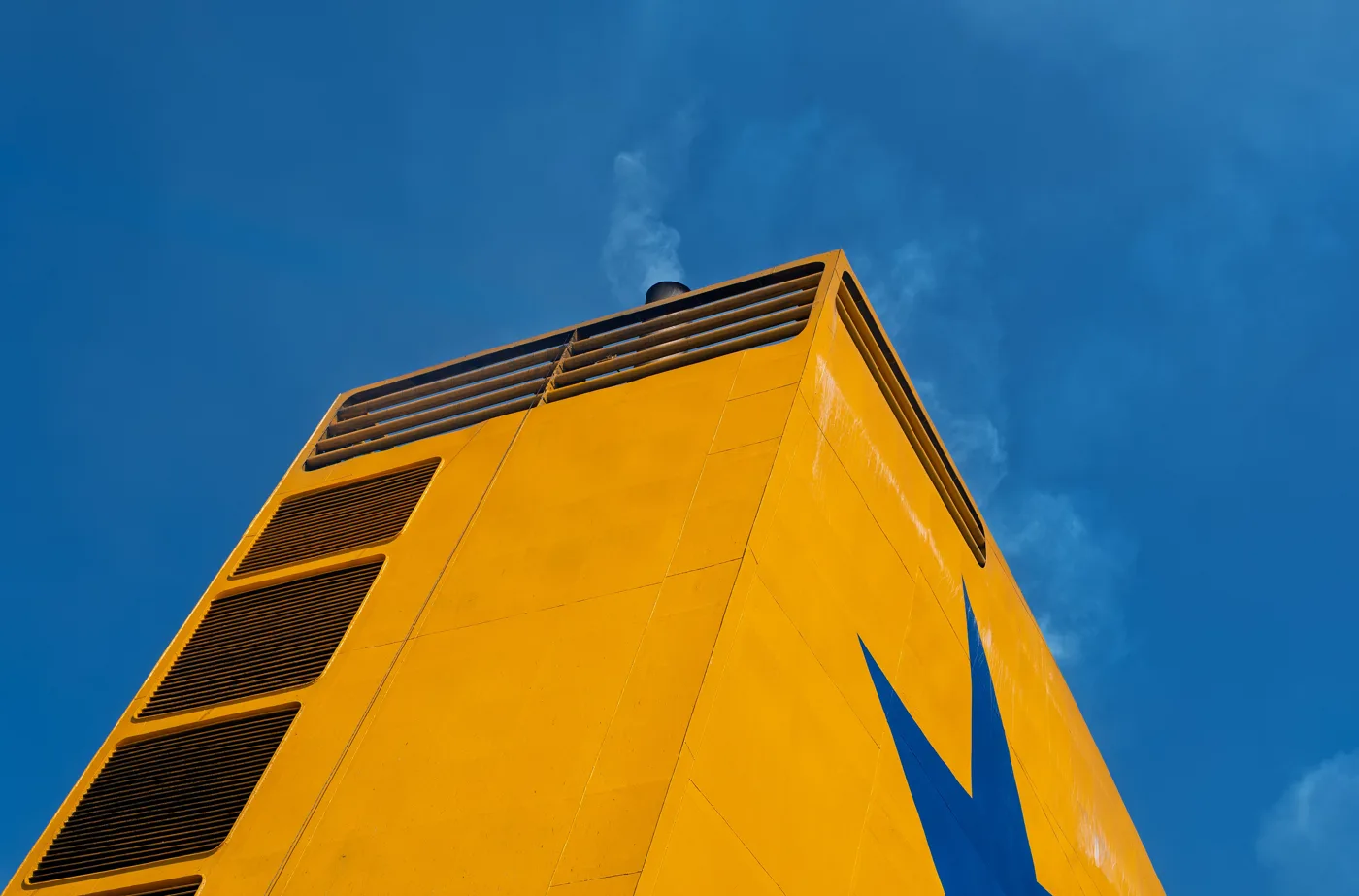
The trademark of Greek ferries.
Photos: Rakoon (CC0), Jean Housen (CC BY-SA 4.0), Zde (CC BY-SA 4.0), Jules Verne Times Two (CC BY-SA 4.0) · Wikimedia Commons
You don't stay on the car deck during the trip, and you can't go down there before you arrive. Take everything you need up to the lounges, water, medicine, charger and documents, before you lock the car.
🎒 What to bring
- ID card or passport in your hand, not in the suitcase you leave in the luggage area.
- Water and something to eat. There are cafés on board, but they are expensive and have queues.
- A charger or power bank, for your tickets and maps.
- A light jacket, because the air conditioning in the lounges is often very strong.
- A seasickness pill, if you get seasick, taken before you set off and not when the rolling starts.
- A hat and sunscreen, for the deck and the wait on the quay.
🌬️ Weather and sailing bans
In summer, mainly in July and August, the meltemi blows across the Aegean, a strong northerly wind. The big ferries usually sail as normal, with some rolling. Fast ferries are affected more often, and when the wind gets very strong, the port authority issues a sailing ban and routes are cancelled or delayed. In winter there are fewer routes, and some islands get ferries only a few times a week.
If you have an international flight, don't plan to return from an island the same day. A cancelled ferry can cost you your flight. Leave at least one night in Athens.
🚤 Rafina and Lavrio
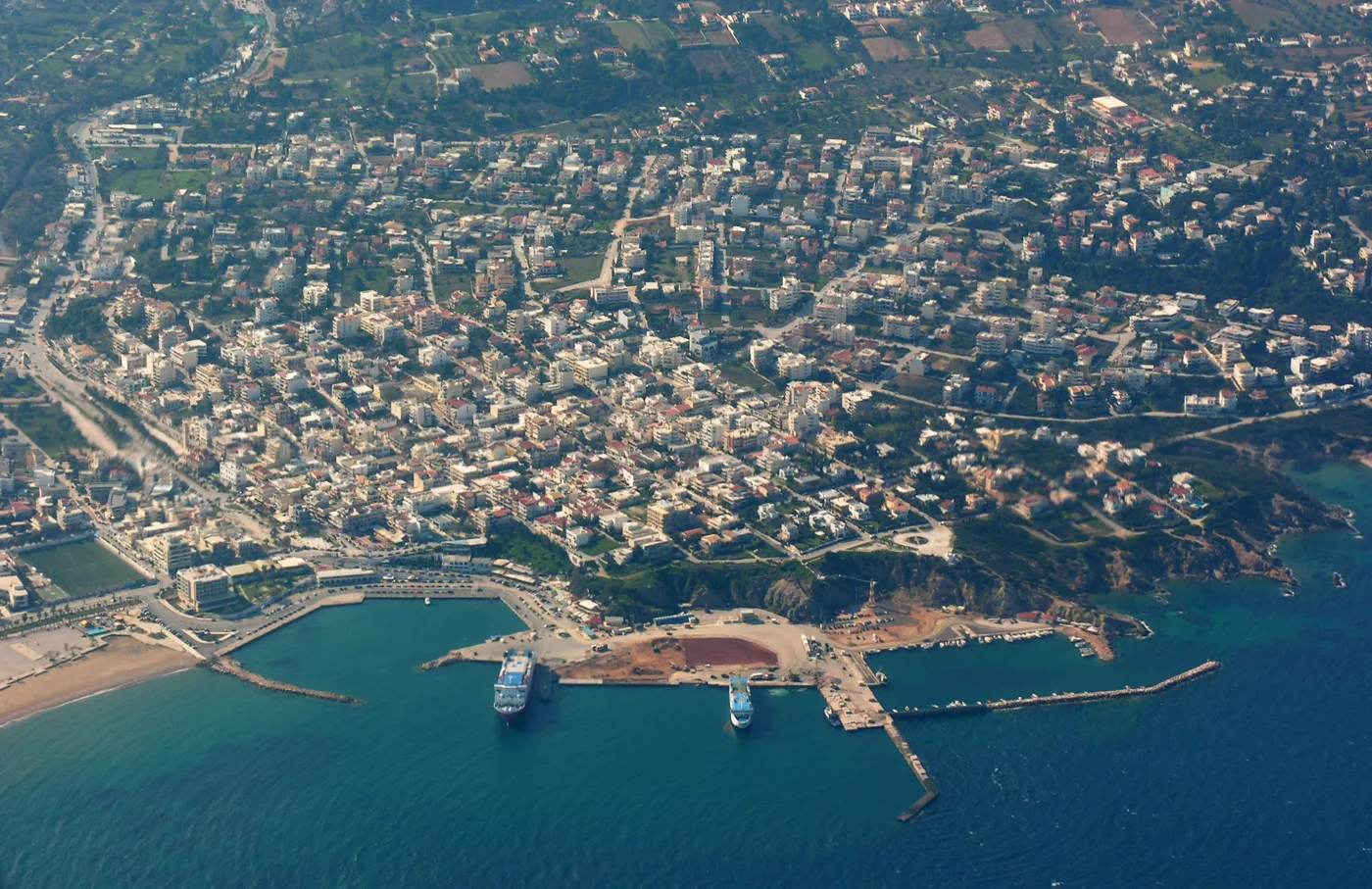
Rafina is a small port on the east coast of Attica, closer to Andros, Tinos and Mykonos. From there the trip to Mykonos is shorter than from Piraeus, and the port is much simpler: the quays are all together. It is also close to the airport, so it is handy if you arrive by plane and go straight to the island.
Lavrio, at the southern tip of Attica, is the port for Kea, the closest Cyclades island, and for some smaller routes. KTEL buses go to both ports from Pedion tou Areos, a few minutes on foot from Ioulianou 50.
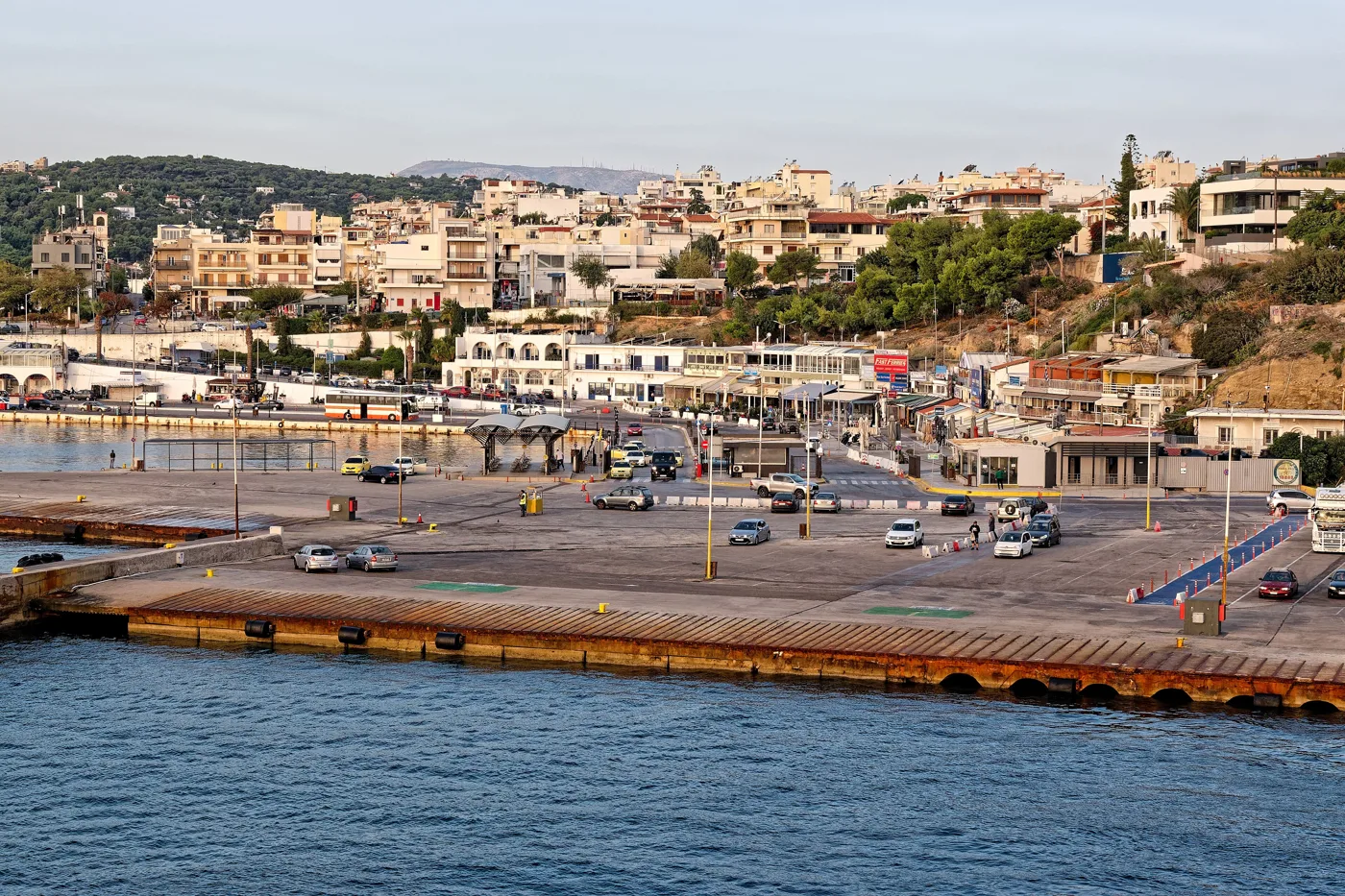
A small port in the east of Attica.
Closer to the northern Cyclades.
Photos: Holger Uwe Schmitt (CC BY-SA 4.0), Hansueli Krapf (CC BY-SA 3.0) · Wikimedia Commons
🗓️ Departure day, step by step
Check everything
Check the time and gate on your ticket, download the QR code to your phone and see if there is any weather update or route change.
Set off
Walk to Victoria and take Line 1 to the end of the line. Count about 30 minutes on the metro and a little time for waiting.
At the port
You come out opposite the port. For the nearby gates, walk. For the far ones, take the free port bus.
Boarding
Show your QR code and ID card or passport, leave your suitcase in the luggage area and go up to the lounges.
⚠️ The usual mistakes
- Arriving at the last minute. The ramps close before the departure time, and the ferry does not wait.
- Going to the wrong gate. The distance from E1 to E10 is long. Check your ticket the night before.
- Booking two ferries back to back. If the first is late, you miss the second. When island hopping, leave a margin.
- Ignoring the weather. With meltemi, check for changes before you leave for the port.
- Dragging a heavy suitcase in a heatwave to a far gate, instead of taking the port bus.
If you want to compare with flying, see our guide to ferry or plane. For routes with several islands, see our tips for island hopping.
Frequently asked questions
How early should I be at the port?
Without a car, 45–60 minutes before departure is a sensible margin. With a car, a far gate or an early ferry in August, come earlier.
How do I know which gate my ferry leaves from?
It is printed on your ticket. If you can't find it, ask the ferry company or look at the signs as soon as you come out of the metro.
Can I buy a ticket at the port?
Yes, there are agencies around the port. But in summer the popular ferries fill up, so it is better to book online in advance.
What happens if my ferry is cancelled?
The company moves you to another sailing or refunds your money. Check your messages and email, and talk to the agency or the company as early as possible.
Piraeus or Rafina for Mykonos?
If you are staying in the centre, Piraeus is easier by metro. If you are coming from the airport or want a shorter trip, Rafina is closer.
— Kathy