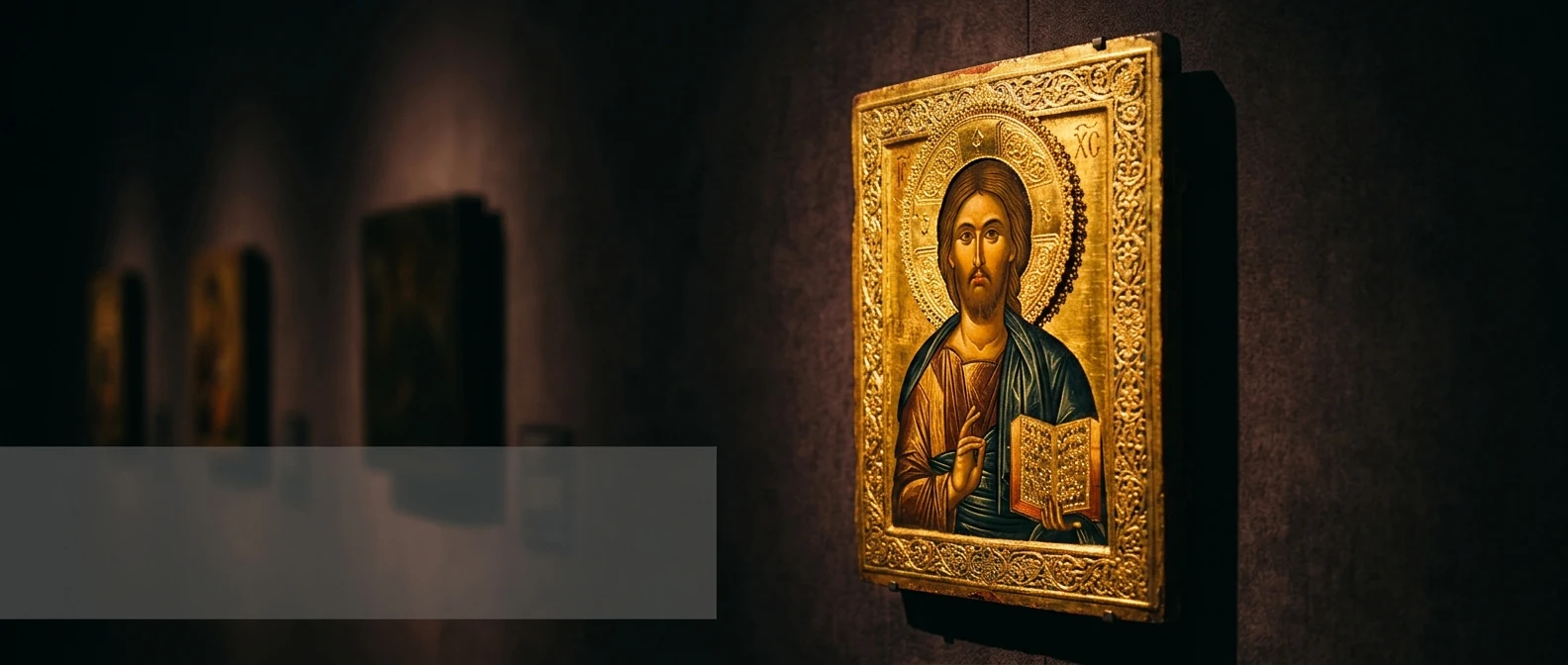
The museum holds thousands of objects from the 3rd to the 20th century AD, from regions linked to Hellenism and the eastern Christian world: Asia Minor, Cyprus, the Balkans, and southern Italy. It is not a museum for a quick photo stop. It asks for a slower look, because its strength often lies in smaller details: a face in an icon, a fragment of a fresco, a liturgical object that once had use rather than only a display case.
The villa first
The collection is housed in part inside Villa Ilissia, the 19th-century villa built for the Duchess of Plaisance, Sophie de Marbois-Lebrun. The building belongs to the strange, cosmopolitan Athens of the early decades of the modern Greek state. The newer underground wing spreads into the slope of the garden without announcing itself loudly from outside. You walk down a few steps and the museum opens out low around a quiet courtyard.
Practical details
Address: Vasilissis Sofias 22, Athens 10675.
Hours: Check the official website before you go, because state museum hours change by season and holiday.
Ticket: There are standard, reduced, and free tickets for specific visitor categories, as well as official free-entry days. Confirm the current terms before your visit.
Metro: Evangelismos (Line 3), about 200 metres away. Or cross the National Garden from Syntagma, about a 12-minute walk and a pleasant route in spring.
Time: 90 minutes if you focus, two hours if you read everything.
How to get there from Angel Athens
From Ioulianou 50, walk a few minutes to Victoria, take Line 1 to Monastiraki, and change to Line 3 for Evangelismos. From the station, the museum is just a short walk to Vasilissis Sofias. Allow around 20 minutes, depending on the metro change.
📍 From Angels Athens to Byzantine & Christian Museum
See at a glance how to get from the apartment at Iouliánou 50. Drag the map and zoom in for details.
The works worth your time
- The mosaic icon of the Virgin — go close enough to see the small tesserae, then step back two paces. The face forms differently from a distance.
- The icon of Saint George from Kastoria — the saint is shown with relief carving in the wood, a technique you do not often see.
- The detached frescoes — they are not simple transfers from old churches. They show what survives when a building is lost or changes use.
- The Treasury — a small dark room with liturgical silver, embroidered vestments, and reliquary crosses. The lighting is theatrical and the room feels almost like a chapel.
- The early Christian sculpture — capitals, screens, and decorative stone members show the moment when older motifs take on Christian use.
The garden
The garden of the villa is one of the reasons not to walk straight back onto Vasilissis Sofias. It has shade, benches, and a cafe-restaurant when it is operating. After a dense sequence of icons and liturgical objects, half an hour outside makes the visit much easier to absorb.
Comparisons
vs Acropolis Museum
The Acropolis Museum stops around AD 500. The Byzantine Museum begins there. They work like two ends of the same shelf.
vs Benaki
The Benaki is broader and more narrative. The Byzantine Museum is more concentrated on Byzantine and post-Byzantine art. If you have time, do both; they are close to each other on Vasilissis Sofias.
vs National Archaeological
The National Archaeological Museum shows the ancient world in great depth. The Byzantine Museum shows another Greece: Christian, eastern, imperial, and post-Byzantine.
Combining it with the rest of the day
The four big museums of Vasilissis Sofias are walkable: Benaki Museum of Greek Culture (Koumbari 1) → Museum of Cycladic Art (Neofytou Douka 4, off Vas. Sofias) → Byzantine and Christian Museum (Vas. Sofias 22) → National Gallery (Vas. Konstantinou 50, just past the Hilton). All four within 1.5 km. A serious museum-day will get through three of them with a long lunch in between; four is a forced march.
The calmest combination is Byzantine Museum + the National Garden. Spend about 90 minutes in the museum, then come back out toward Vasilissis Sofias and walk into the Garden. After so many icons and so much low light, the greenery works like a clean breath.
FAQ
Are the icons original or copies?
The main icons in the permanent exhibition are original works, not simple copies. For specific objects, read the label: the museum clearly distinguishes material, origin, and date.
Is it kid-friendly?
It can work for children, but it helps to be selective. The permanent collection is dense and fairly theological. Keep the visit shorter, stop at the more visual points, and check whether family programmes are running on the day you go.
Photography?
Photography rules may differ by gallery and temporary exhibition. Follow the signs and avoid flash.
Is it part of any combined ticket?
No. It is a separate museum and is not included in the Acropolis archaeological-sites combined ticket.
— Kathy