What it actually was
The word "library" does not tell the whole story. Hadrian built the site in the 2nd century AD as a large public complex: a courtyard with stoas, columns, a water feature, halls, and reading spaces. The actual library stood on the eastern side. Pausanias mentions the many columns and the valuable marbles, showing that the building belonged to the wider Hadrianic programme in Athens, alongside the Olympieion, the Arch, and other public works.
In modern terms, it was somewhere between a library, a stoa, and a centre for public learning. Hadrian wanted to present Athens as a city of education inside the Roman Empire. So this was not a simple storehouse of books. It was also a place of prestige.
What you see today
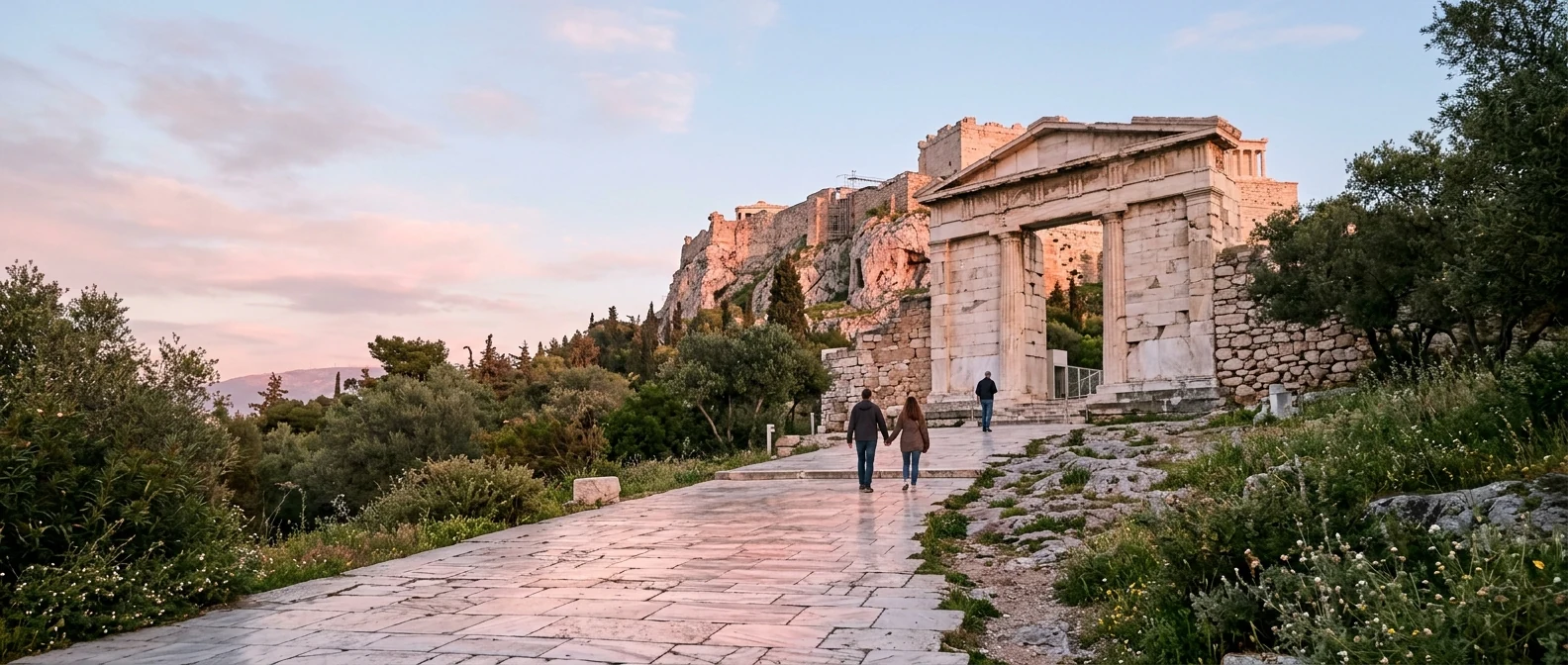
The Library suffered major destruction, especially after the Herulian invasion in the 3rd century AD, and it was later reused in new ways. Today you mainly see the plan of the site, the west facade, and traces of the later phases:
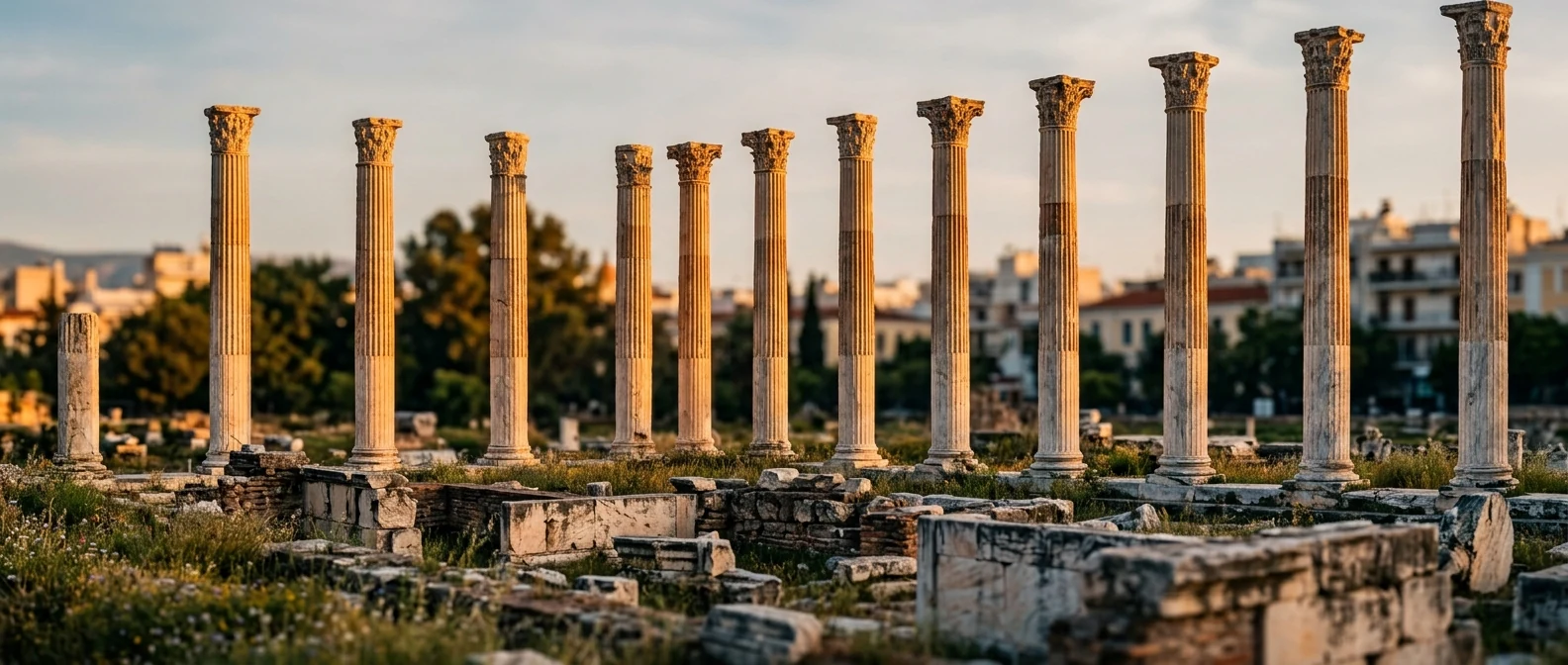
- The west facade — the most recognisable part, facing Areos Street, with surviving columns and restored sections.
- The courtyard — a large open area where the scale of the complex still reads clearly, even though most of the upper structure is gone.
- The Tetraconch — an early Christian building that shows how the Roman site changed use in later centuries.
- The eastern side — the area where the library itself stood, with traces of niches and spaces connected with storing and using books.
- The later foundations — Christian and post-Byzantine remains that remind you the site never simply became a static ruin.
📍 From Angels Athens to Hadrian's Library
See at a glance how to get from the apartment at Iouliánou 50. Drag the map and zoom in for details.
How to get there from Angel Athens
From Ioulianou 50
Walk a few minutes to Victoria and take Line 1 directly to Monastiraki. From the station exit, it is about a one-minute walk toward Areos Street. This is one of the simplest routes from Angel Athens.
Practical details
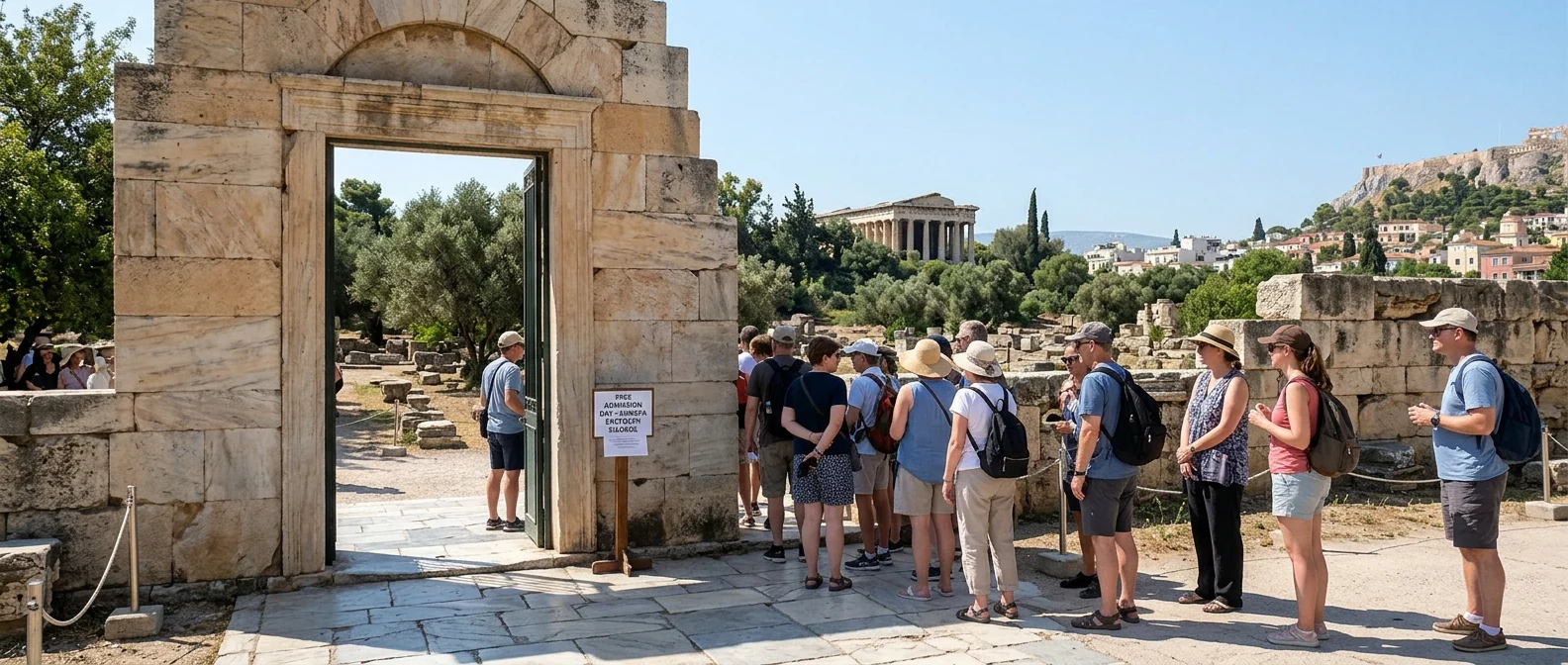
- Entrance: on Areos Street, opposite Monastiraki Square. Walk one minute from the metro exit toward the Tower of the Winds and the gate is on your left.
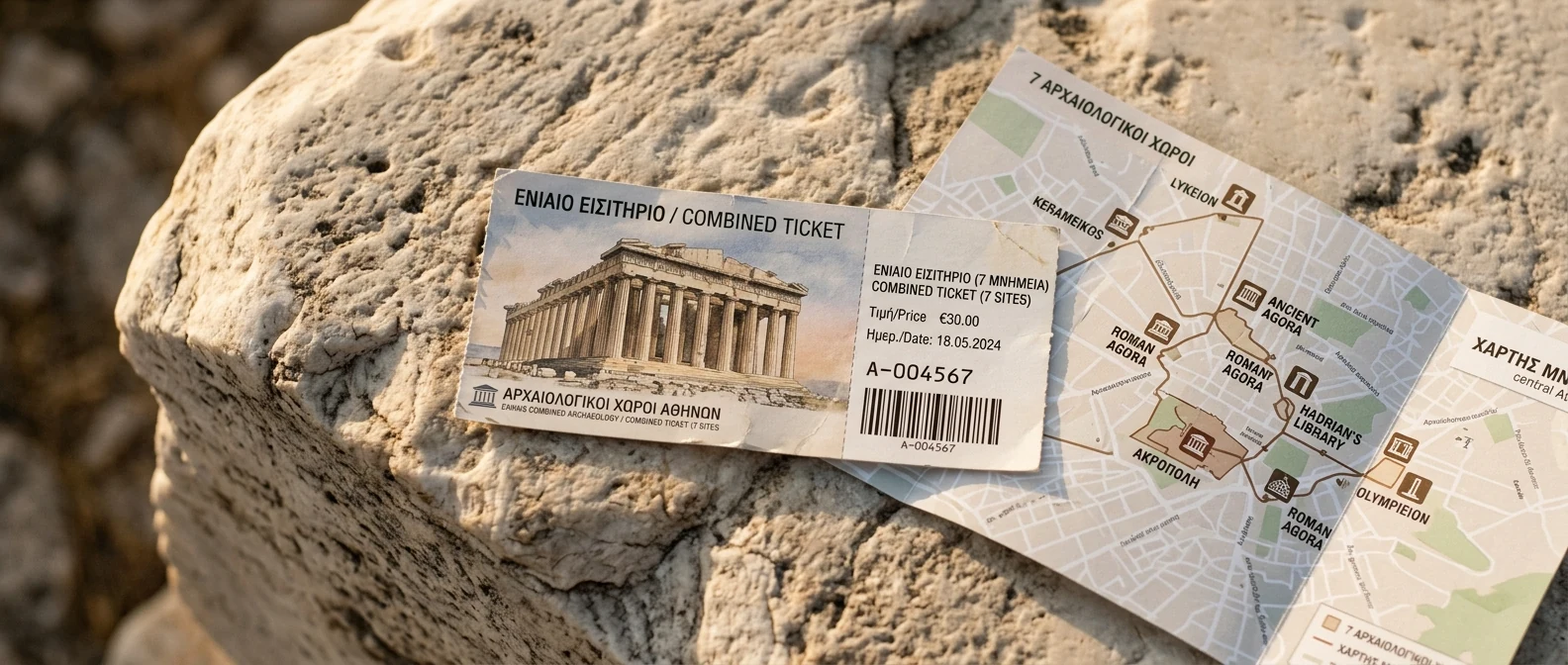
- Ticket: there is a standalone ticket, and the site is often included in combined archaeological-site packages. Check what applies on hhticket.gr before you go.
- Reduced and free entry: certain visitor categories qualify with the necessary documents, as at other state sites.
- Hours: they change by season. Check the opening hours the day before, especially if you are fitting it into a full itinerary.
- Booking: it is usually an easy visit without much planning, but the official entry rules always take priority.
How long it takes
15–20 minutes
If you enter, walk the perimeter, photograph the facade, and leave. This is the average visit.
40–50 minutes
If you read the information panels, look closely at the Tetraconch remains, and try to recognise the plan of the complex.
60+ minutes
If you are especially interested in architecture or Roman history. The site has enough for that audience, but not for every visitor.
What to combine it with
Hadrian's Library fits easily into a walk through Monastiraki and Plaka. The most natural pairing is the Roman Agora and the Tower of the Winds, a few minutes farther south through the lanes. If you have more time, continue toward the Monument of Lysicrates, the Olympieion, and Hadrian's Arch. That gives you a clearer view of Roman and Hadrianic Athens without leaving the historic centre.
Photo notes
The west facade photographs well even from outside, from the pavement on Areos Street. Inside the site, try framing the columns with the Acropolis or the surrounding buildings. Morning light helps the facade, while later in the day the shadows make the plan easier to read.
Do not confuse it with
People often confuse Hadrian's Library with Hadrian's Arch, which stands on the other side of the Acropolis next to the Olympieion. They are two different monuments. The Library is next to Monastiraki, while the Arch stands on Vasilissis Amalias and marks the boundary between the old city and Hadrian's extension, as its inscriptions declare.
FAQ
Can you go inside the library structure?
No. The interior of the library itself, including the wall niches for scrolls, is fenced off. You see the eastern wall from the courtyard side. You can walk around the Tetraconch remains, but not enter them.
Is there a museum on site?
It is not a museum with large indoor galleries. There is information on site and panels that help you read the layout. If you want more movable finds, combine the visit with the Ancient Agora or museums in the centre.
Wheelchair access?
The site is relatively level, but the surface can be uneven, with gravel, ancient paving, and areas that are not easy to cross. For wheelchair use or limited mobility, check the official accessibility information before you go.
Sources:
— Kathy