Three orders, in chronological order
Greek architecture developed three "orders", sets of rules governing the proportions of the columns, the capitals, and the entablature. They appeared in sequence: Doric (around the 7th century BCE, on the Greek mainland and in the western colonies), Ionic (around the 6th century BCE, in eastern Greece and the islands), and Corinthian (late 5th century BCE, though it spread widely later). The Romans added the Tuscan and the Composite, but the three Greek orders remained the basic language of classical architecture for the Renaissance and Neoclassicism.
How to recognize them quickly
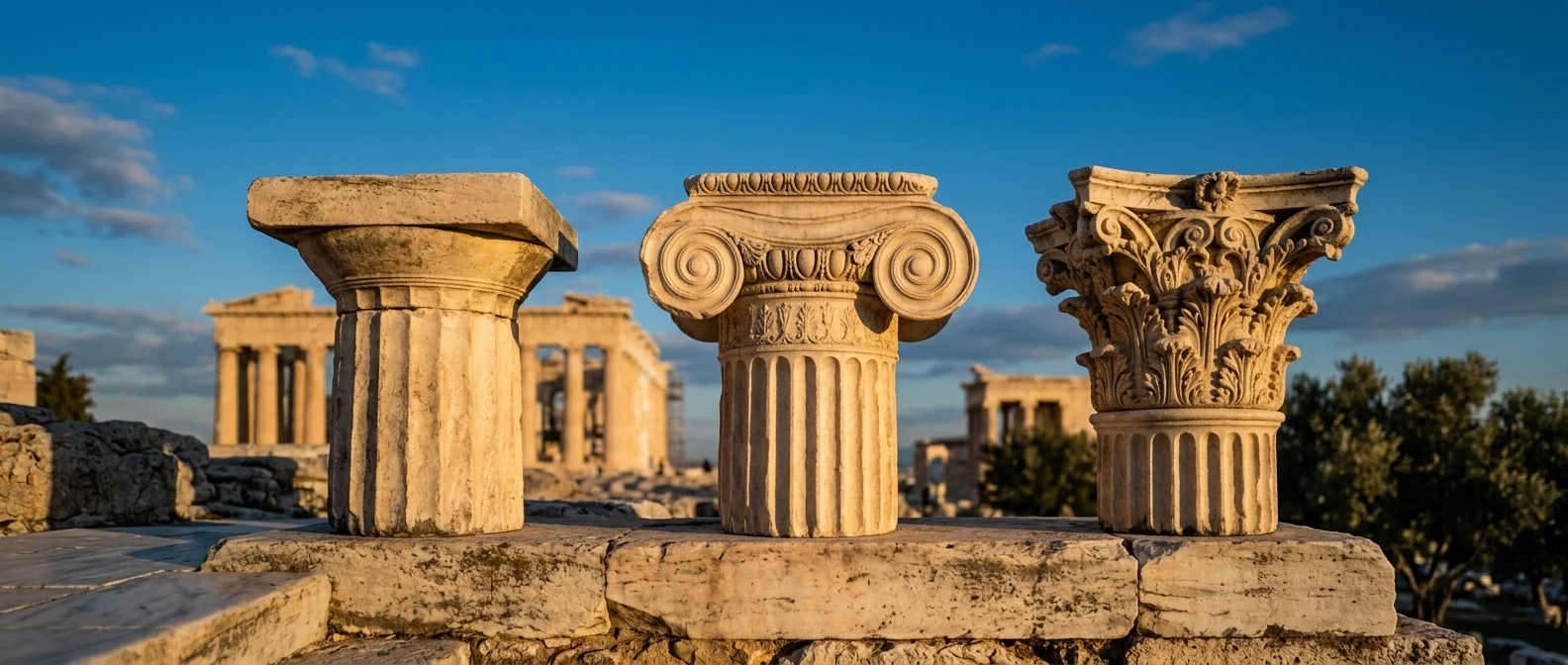
Doric — plain bowl
A simple rounded capital, like an upside-down bowl. There is no base: the column begins directly from the stylobate. The proportions are heavier and stricter.
Ionic — scrolls
The capital has two volutes, spiral forms like scrolls. The column has a base and the proportions are slimmer and taller.
Corinthian — leaves
The capital is covered with acanthus leaves spreading outward. It is the most decorative of the three and became especially popular in Roman architecture.
Caryatid (variant)
A sculpted female figure replaces the column altogether. The best-known example is the porch of the Erechtheion on the Acropolis.
🏛️ Doric in detail
- Origin: Greek mainland, ~7th c. BCE. Possibly evolved from earlier wooden architecture.
- Column: 4-8 diameters tall (sturdy proportions). No base. Fluted shaft (~20 grooves).
- Capital: square abacus on circular echinus (curved cushion). Plain.
- Entablature (top horizontal beam): triglyphs (3-grooved blocks) alternating with metopes (square panels, often sculpted).
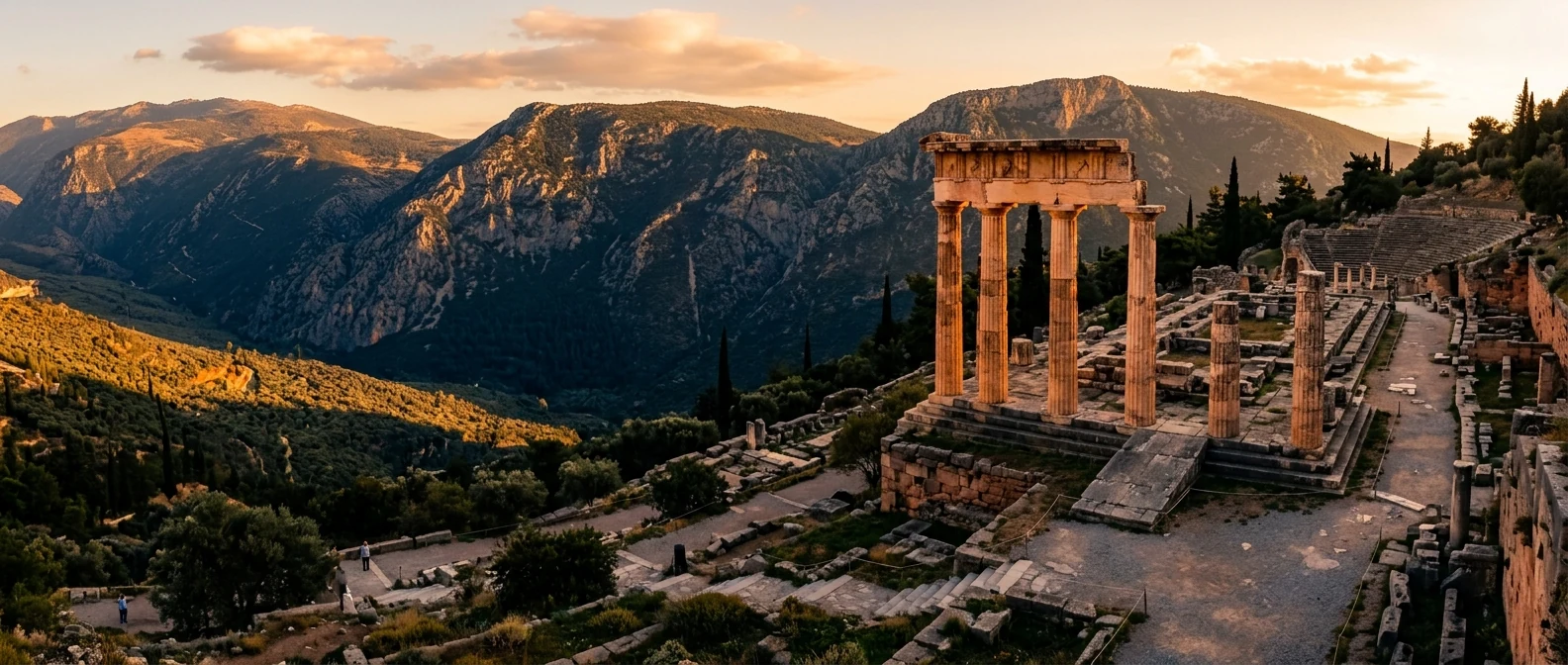
- Examples: the Parthenon, the Hephaisteion in the Agora, one of the best-preserved ancient Greek temples, the Temple of Apollo at Delphi, and the Temple of Poseidon at Sounion.
🏛️ Ionic in detail
- Origin: eastern Greece + Aegean islands (Ionia), ~6th c. BCE.
- Column: ~9 diameters tall (slimmer). Has base (typically Attic base — convex/concave/convex). 24 flutes (more than Doric).
- Capital: the characteristic double volutes. They are sometimes compared to ram's horns.
- Entablature: continuous frieze (often sculpted) instead of triglyphs/metopes.
- Examples: the Erechtheion on the Acropolis, the Temple of Athena Nike at the entrance to the Acropolis, and the Temple of Artemis at Ephesus, one of the seven wonders.
🏛️ Corinthian in detail
The legend of the basket
According to the Roman architect Vitruvius, the sculptor Callimachus was inspired in Corinth, probably in the 5th century BCE, when he saw a basket on a grave around which an acanthus had grown. The story is attractive, though probably polished by later retelling. The Corinthian order has slender proportions, a capital with two or three rows of acanthus leaves, and small volutes at the corners. The Romans used it widely in major public buildings. In Athens, the Olympieion offers the clearest example: its columns rise to around 17 metres, and 15 of the original 104 still stand.
🏛️ Caryatids — sculpted columns
- Caryatid: sculpted female figure used as architectural support replacing column.
- The porch of the Erechtheion (Acropolis, ~420 BCE): six Caryatids, the best-known example. Five originals are in the Acropolis Museum, one is in the British Museum, and the site displays copies.
- Atlas: male equivalent. Less common.
- Origins: the name is linked with Karyai in Lakonia. Ancient and later explanations differ, so some caution is needed.
📊 At a glance
3 main orders
Doric, Ionic, and Corinthian. Together they define Greek architecture.
Doric ~7th c. BCE
The earliest order, associated with the Greek mainland.
Ionic ~6th c. BCE
From eastern Greece, the Aegean islands, and Ionia.
Corinthian ~5th c. BCE
The latest of the three, marked by acanthus leaves and widely used in Roman architecture.
🚶 Athens-tour route by order
- Acropolis: Parthenon (Doric), Erechtheion (Ionic + Caryatids), Athena Nike (Ionic), Propylaia (Doric exterior, Ionic interior).
- Agora: Theseion or Hephaisteion (Doric, ~450 BCE), one of the best-preserved Doric temples.
- Olympieion (Temple of Olympian Zeus): 15 surviving Corinthian columns, about 17 metres high, east of the Acropolis. See this guide.
- Roman Agora: Tower of the Winds (octagonal — unusual hybrid Roman style).
- Stoa of Attalos: reconstructed, with mixed orders, Doric on the exterior ground floor and Ionic inside and above.
- Lysikrates Monument (Plaka): a small choregic monument with the earliest surviving exterior Corinthian capital, from 335 BCE.
🏛️ Beyond Greece — neoclassical influence
- Roman buildings: many of them use Greek orders, especially Corinthian and Composite, the Roman variant.
- Renaissance: architects studied the orders again and reused them in civic and religious buildings.
- Neoclassicism (18th-19th centuries): copied the orders deliberately.
- Athens University, Academy, National Library (the "Athenian Trilogy" on Panepistimíou St.): pure neoclassical with Greek orders.
- US Capitol, White House, Supreme Court, Lincoln Memorial: all use Greek orders to suggest durability, public prestige, and civic seriousness.
🔍 Reading temple plan
- Krepidoma: stepped base.
- Stylobate: top step (where columns rest).
- Cella / naós: inner sanctuary (housed cult statue).
- Pronaós: front porch.
- Opisthódomos: rear chamber (treasury).
- Peristyle: surrounding row of columns.
- Pediment: triangular gable at front + back (often sculpted).
🎨 Subtle Doric refinements
- Entasis: columns slightly bulge in middle (compensates for optical illusion of concavity).
- Stylobate curvature: Parthenon's base curves up slightly in middle.
- Inward-leaning columns: by roughly 6 cm over 11 metres of height, so the building appears more stable to the eye.
- Corner columns thicker: visual correction for sky-backlight optical thinning.
- Result: in the Parthenon, there are fewer straight lines than most visitors imagine. The sense of balance comes from many small, deliberate corrections.
🎯 FAQ
Quickest way to identify the order?
Look at capital. Plain bowl = Doric. Scrolls = Ionic. Leaves = Corinthian.
Is there a best order?
Not in any absolute sense. Doric gives weight and severity, Ionic slenderness and movement, Corinthian ornament and theatricality. Each has its own logic.
Which Athens temple is the best preserved?
The Theseion or Hephaisteion in the Ancient Agora: Doric, around 450 BCE, with its entablature and roof beams still largely intact.
Why are Caryatids on Erechtheion?
They probably symbolised ancient Athenian tribes or sacred priestesses. They support the south porch in place of columns.
Where can I see Corinthian columns in Athens?
At the Olympieion for the monumental version, at the Lysikrates Monument for a smaller and earlier example, and in various Roman-period buildings.
Did Greeks use specific orders for specific buildings?
Broadly, yes. Doric was common for major mainland temples, Ionic for treasuries and smaller temples, and Corinthian appeared later in monuments and buildings shaped by Roman taste.
Sources:
— Kathy