🌿 What makes the difference
The Cretan diet drew international attention from the 1960s onward, largely through Ancel Keys' Seven Countries Study. The interest was not only medical. Everyday Cretan cooking used simple ingredients, many plant foods, smaller amounts of good meat, legumes, greens and plenty of olive oil.
- Olive oil — not only for finishing a dish, but as the base of the cooking.
- Greens — stamnagathi, vrouva, askolimbros and other seasonal greens, usually boiled with lemon and olive oil.
- Cheese and rusks — graviera, mizithra, anthotyro, xygalo Sitias and the barley rusks used for dakos.
- Fire-cooked meat — lamb and goat cooked slowly when the space and time allow it.
- Tsikoudia or raki — a clear pomace spirit, often served at the start or end of the meal.
🥗 Dishes worth looking for
Dakos
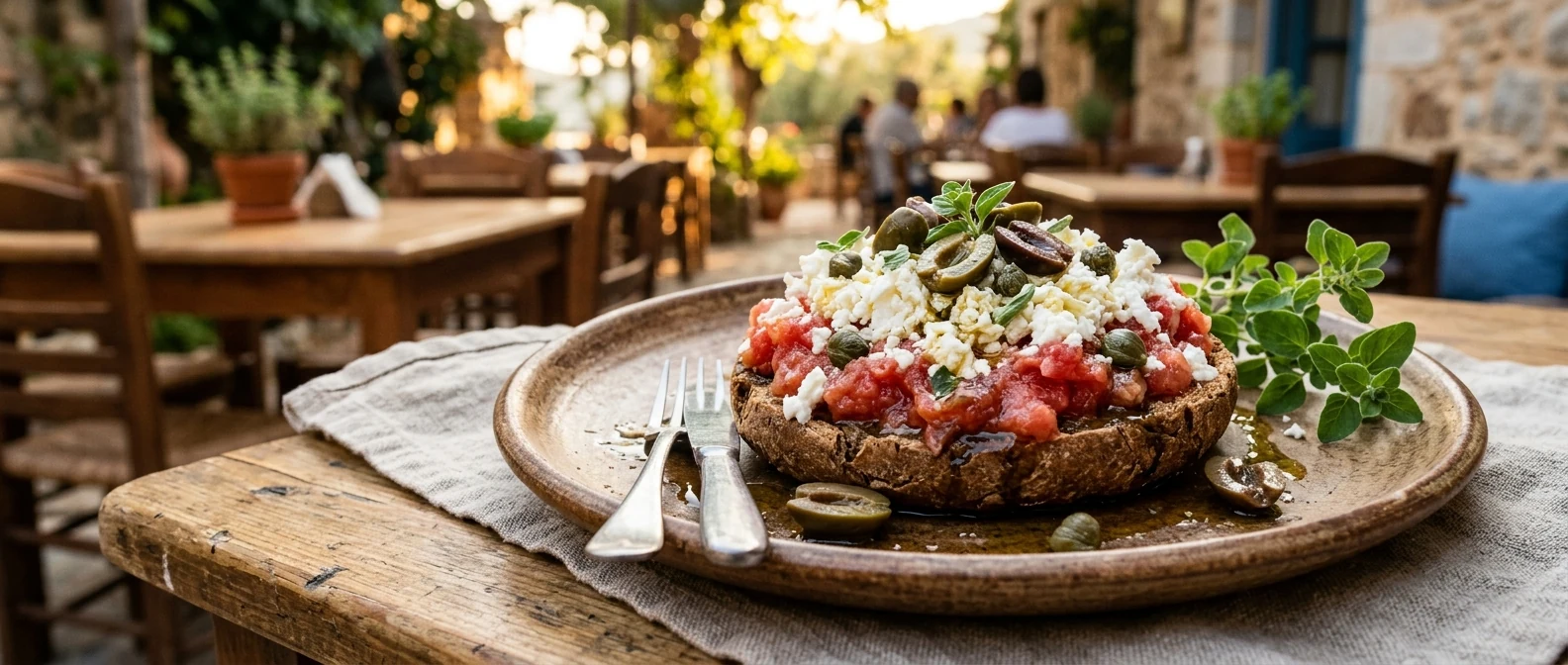
A barley rusk with grated tomato, mizithra or xinomizithra, olives, oregano and olive oil. It looks simple, but the quality of the rusk, tomato and oil makes the difference.
Chochlioi boubouristi
Snails fried with olive oil, salt, rosemary and vinegar. They are not for everyone, but in a good Cretan taverna they usually show that the kitchen pays attention to tradition.
Apaki
Pork cured in vinegar and smoked with herbs. It is usually served in thin slices as a meze with raki.
Sfakianopita
A thin pan-fried cheese pie from Sfakia, usually finished with thyme honey. It can arrive as a starter or as a dessert.
Gamopilafo
"Wedding pilaf" — rice slowly cooked in meat broth, often finished with staka. It is a richer dish, closer to a festive meal than to a light meze.
Antikristo / kleftiko
Antikristo cooks lamb slowly opposite the fire. Kleftiko is cooked sealed, usually in the oven. In Athens, kleftiko appears more often.
📍 Where to find Cretan food in Athens
Cretan tavernas in and around the centre usually appear in three patterns:
- Around Omonia and Acharnon — older family tavernas, often with meze, raki and a simpler dining room.
- Pangrati and Mets — more modern places, with Cretan ingredients, stronger wine lists and a more polished setup.
- Exarchia and nearby streets — smaller places, often closer to the style of a mezedopoleio with a steady local crowd.
🔍 How to tell a good Cretan place
Five quick tests
- Raki or tsikoudia on the table — if a good small carafe appears, it usually means the place takes its Cretan identity seriously.
- Snails when they are properly available — it is better for them to be missing some days than served carelessly.
- Dakos with a rusk that still holds — it should soften from the tomato, not turn into paste.
- Cretan grapes on the wine list — Vidiano, Vilana, Dafni, Plyto, Kotsifali, Mandilaria or Liatiko usually show attention to origin.
- Honey in the desserts — sfakianopita, kalitsounia and lichnarakia usually work better with honey than with heavy syrup.
🍷 Cretan wines worth ordering
Crete has a strong place in modern Greek wine. If you see the grapes below on the list, they are worth considering:
Vidiano (white)
Aromatic, often with ripe fruit and a fuller body than a simple taverna white.
Vilana (white)
Lighter and fresher. It works well with dakos, greens and fried meze.
Liatiko (red)
A paler and more aromatic red, usually lighter in character than heavier reds.
Kotsifali / Mandilaria blend
The classic Cretan red blend — soft fruit from Kotsifali, structure and colour from Mandilaria.
💰 What it costs
A full Cretan meze meal for two — eight or nine small plates, a half-litre of wine or raki — usually lands around €35–55 in a neighbourhood taverna. More modern places in Pangrati or Mets may reach €60–90 for two, especially with bottled wine.
🥄 What to order if you only have one meal
- Dakos (the test).
- Chochlioi boubouristi (snails).
- Wild greens (whichever stamnagathi or vlita they have).
- Lamb antikristo or kleftiko as the main.
- Sfakianopita with honey as dessert.
- Raki at the end.
With this combination you get a good first picture of Cretan cooking without getting lost in the menu.
🚇 How to get there from Angel Athens (Ioulianou 50)
For the Omonia and Acharnon area, from Ioulianou 50 it is usually only a 7-15 minute walk, depending on the taverna. For Pangrati and Mets, walk about 3 minutes to Victoria, take Line 1 to Monastiraki, and change to Line 3 for Evangelismos. From there, allow another 10-15 minutes on foot. In total, around 25-35 minutes. By taxi, depending on traffic, it is usually 15-25 minutes.
🎯 FAQ
Is raki the same as ouzo?
No. Cretan raki or tsikoudia is a clear pomace spirit without anise. It is closer to Italian grappa than to ouzo. It is usually served cool, but not icy cold, in small glasses.
Is the food vegetarian-friendly?
Yes. Greens, gigantes, dolmades, dakos, fava, stuffed vegetables, cheese pies and fried zucchini blossoms can make a full table without meat.
Are the snails really good?
If you already like snails, yes. Chochlioi boubouristi have strong rosemary, vinegar and olive oil. Their texture is often closer to a seafood meze than to something heavy.
— Kathy