What is "Cycladic art"?
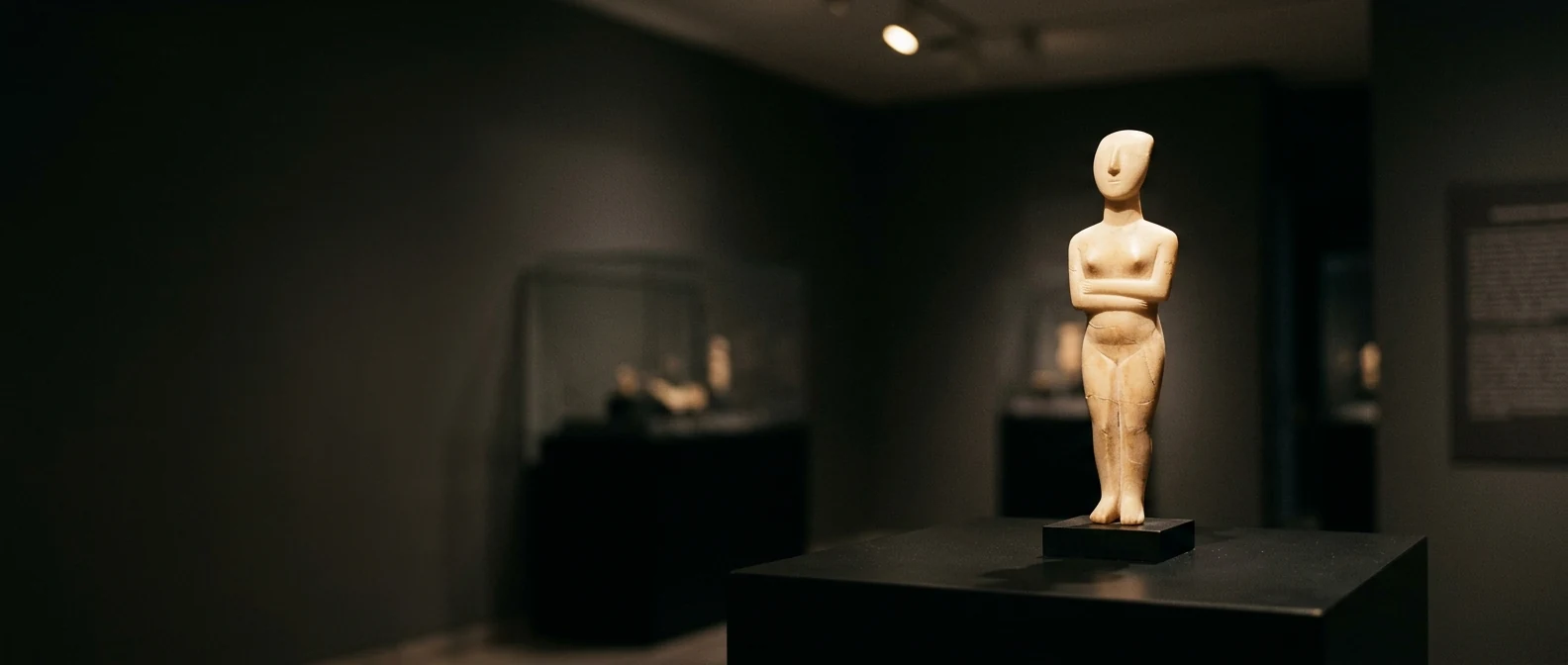
The Cyclades are the island group in the southeastern Aegean: Naxos, Paros, Amorgos, Santorini and many others. In the Early Bronze Age, roughly between 3200 and 2000 BC, a distinctive tradition of marble figurines developed there. The forms are simple: faces where the nose is the main feature, arms folded across the body, and bodies reduced to clear geometry. Many of these figurines probably once carried paint, even if today we mostly see them as white marble.
What surprises many visitors is how modern they look. Their clear form made later artists and art historians see them in a different way. The museum presents this material without too much staging: enough space, quiet lighting, and objects that reward slow looking.
The collection in numbers
3,000+
Total objects in the permanent collections: Cycladic, Ancient Greek, Ancient Cypriot, and the Stathatos Collection of decorative arts.
4th millennium BC – 6th c. AD
The chronological range of the collections, covering around 4,500 years of Aegean and Eastern Mediterranean culture.
1986
The year the Goulandris foundation opened the museum to the public. Since then, it has built a strong program of permanent and temporary exhibitions.
📍 From Angels Athens to Museum of Cycladic Art
See at a glance how to get from the apartment at Iouliánou 50. Drag the map and zoom in for details.
Two buildings, two very different atmospheres
The museum occupies two adjoining buildings in Kolonaki, connected by a glass passage:
- The main building — a modern four-storey building designed for the collection. The lighting is discreet and the figurines are displayed with enough space around them.
- The Stathatos Mansion — a 19th-century neoclassical house designed by Ernst Ziller and restored as exhibition space. Temporary exhibitions are often shown here, and the contrast between the historic building and the museum display can be part of the experience.
Floor by floor, the permanent collection
Floor 1 — Cycladic Civilisation
This is the main floor for most visitors. The cases show the figurines in development, from simpler early forms to the more mature folded-arm figures. Look out for the musician figures, the larger figurines, and the pieces that still preserve traces of color. They remind you that these objects were not always the white minimalist works many people imagine today.
Floor 2 — Ancient Greek Art
From the Bronze Age to the Roman period, with pottery, figurines, small objects and jewelry. It is a more familiar section if you have visited other Greek archaeological museums, but it helps place Cycladic art within the wider Aegean world instead of leaving it isolated.
Floor 3 — Ancient Cypriot Art
An important section on Cyprus, with pottery, figurines, limestone sculpture, and objects that show contact with the Greek, Egyptian, and eastern Mediterranean worlds. If you have limited time, a quick round is enough; if you are interested in the eastern Mediterranean, it is worth longer.
Floor 4 — Scenes of daily life in antiquity
This is often the easiest floor for families and for visitors without much archaeological background. The display is thematic, covering childhood, athletics, the symposium, and death. It works well as a bridge between the objects and everyday life.
Practical information
- Address: 4 Neophytou Douka Street, Kolonaki. About five minutes on foot from Evangelismos metro and around eight from Syntagma. From Angel Athens, the simplest route is Victoria to Omonia on Line 1, then Line 2 to Syntagma and a short walk.
- Hours: these can change depending on the season, temporary exhibitions, or holidays. Check cycladic.gr before you go.
- Tickets: there are standard, reduced, and special categories. It is best to confirm prices and current offers on the official site.
- Booking: the permanent collection is usually easy to visit without much planning, but some temporary exhibitions may need more attention.
- Audio guide: check whether there is an app or available guide in the language you prefer, and download it before you enter the galleries.
The cafe in the courtyard
Cycladic Cafe in the Stathatos Mansion courtyard
The museum cafe, in the courtyard of the Stathatos Mansion, is a good stop before or after your visit. It has a calmer atmosphere than many cafes in Kolonaki and works well if you want to continue your day without moving far. Check opening times and access before you go, since events and temporary exhibitions can affect them.
Temporary exhibitions worth checking
The museum often works on the relationship between antiquity and contemporary art, with temporary exhibitions that can change the reason for visiting. Always check cycladic.gr before you go. Some exhibitions have separate tickets or specific time slots, and it helps to know in advance whether you want only the permanent collection or also the Stathatos program.
How long to plan for
1 hour if you stay with Cycladic Floor 1 and make a quick pass elsewhere — a perfectly reasonable visit. 2 hours for a full visit including a temporary exhibition. 3 hours if you want all four permanent floors, the Stathatos, and a coffee break.
What to pair it with
The museum is in Kolonaki, close to the Benaki Museum, the Byzantine and Christian Museum, and the Vasilissis Sofias museum axis. It pairs easily with the Benaki Museum of Greek Culture or with a walk toward Lycabettus if you do not mind the uphill part. For a full but reasonable museum day, Cycladic plus Benaki is a more realistic combination than trying to do the whole Vasilissis Sofias axis in one go.
Frequently asked questions
Are the figurines really that small?
Most are 15–30 cm tall — palm-sized. A small number reach 60–80 cm, and a single famous example is roughly life-sized at 1.4 metres. The smallness is part of the impact: you have to lean in.
Is photography allowed?
Photography without flash is usually allowed in the permanent collection, but rules may be different in temporary exhibitions. Follow the signs at the entrance to each gallery.
Is it worth visiting if you are not an art specialist?
Yes, especially if you like smaller museums and clear presentation. You do not need special background knowledge to spend time with the figurines. You do, however, need some willingness to look slowly. If you want a bigger sense of spectacle, the Acropolis Museum or the National Archaeological Museum may suit you more.
— Kathy