A temple that took a long time to finish
The history of the Olympieion stretches across many centuries. It began in archaic Athens, was taken up again in the Hellenistic period, and was completed under Hadrian. The timeline is easiest to read in four stages:
- 6th century BC — the first large building works belong to the time of the Peisistratids. The project stops after the fall of the tyranny.
- 2nd century BC — Antiochus IV Epiphanes restarts construction in the Corinthian order, with the architect Cossutius. His death leaves the project unfinished again.
- 86 BC — after the capture of Athens, Sulla removes columns to Rome, according to the ancient sources. The monument enters the Roman history of the city as well.
- 131/132 AD — Hadrian completes and inaugurates the temple, giving it the form of one of the largest sanctuaries of Roman Athens.
The numbers
104 columns
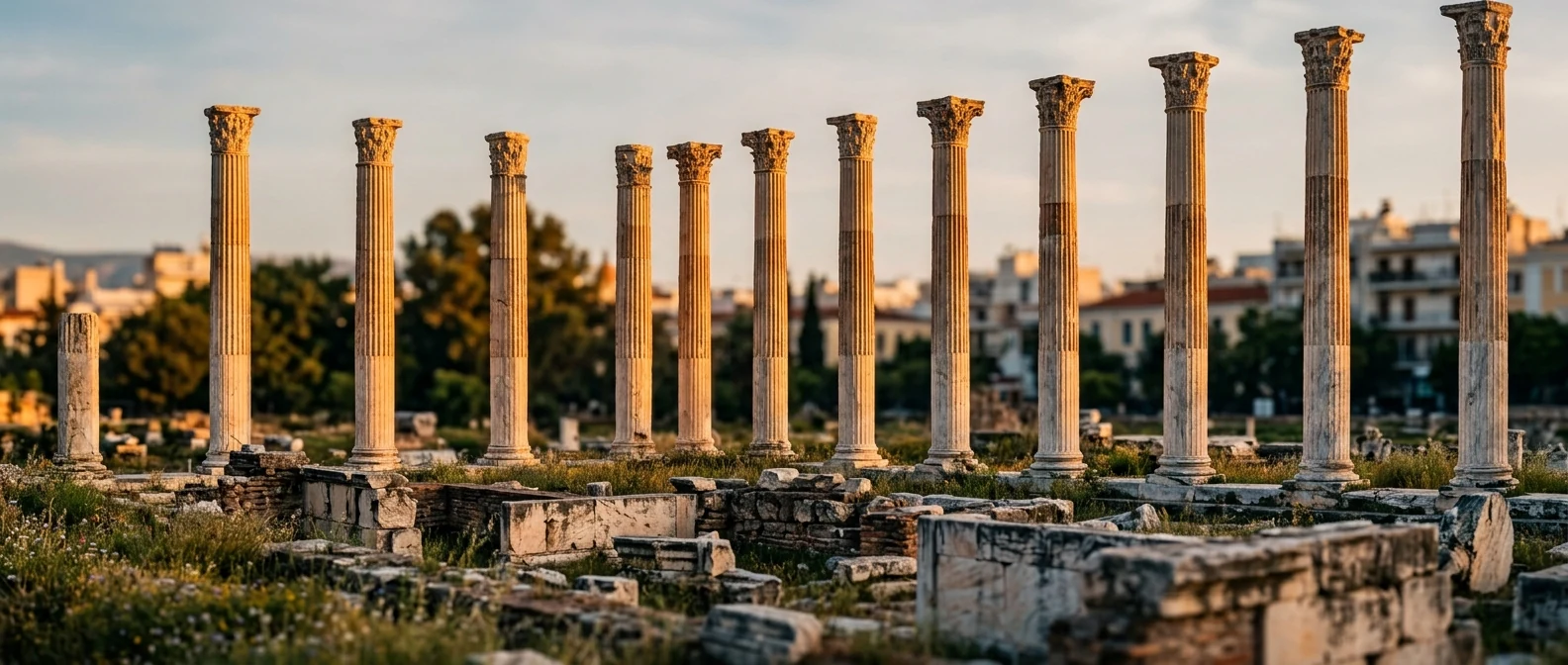
That was the completed temple, in double colonnade. The original image was much denser than what survives today.
15 standing and one fallen
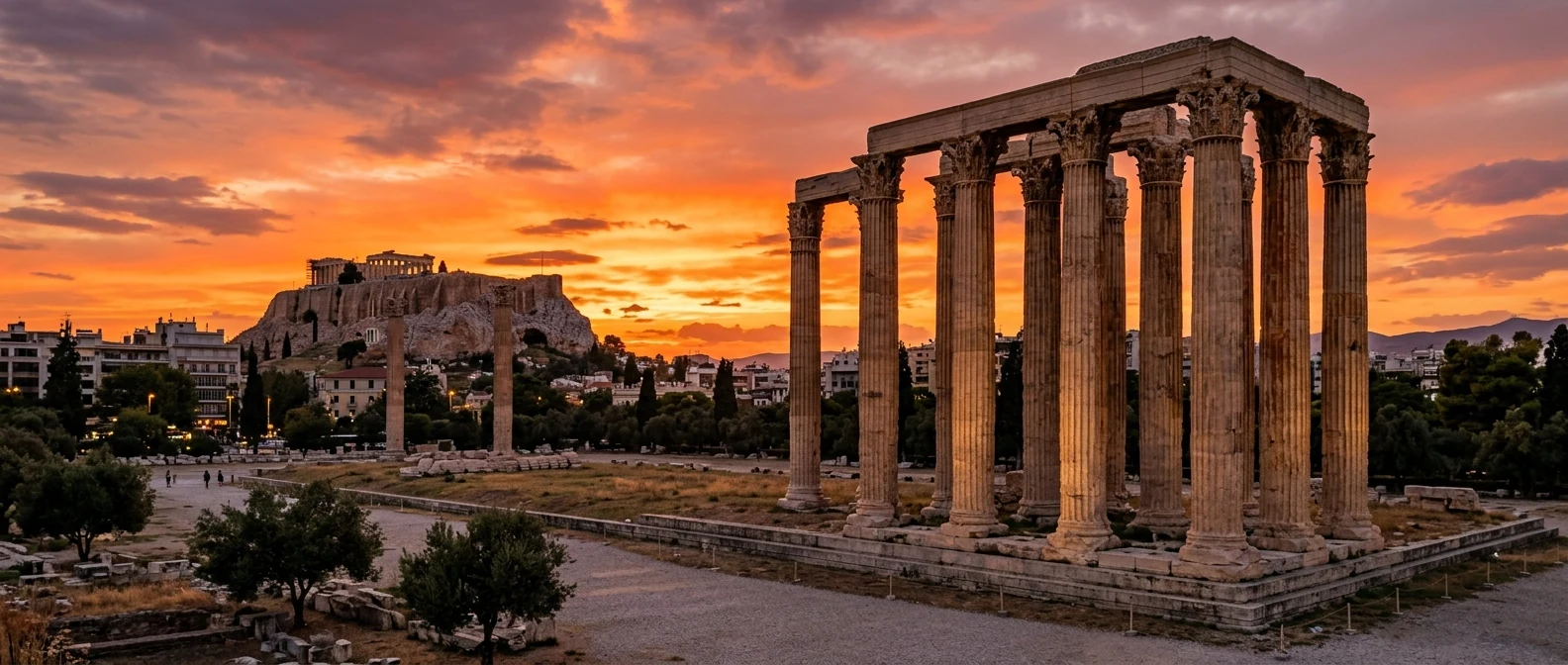
Today fifteen columns still stand. Another lies on the ground after a storm in 1852, making the drum-by-drum construction easy to understand.
17 m tall
That is roughly the height of each column. Stand at the base and look up; that is the easiest way to feel the scale.
96 × 40 m
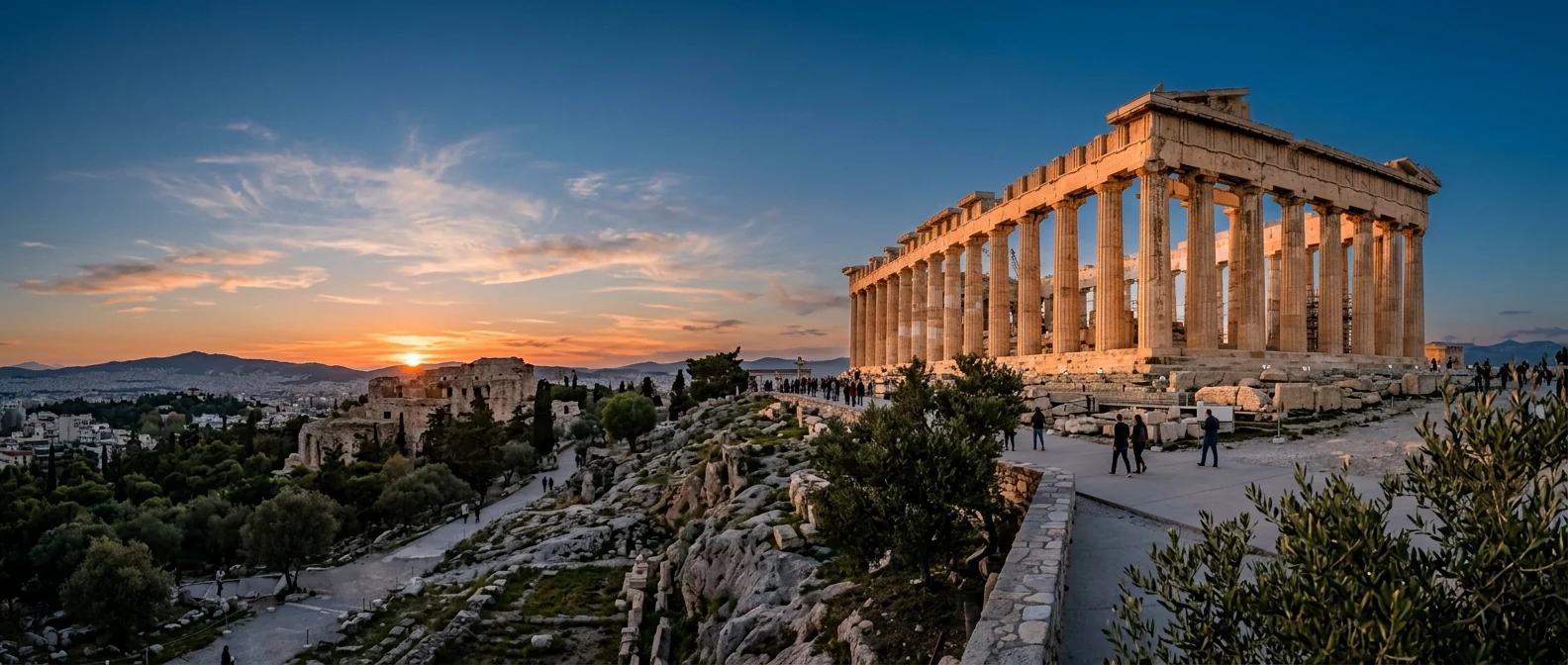
These are roughly the dimensions of the stylobate. The Olympieion was clearly larger than the Parthenon and belongs among the major monuments of the ancient Mediterranean.
📍 From Angels Athens to Temple of Olympian Zeus · Hadrian's Arch
From Angel Athens, walk to Victoria, take Line 1 to Omonia, change to Line 2 for Acropoli, then continue east on foot. Drag the map and zoom in for details.
What you can see today
The site itself is mostly an open field. There are three things to focus on:
- The standing group of columns — the characteristic image of the site. From the south-east corner you can frame the Acropolis as well.
- The fallen column — the drums lined up in sequence show in a very direct way how each column was built.
- The traces of the foundations — the rectangular platform helps you imagine the original size of the temple.
Hadrian's Arch — read the inscriptions
A few metres from the archaeological site, on Vassilissis Amalias Avenue, stands the arch connected with the age of Hadrian. It is made of Pentelic marble and worked as a symbolic boundary between old Athens and the newer Roman city that developed farther east.
The two inscriptions are what most people remember, one on each side, in Greek:
The inscriptions explain the role of the arch with very few words: on one side the city of Theseus, on the other the city of Hadrian. The arch stands on a public pavement, so you can see it freely without a ticket.
Practical information — Olympieion
- Address: Vassilissis Olgas Avenue, at the corner with Amalias. Two minutes from Acropoli metro (Red Line 2) or 10 minutes on foot south of Syntagma. From Angel Athens at 50 Ioulianou, walk to Victoria, take Line 1 to Omonia, and change to Line 2 for Acropoli. Alternatively, get off at Syntagma and walk south on Amalias if you want to see Hadrian's Arch first.
- Tickets: there are individual tickets and, depending on the period, combined options with other archaeological sites. Check current prices on hhticket.gr.
- Hours: they change by season and can be affected by works or special conditions. Confirm before you go.
- Booking: a simple visit is usually easy, but it is still worth checking the official platform in peak season.
- Hadrian's Arch: visible freely from the pavement.
How much time you need
The site is open and the main monuments are easy to see, so the visit is short: about 20-30 minutes inside the fence, plus a few minutes at the arch outside. There is not much shade. In summer you will want water and a hat.
Best photo angles
- Through the arch toward the temple — stand on Amalias Avenue and frame the columns inside the opening of the arch. This is the classic view.
- From inside the site, south-east corner — this gives you the standing columns with the Acropolis on the horizon.
- The fallen column from above — kneel down and frame it along its full length. The repeating drums show the scale clearly.
- Late light — when the sun lowers, the columns take on a warmer colour and separate better from the city behind.
What to combine it with
The Olympieion combines easily with a short walk around the National Garden, Zappeion, and the Panathenaic Stadium:
1 · Olympieion + Hadrian's Arch
Start here and see both together.
2 · National Garden
Cross Amalias and head north through the shaded garden, a good breath after the open temple field.
3 · Panathenaic Stadium / Kallimarmaro
A little farther east, if you want to continue with a monument from more recent Olympic history.
4 · Plaka or Pangrati for lunch
Plaka stays closer to the classic visitor walk, while Pangrati gives you a more everyday Athenian feel.
FAQ
Do you need a separate ticket?
That depends on the ticket you have and on the options in place during your visit. Check on hhticket.gr whether the Olympieion is included in a combined ticket or needs a separate purchase.
Can you see the temple without going inside?
The columns are clearly visible above the fence from Vassilissis Olgas and Amalias. If you go inside, what you gain is the sense of scale, the fallen column up close, and a better understanding of the ground plan.
What happened to the colossal statue of Zeus?
It does not survive. The sources mention a colossal statue inside the temple, but its fate is uncertain and no fragments have been securely identified.
Is the site accessible?
The site is relatively flat, with paved and gravel sections. For wheelchair access or reduced mobility, check the current site instructions before you go. Hadrian's Arch stands on the pavement.
Sources:
— Kathy