What "Byzantine" means
What we call the Byzantine Empire today was the eastern Roman Empire, especially after the western part collapsed in the 5th century CE. The Byzantines themselves did not use the word "Byzantine". They called themselves Romans. Their capital was Constantinople, inaugurated by Constantine in 330 CE. Greek became the dominant language from the 7th century onward. The empire lasted, with changes and crises, from 330 CE to 1453 CE: more than 1,123 years.
For Greece, this matters. Greek lands remained for centuries within a Greek-speaking, Christian, literate state. Modern Greek identity does not come only from classical antiquity. It also owes much to the Byzantine millennium: to language, church tradition, art, and a strong sense of historical continuity.
The long timeline
330-610 CE
Early Byzantium. Justinian ruled from 527 to 565. Hagia Sophia was built, the empire moved from Latin toward Greek, and the plague struck in 541.
610-1025 CE
Middle Byzantium. Wars with Slavs, Arabs, and Bulgars. Iconoclasm from 726 to 843. The Macedonian dynasty, from 867 to 1056, brought a period of strength.
1025-1204 CE
Decline, though not without recovery. Manzikert in 1071, the First Crusade, and the Komnenian revival all belong here.
1204-1453 CE
Late Byzantium. The Fourth Crusade sacked Constantinople in 1204, Latin states appeared in Greek lands, the Palaiologan revival began in 1261, and the Ottomans took Constantinople in 1453.
Byzantine Athens
- 3rd-5th centuries CE: Athens remained a pagan and intellectual centre. The philosophical schools continued until 529 CE, when Justinian closed the Academy.
- 5th-7th centuries: Christianisation advanced. The Parthenon was converted into a church of the Virgin Mary.
- Slavic invasions in the 6th and 7th centuries: Athens shrank, though it remained continuously inhabited and provincial rather than abandoned.
- 9th-12th centuries: a Byzantine revival. Small churches of fine masonry were built, including Kapnikarea, Agioi Theodoroi, Agios Eleftherios, and the monastery of Daphni.
- 1204-1456: the Latin Duchy of Athens, with the Acropolis serving as a ducal palace.
- 1456: Ottoman conquest. The Parthenon became a mosque, and urban life continued under Ottoman rule until independence.
Byzantine art and architecture
Cross-in-square churches
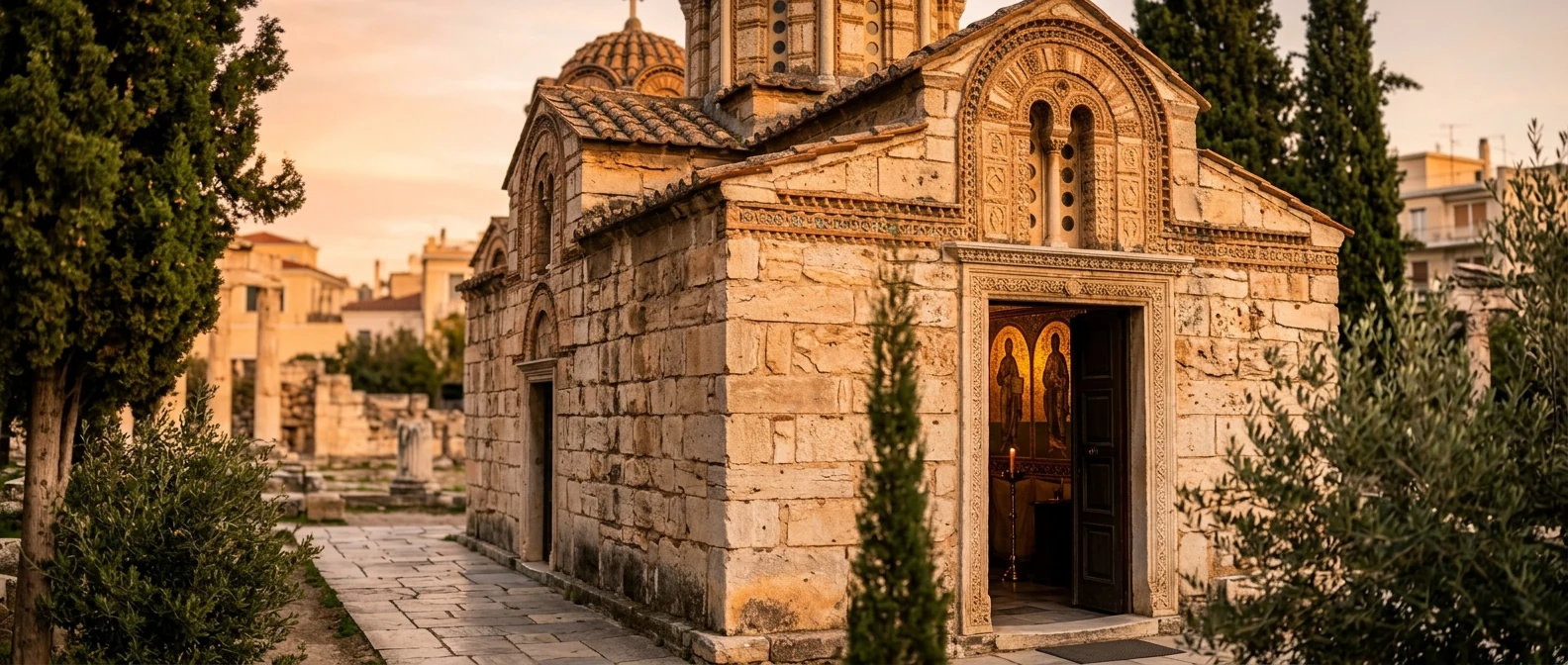
The middle Byzantine period developed a recognisable church type: a Greek cross inscribed within a square, crowned by a central dome. The scale is often small and human. Many of these churches held around 50 to 200 worshippers. Athens has more than 30 surviving Byzantine churches, mostly from the 9th to the 12th century. Many are built in cloisonne masonry, with stones framed by rows of brick. Examples include Kapnikarea on Ermou Street, Agioi Apostoloi in the Ancient Agora, Agios Eleftherios on Mitropoleos Square, and Sotira Lykodimou, today the Russian Orthodox church.
Iconography
- Icons: religious images, usually tempera on wood with a gold background. They are highly stylised and symbolic rather than naturalistic.
- Mosaic: glass tesserae set into plaster. The monastery of Daphni, near Athens, preserves major examples and is a UNESCO World Heritage site.
- Fresco: often replaced mosaic in later Byzantine churches because it was cheaper. Mystras and the monasteries of Mount Athos preserve important late Byzantine cycles.
- Iconoclasm (726-843): the imperial dispute over whether icons were idolatrous. Many were destroyed in the iconoclastic periods. Their restoration in 843 is still celebrated as the "Triumph of Orthodoxy."
- Manuscript illumination: gospel books, psalters with painted miniatures.
At a glance
330-1453 CE
1,123 years of the eastern Roman Empire.
529 CE
Justinian closes the philosophical schools of Athens, a symbolic end of antiquity in the city.
30+
Surviving Byzantine churches in Athens, mostly from the 9th to the 12th century.
1456
The Ottoman conquest of Athens, after which the Parthenon became a mosque.
Byzantine intellectual life
- Greek language: continuous from antiquity through Byzantium into modern Greek. Modern Greek developed directly out of Byzantine spoken Greek.
- Manuscript preservation: the Byzantines copied and preserved many classical Greek texts. Without this tradition, much of Plato, Aristotle, Sophocles, and Homer might not have survived.
- Theology: Greek fathers (Basil the Great, Gregory of Nazianzus, John Chrysostom, John of Damascus) shaped Christian doctrine.
- Schools: Constantinople had organised higher learning, and the Magnaura stood out from the 9th century onward.
- Influence on the West: Byzantine scholars fleeing the Ottoman conquest in the 15th century brought manuscripts and knowledge to Italy, helping to feed the Renaissance.
Byzantine music and chant
- Byzantine chant: monophonic liturgical vocal music, organised in the eight-mode system.
- A continuous tradition: it is still sung in Greek Orthodox churches today and can be heard clearly in Athens during Sunday liturgy.
- Composers: Romanos the Melodist in the 6th century, John of Damascus in the 8th, and Kassia in the 9th, one of the earliest known female composers of the medieval world.
The medieval Greek lands
- Thessaloniki: the second-largest Byzantine city after Constantinople, with walls and major churches such as Saint Demetrios and the Rotunda.
- Mystras (near Sparta): the late Byzantine capital of the Morea, with ruins, palaces, and frescoes. It is a UNESCO site, and the last Byzantine emperor, Constantine XI, was crowned there.
- Méteora: monasteries on rock pillars, founded 14th c. UNESCO. (See Meteora day trip.)
- Mount Athos: monastic republic; founded 963 CE; still operating; 20 monasteries. UNESCO.
- Crete: Byzantine and later Venetian from 1204 to 1669. Heraklion and Chania still show layered medieval architecture.
- The Greek islands: many preserve Byzantine, Venetian, and Genoese castles and churches.
Key dates for the Greek lands
- 529 CE: Justinian closes Plato's Academy in Athens.
- 726-843 CE: Iconoclasm, the long dispute over religious art and its destruction.
- 867-1056: the Macedonian dynasty and a high point of Byzantine culture and military expansion.
- 1054: the Great Schism between the Roman Catholic and Greek Orthodox churches.
- 1204: Fourth Crusade sacks Constantinople. Catastrophe for Byzantium.
- 1204-1261: Latin Empire (Crusader rule of Constantinople). Greek successor states (Nicaea, Epirus, Trebizond).
- 1261: Constantinople is recovered by the Greeks. The Palaiologan dynasty rules until the end.
- 1453: Constantinople falls to Mehmed II. The Byzantine Empire ends.
- 1456: Athens falls to Ottomans.
- 1460: the last Byzantine stronghold, Mystras, falls.
Where you can still encounter Byzantine Greece in Athens
Byzantine and Christian Museum
On Vasilissis Sofias Avenue. The main collection for icons, mosaics, manuscripts, and sculpture from the Byzantine period. See our guide.
Daphní Monastery
About 10 km west of Athens. A UNESCO site with major 11th-century mosaics. Check opening hours before going.
Kapnikaréa Church
On Ermou Street in central Athens. Dating to around 1050 CE, and still a functioning church.
Agios Eleftherios (Mikri Mitropoli)
Next to the cathedral of Athens. A 12th-century church built with reused ancient sculpture.
Byzantine legacy in modern Greece
- Greek Orthodox Church: continuous from Byzantine era. ~95% of Greeks identify as Greek Orthodox.
- Greek language: modern Greek is the later development of Byzantine Greek.
- National identity: 19th-century Greek nationalism drew deeply from both Byzantine and classical heritage.
- Calendar and religious feasts: the Greek Orthodox calendar is part of this Byzantine inheritance.
- Place names + architecture: Byzantine era left lasting imprint.
FAQ
Were the Byzantines Greek or Roman?
In their own understanding, both. Politically they were Roman, while linguistically and culturally, especially after the 7th century, their Greek character became dominant. Modern Greeks inherit both layers.
Why do we call them "Byzantine" not "Roman"?
The label was created by Western scholarship in the 16th century. It is an outsider's term. The Byzantines themselves called themselves Roman.
Did Athens decline in Byzantine era?
Yes, at first. Its population fell, but from the 9th to the 12th century it revived through church building. It became provincial, but it was not abandoned.
What is Daphni Monastery?
An important Byzantine monastery near Athens with major 11th-century mosaics. It is a UNESCO site and is sometimes closed for restoration work.
Which Athenian church is best for a first visit?
Kapnikarea is the easiest because of its location. Agios Eleftherios clearly shows the reuse of ancient stone, while Daphni requires more travel but offers some of the finest mosaics near Athens.
How does Byzantium connect to modern Greek identity?
Very deeply. Religion, language, historical continuity, and a sense of place all carry Byzantine inheritance. Modern Greek nationalism often treated Byzantium as a direct ancestor.
Sources:
— Kathy