🪪 The Saronic Islands at a glance
📍 Where they are
The Saronic Gulf is the gulf in front of Athens and Piraeus, between Attica and the Peloponnese. In the middle are Aegina and little Agistri. Further south, Poros lies just a few hundred metres off the coast of the Peloponnese. Further south still, outside the gulf, are Hydra and Spetses, at the entrance to the Argolic Gulf. All of them have daily connections with Piraeus.
📍 Where the Saronic Islands are
The five islands are shown in red: Aegina and Agistri in the middle of the gulf, Poros right next to the Peloponnese, and further south Hydra and Spetses. The green dashed lines show the ferry routes from Piraeus.
🧭 Which island to choose
If you have one day, go somewhere close: Aegina, Agistri or Poros. Hydra also works as a day trip if you take a morning fast ferry. For Spetses, a weekend is better. Here is how they differ:
| Island | By fast ferry | What it has | For whom |
|---|---|---|---|
| Aegina | About 40 minutes | Temple of Aphaia, pistachios, Agios Nektarios, Perdika | A first day trip, families |
| Agistri | About one hour | Pines down to the sea, clear water, peace and quiet | Swimming, relaxing |
| Poros | About 1–1.5 hours | A town on a hill, the clock tower, pines, a narrow strait to the Peloponnese | Families, laid-back holidays |
| Hydra | About 1.5–2 hours | No cars, stone mansions, donkeys | Couples, photography, atmosphere |
| Spetses | About 2–2.5 hours | Bouboulina, the Old Harbour, beaches with pine trees | Weekends, history |
👍 Why go
- So close you need neither a flight nor an overnight ferry.
- Fast ferries every day from Piraeus, all year round.
- Five very different islands: ancient sites, pine forests, mansions, a car-free island.
- Ideal for a day trip or a weekend.
- Open and lively outside summer too.
👎 What to know
- Summer weekends fill up with Athenians.
- The sea and scenery are not Cycladic.
- Fast ferries are cancelled in strong winds.
- Hydra and Spetses are expensive.
- Tickets for Fridays and Sundays sell out early.
📜 A little history
In antiquity Aegina was a powerful seafaring city, a rival of Athens, and one of the first places in Greece to mint its own coins. In modern times the Saronic Gulf played a big role in the War of Independence of 1821: the shipowners of Hydra and Spetses gave their ships to the struggle, and Laskarina Bouboulina came from Spetses. Aegina was briefly the first capital of the new Greek state, under Kapodistrias, before Nafplio.
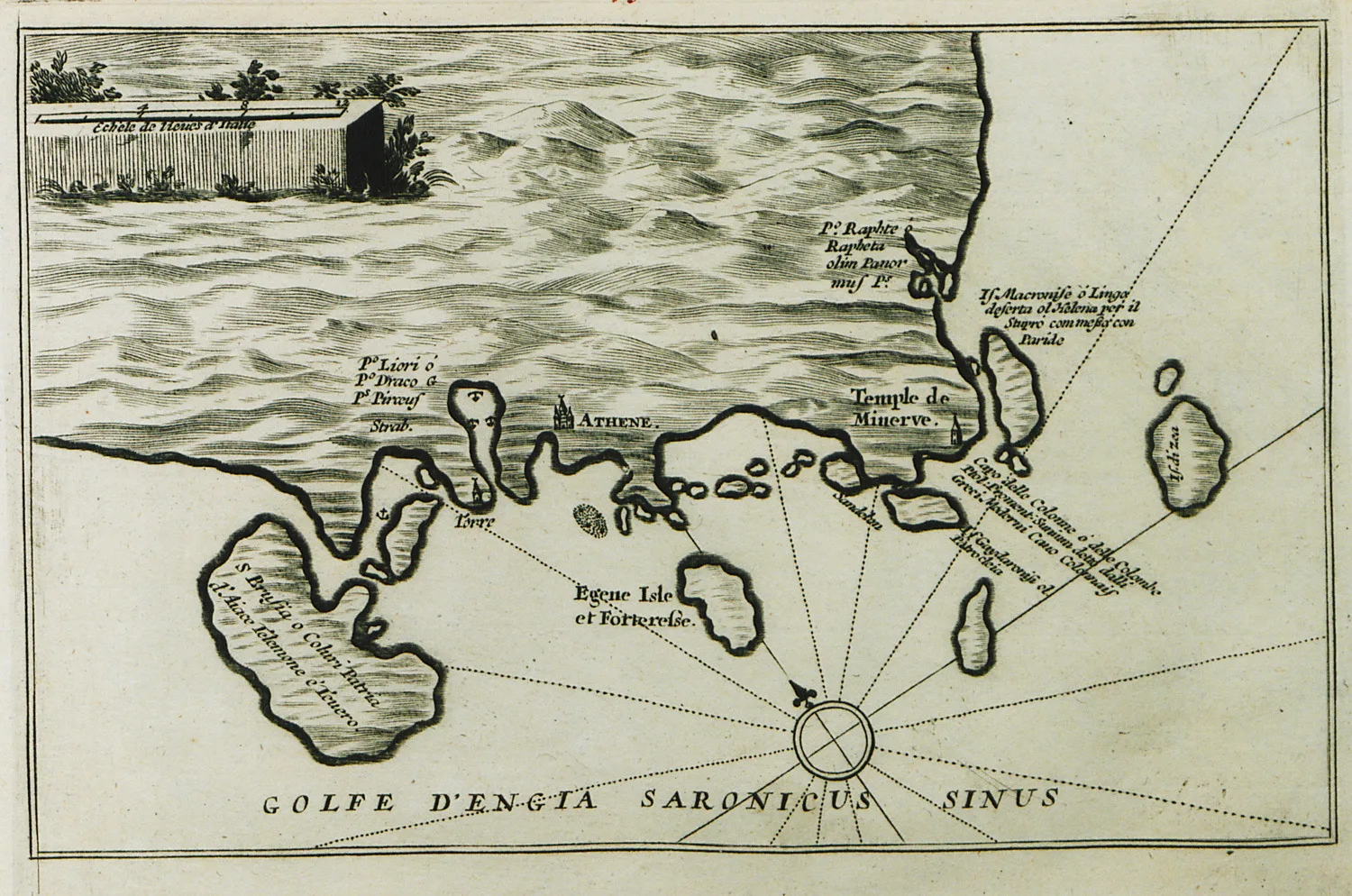
Map: Jacob Peeters (Public domain) · Wikimedia Commons
🏛️ Aegina: a temple, pistachios and fishing villages
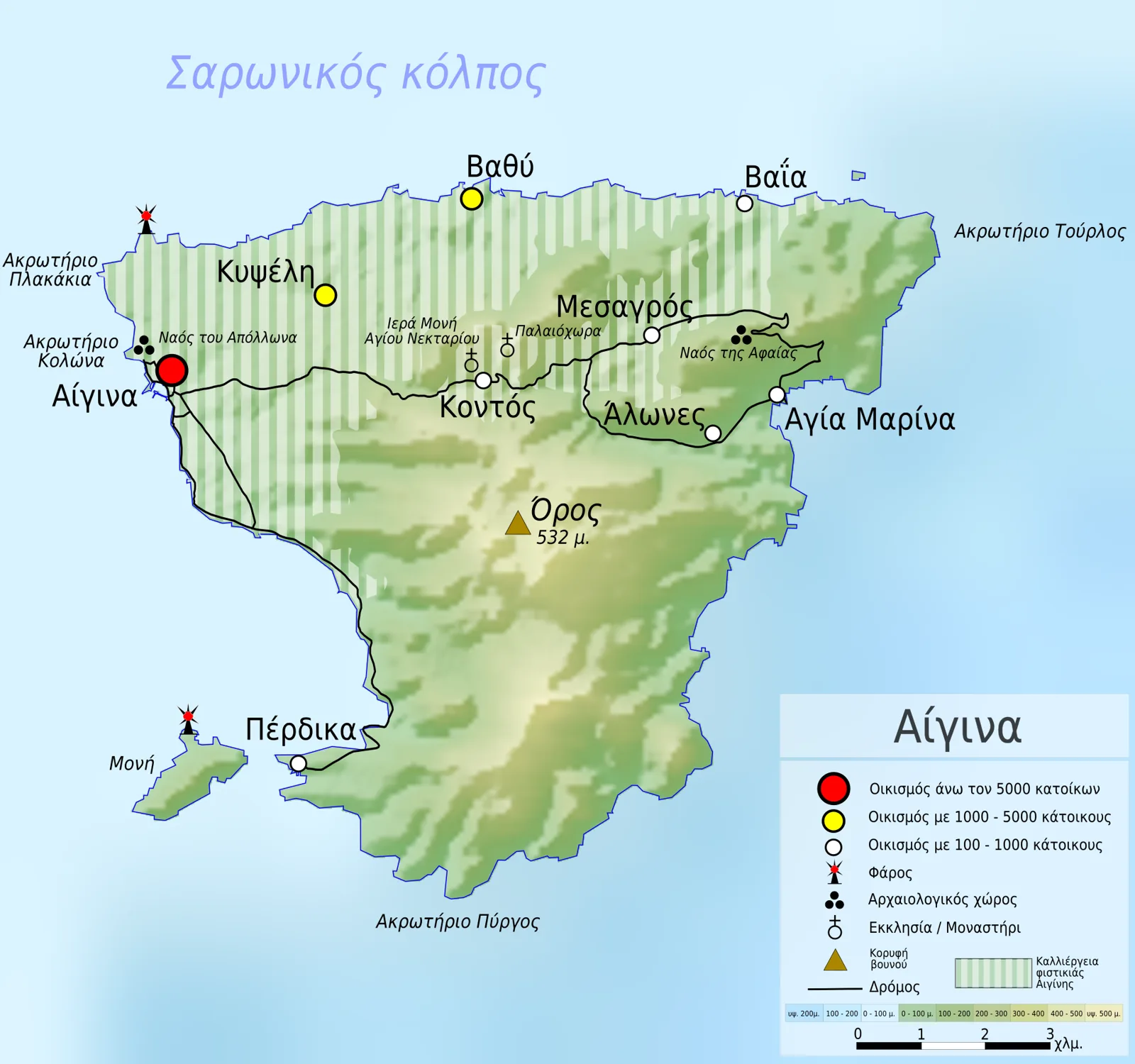
Aegina is the closest and easiest island. The town has a lovely waterfront with neoclassical houses, a little harbour with fishing boats and, next to it, Kolona hill with the only column left from the Temple of Apollo. In the north-east, on a pine-covered hill, stands the Temple of Aphaia, a Doric temple from the 5th century BC and one of the best preserved in Greece.
On the way to the temple you will see the large Monastery of Agios Nektarios, visited by many pilgrims, and opposite it the rocky hill of Paleochora, the abandoned medieval capital, with dozens of small chapels. In the south, Perdika is a fishing village with tavernas by the water. Aegina is known for its pistachio, which has a protected designation of origin: you will find it everywhere, roasted, in sweets and in sesame bars.
🗺️ Aegina and Agistri
Aegina town is on the west coast. The Temple of Aphaia is in the north-east, on a pine-covered hill, and Perdika in the south. To the west lies little Agistri. Tap each number to see what it is.
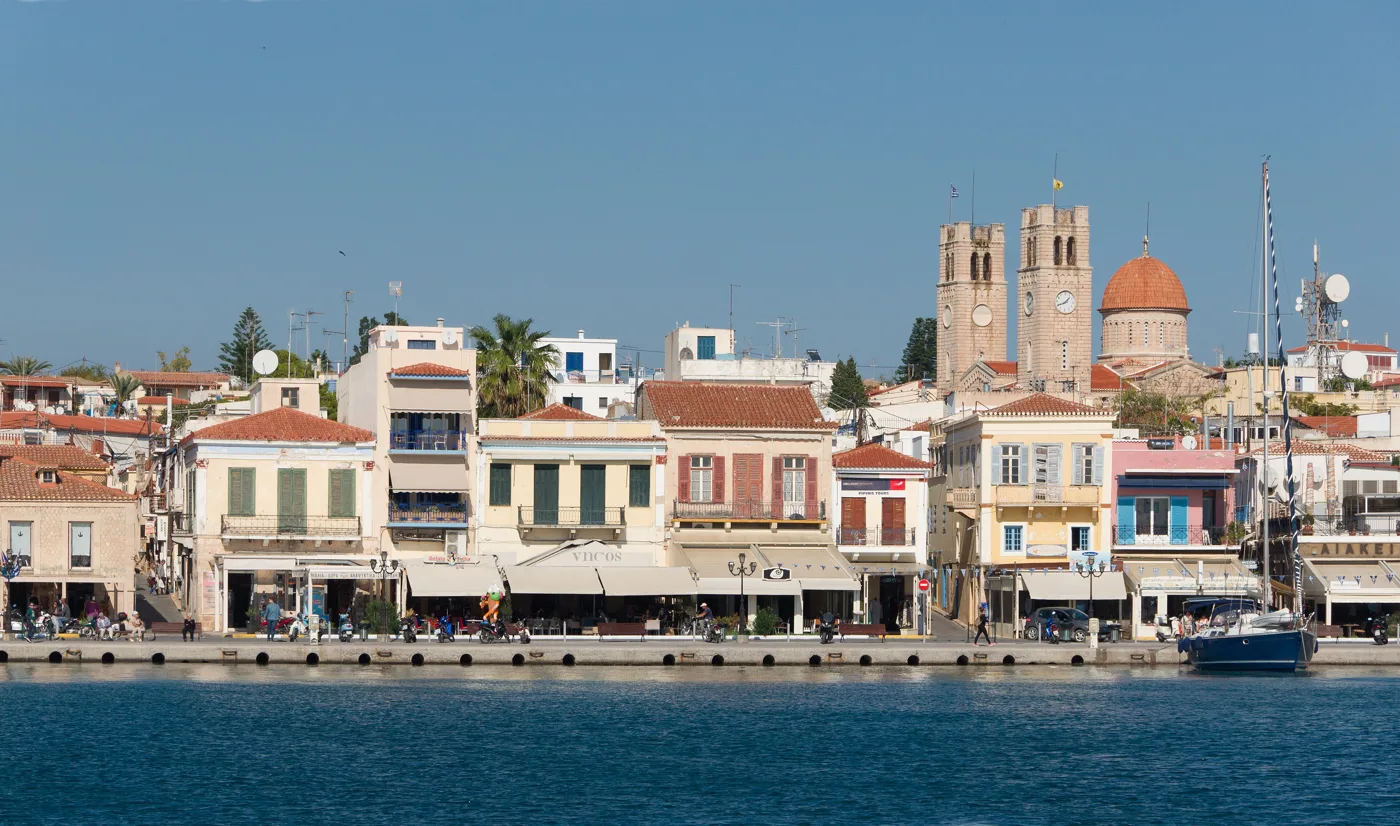
Neoclassical houses on the waterfront.
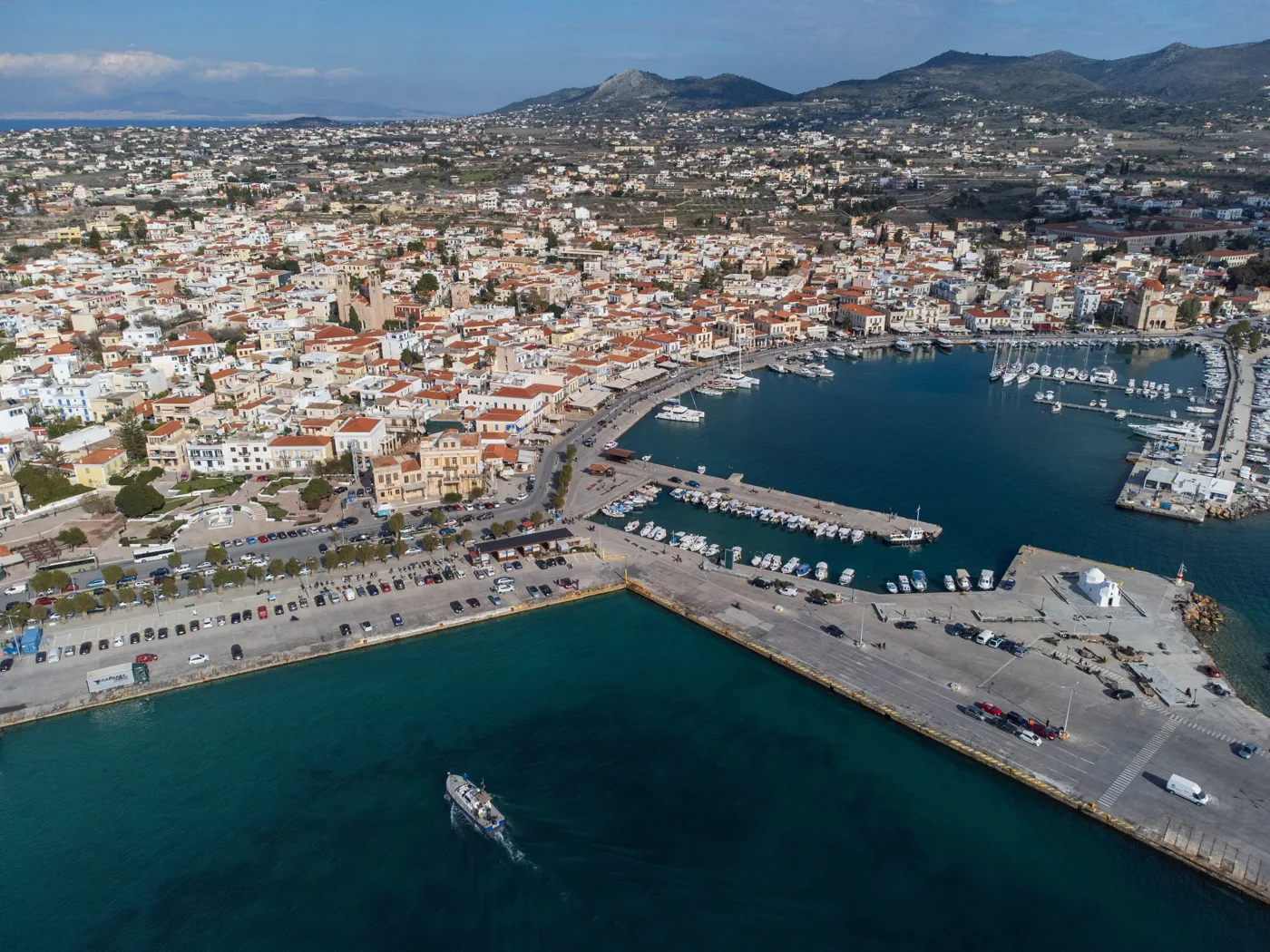
The town and the harbour.
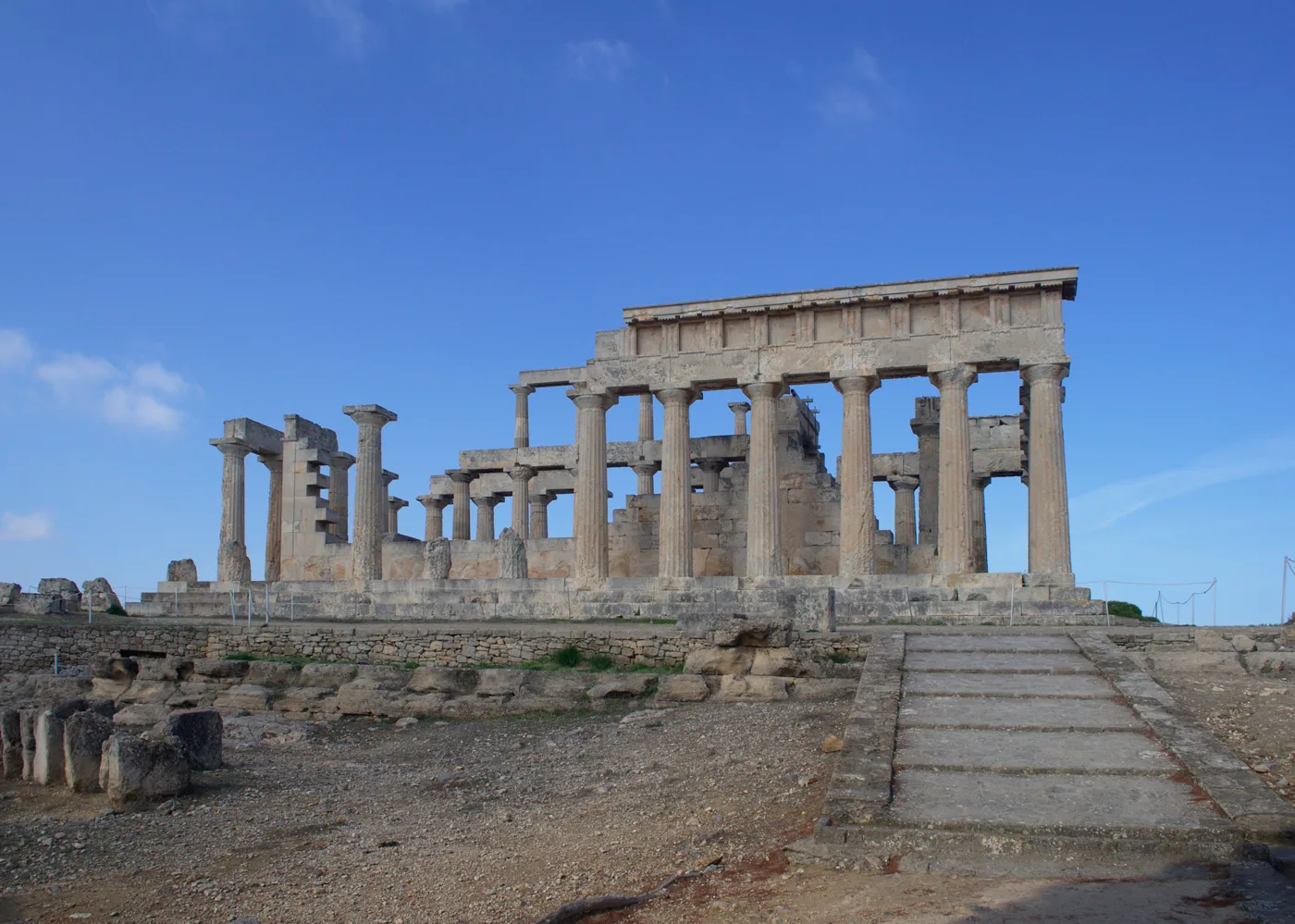
A Doric temple from the 5th century BC.
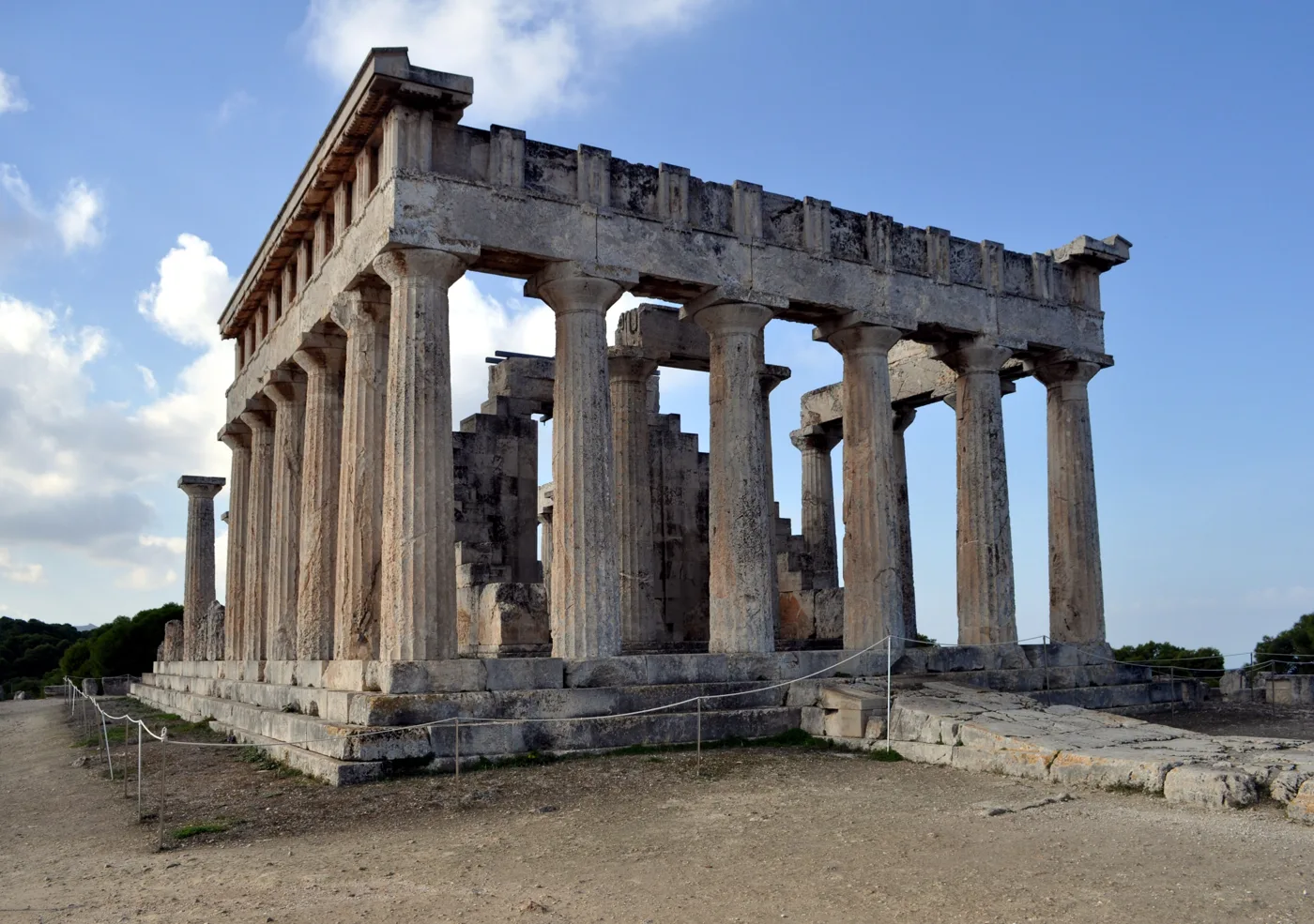
One of the best-preserved temples.
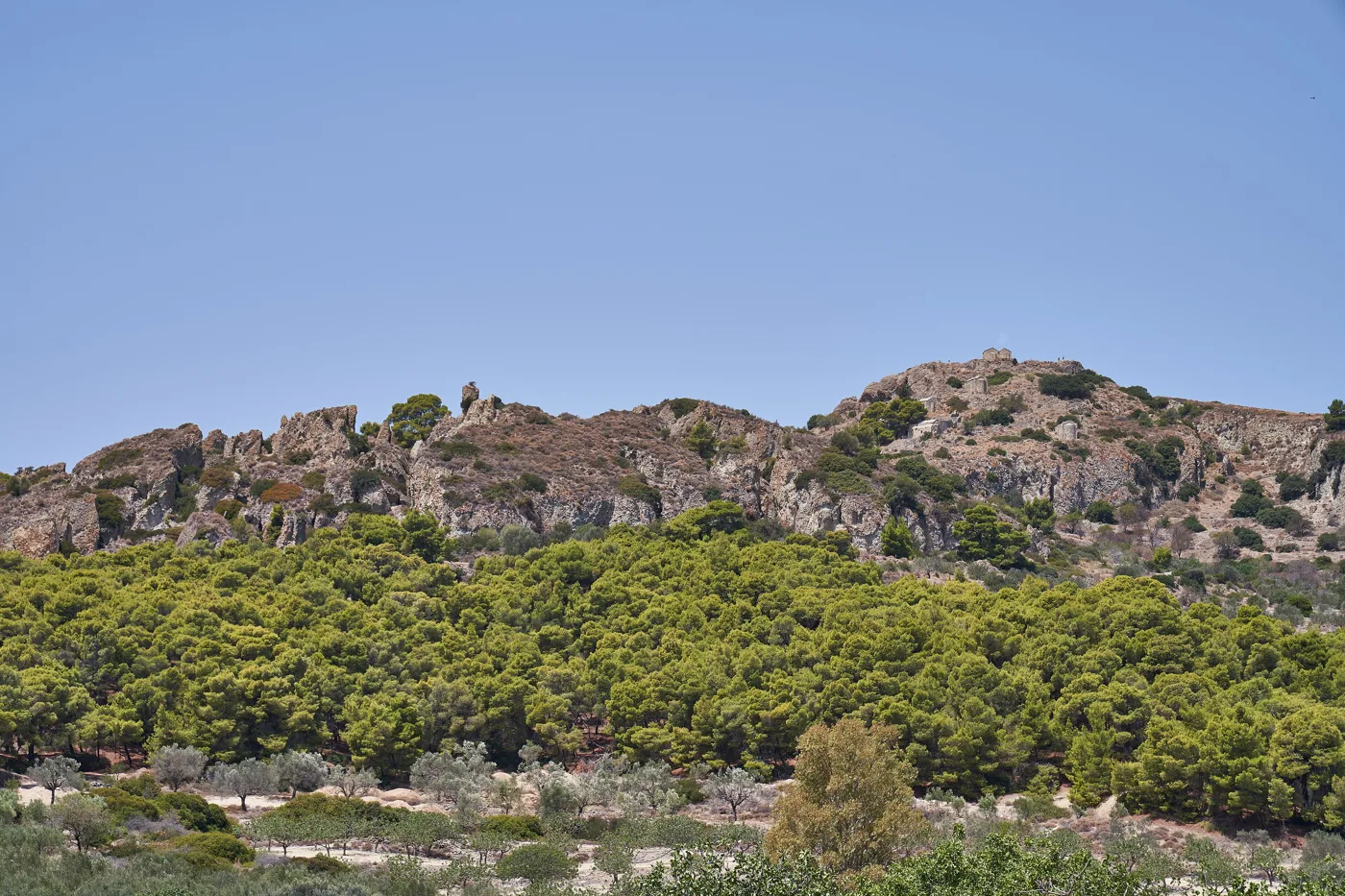
The medieval capital with its chapels.
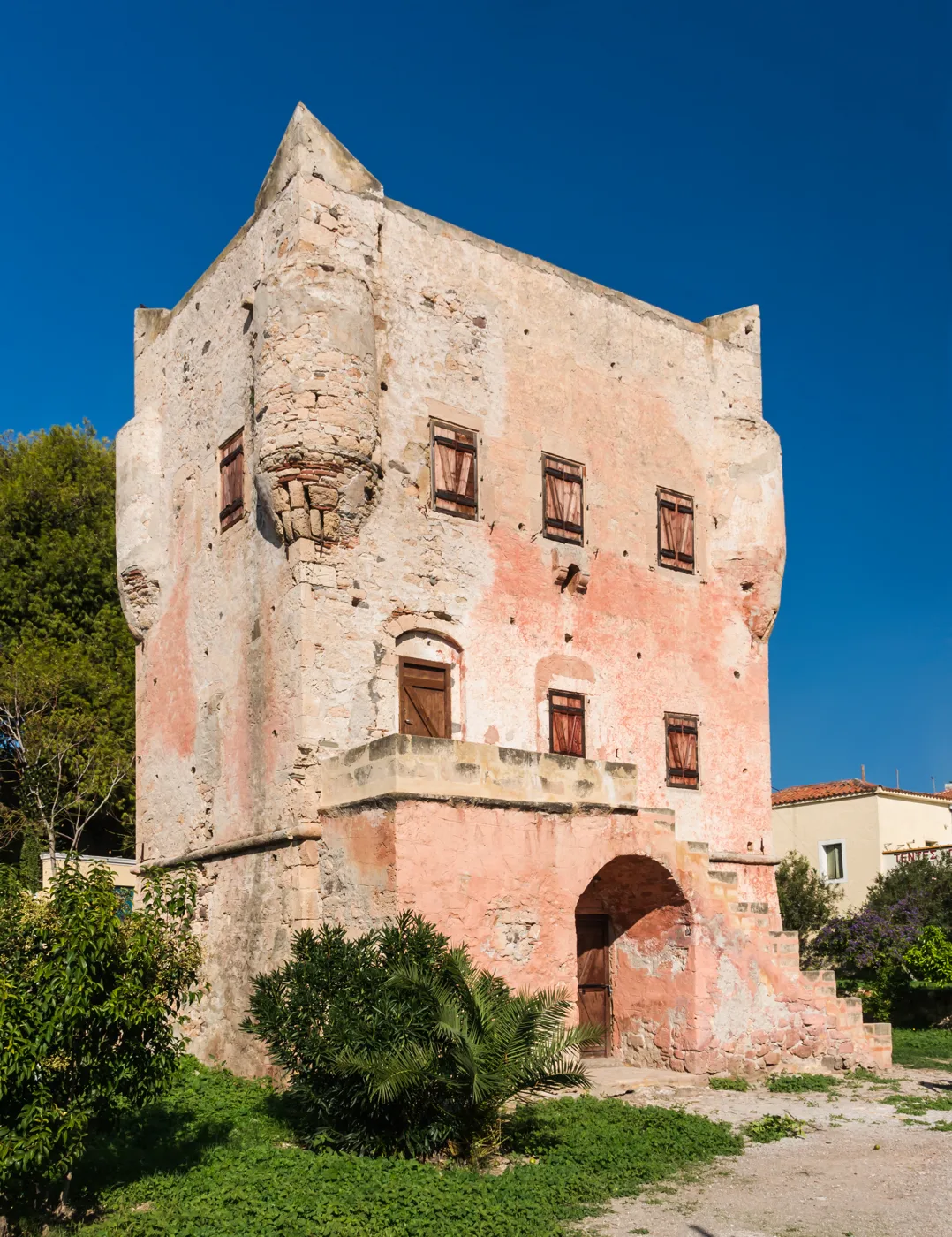
A tower house in town.
Photos: Jebulon (CC0), C messier (CC BY-SA 4.0), Paweł 'pbm' Szubert (CC BY-SA 3.0), George E. Koronaios (CC BY-SA 4.0) · Wikimedia Commons
Map: Uwe Dedering (CC BY-SA 3.0) · Wikimedia Commons
🌲 Agistri: pines down to the sea
Agistri is a small island next to Aegina, covered in pines that reach right down to the water. It has no big sights: you come for swimming in clear, turquoise water and for peace and quiet. Skala is the port, with a beach next to it, and Megalochori is the old village. On the west side, Aponisos and Dragonera have rocks, pines and very clear water. Go by fast ferry from Piraeus or by small boat from Aegina.
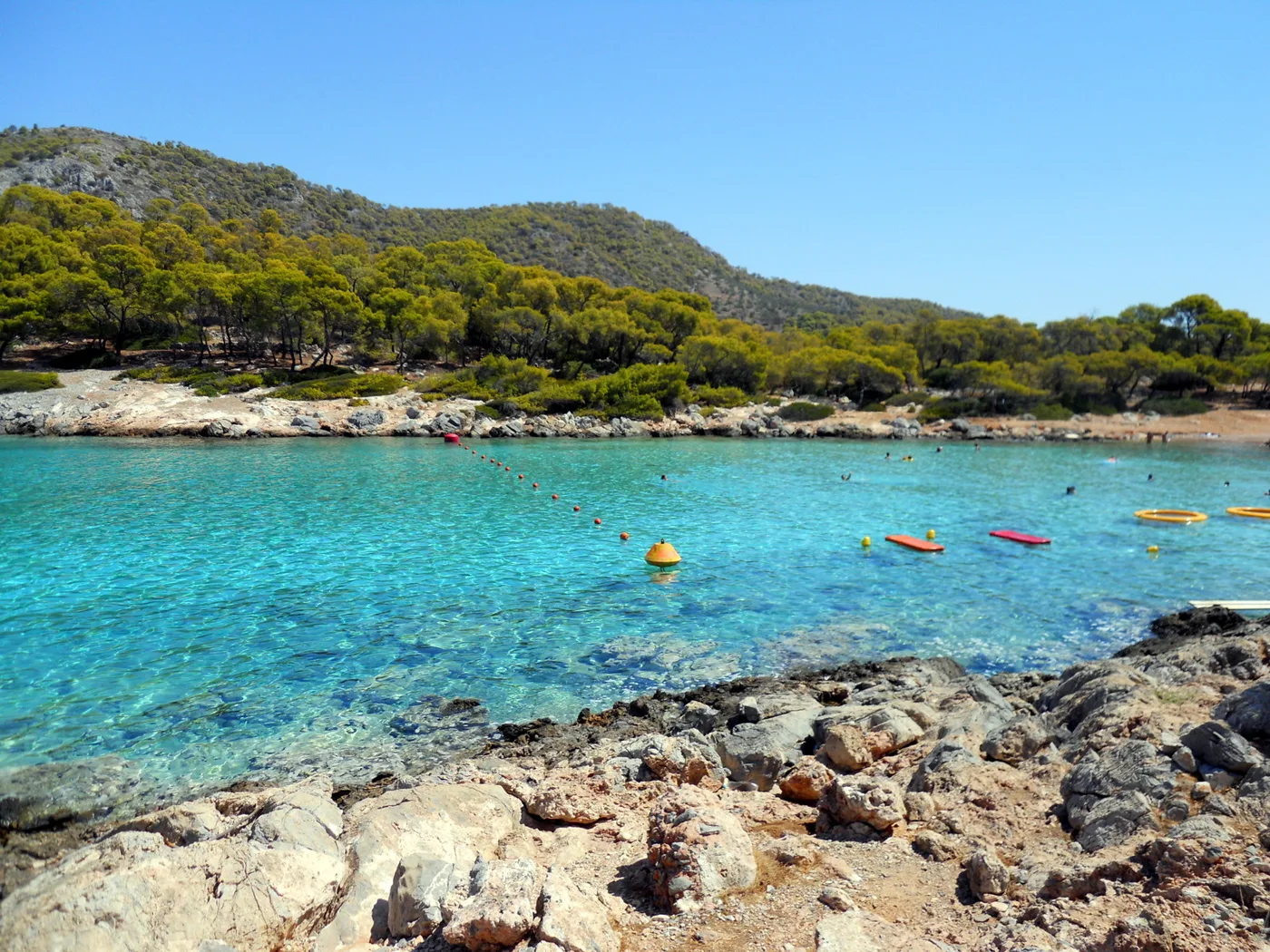
Turquoise water below the pines.
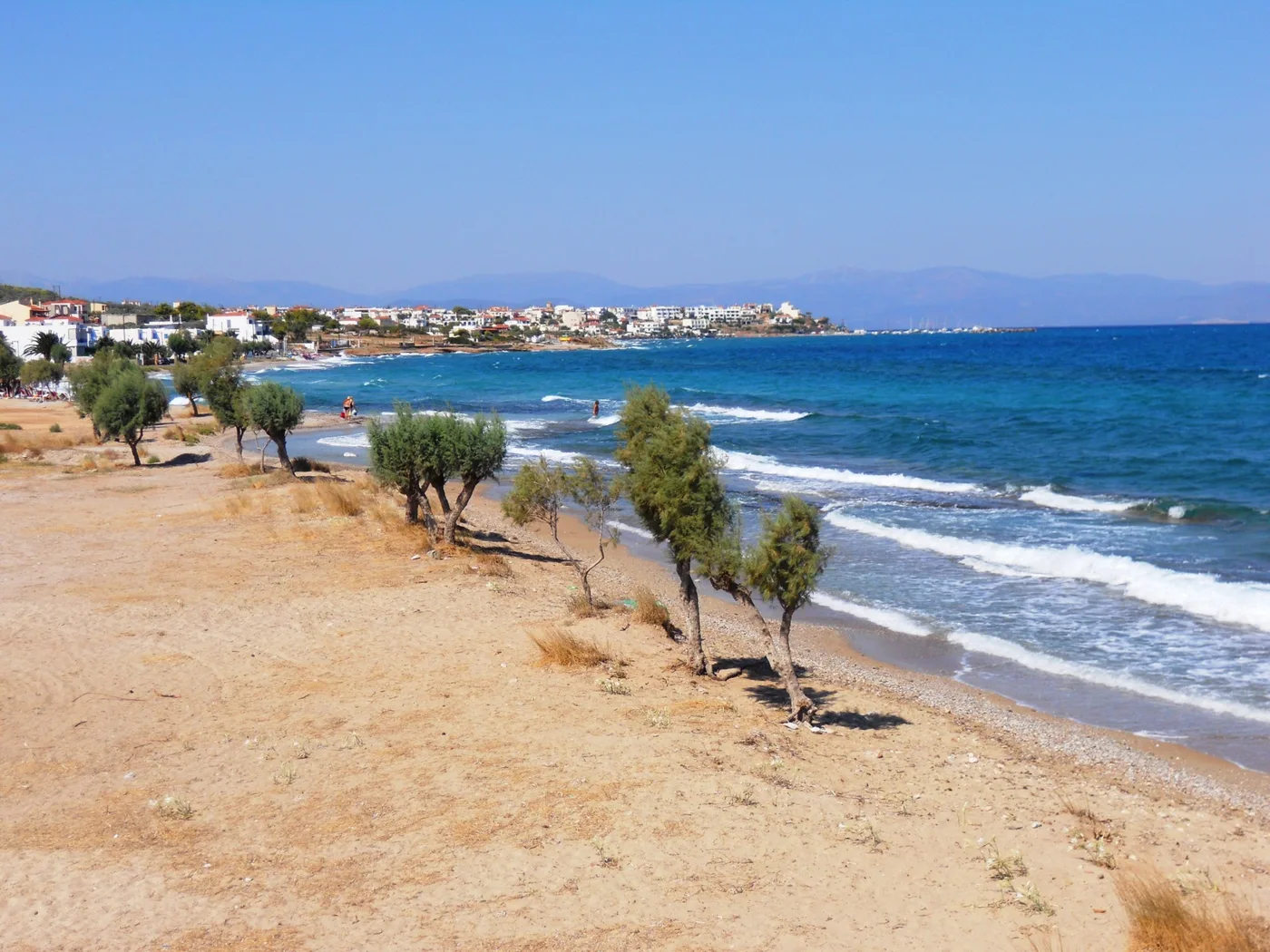
The beach next to the port.
Photos: Lichinga (CC BY-SA 4.0) · Wikimedia Commons
🕰️ Poros: the clock tower and the strait
Poros is actually two islands joined together: little Sferia, with the town built like an amphitheatre around a hill, and the larger, pine-covered Kalavria. At the top of the town stands the clock tower, the symbol of the island. Opposite, just a few hundred metres away, is Galatas in the Peloponnese, with little boats going back and forth all the time.
On Kalavria you will find small beaches with pine trees, such as Askeli, the Zoodochos Pigi monastery in the forest, and the ruins of the Temple of Poseidon, where, according to tradition, the orator Demosthenes died. Poros is quiet, green and good for families.
🗺️ Poros
Poros town is on little Sferia, opposite Galatas. The larger part of the island, Kalavria, is covered in pines. The dashed line shows the small boat to Galatas.
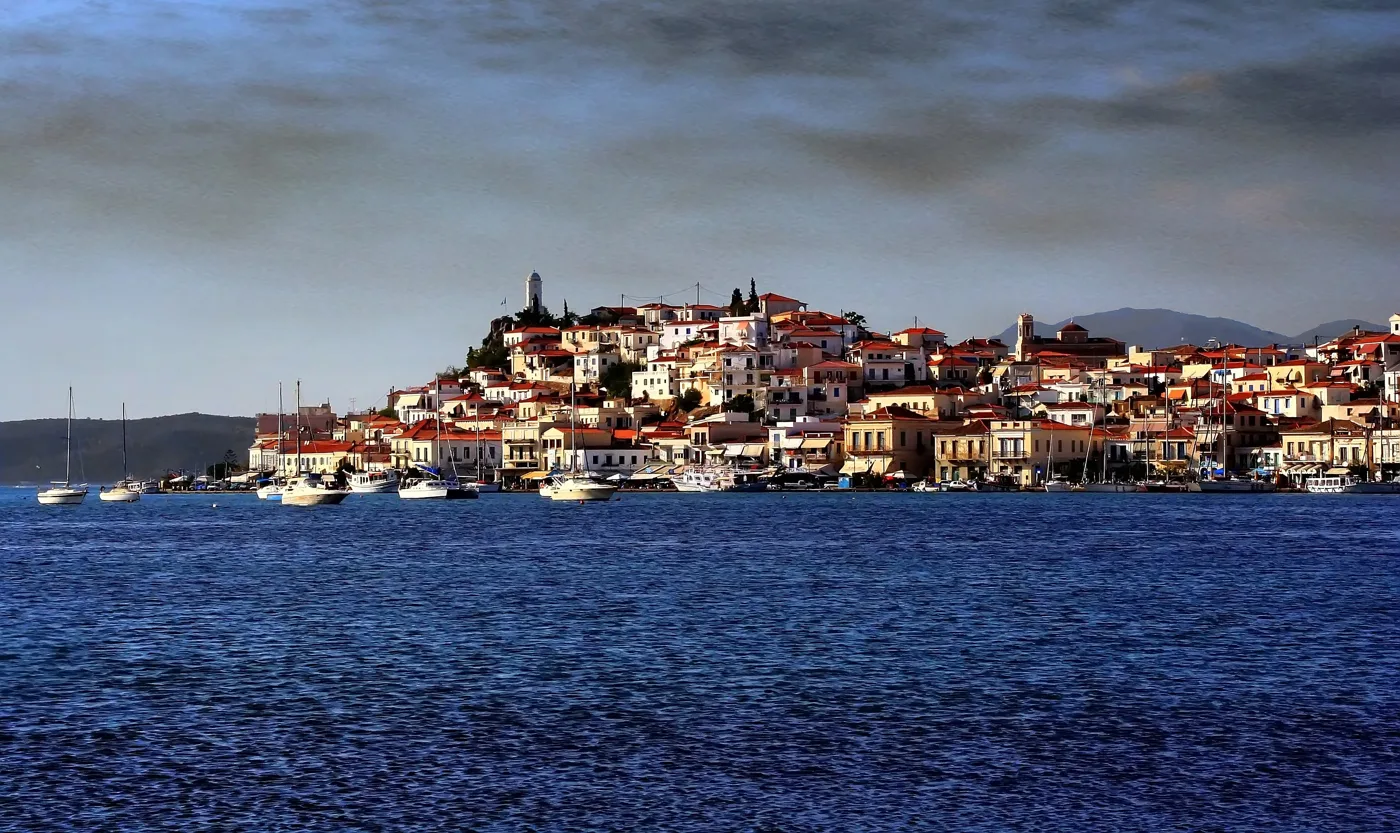
The town on the hill of Sferia.
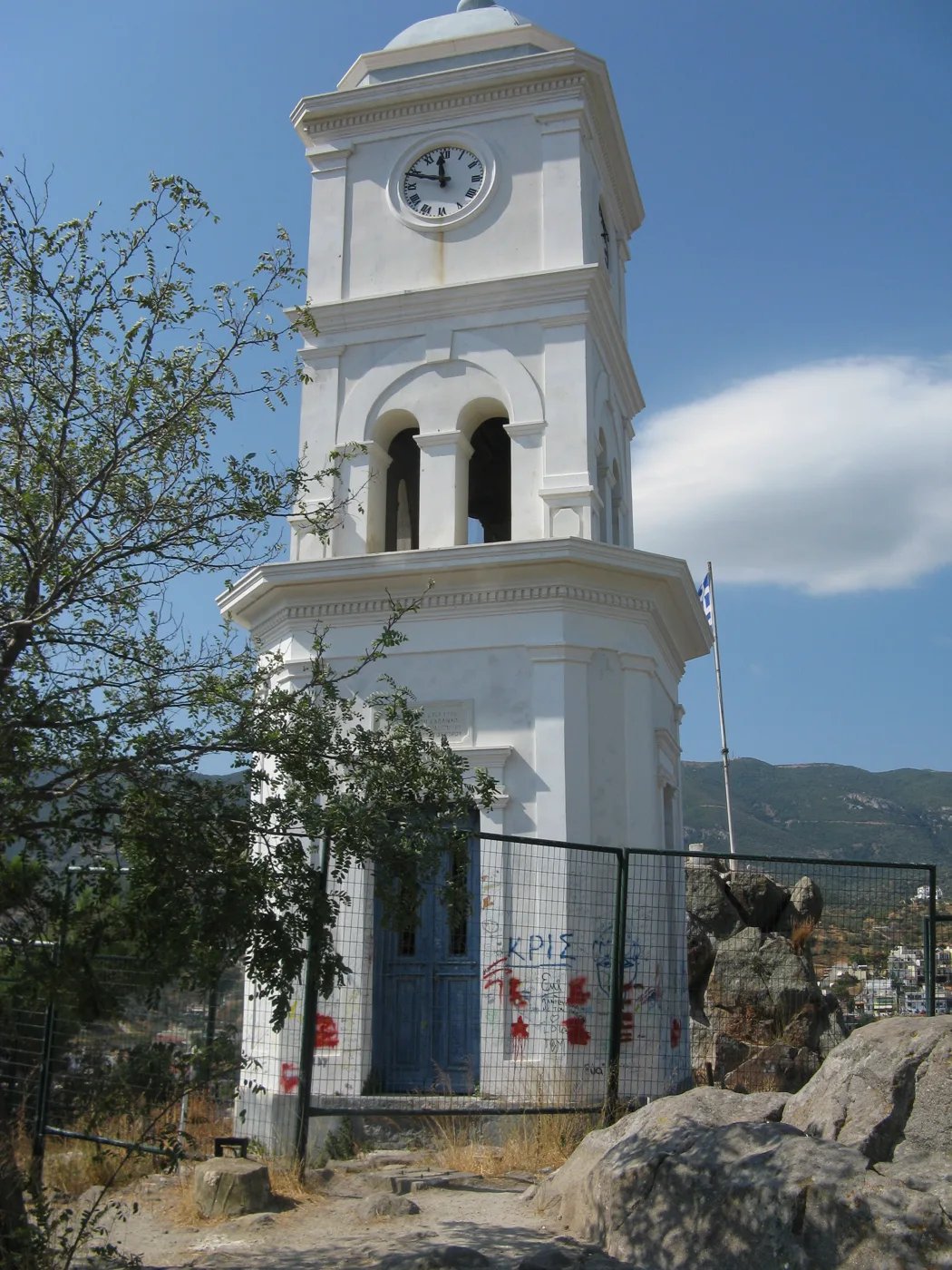
The symbol of the island.
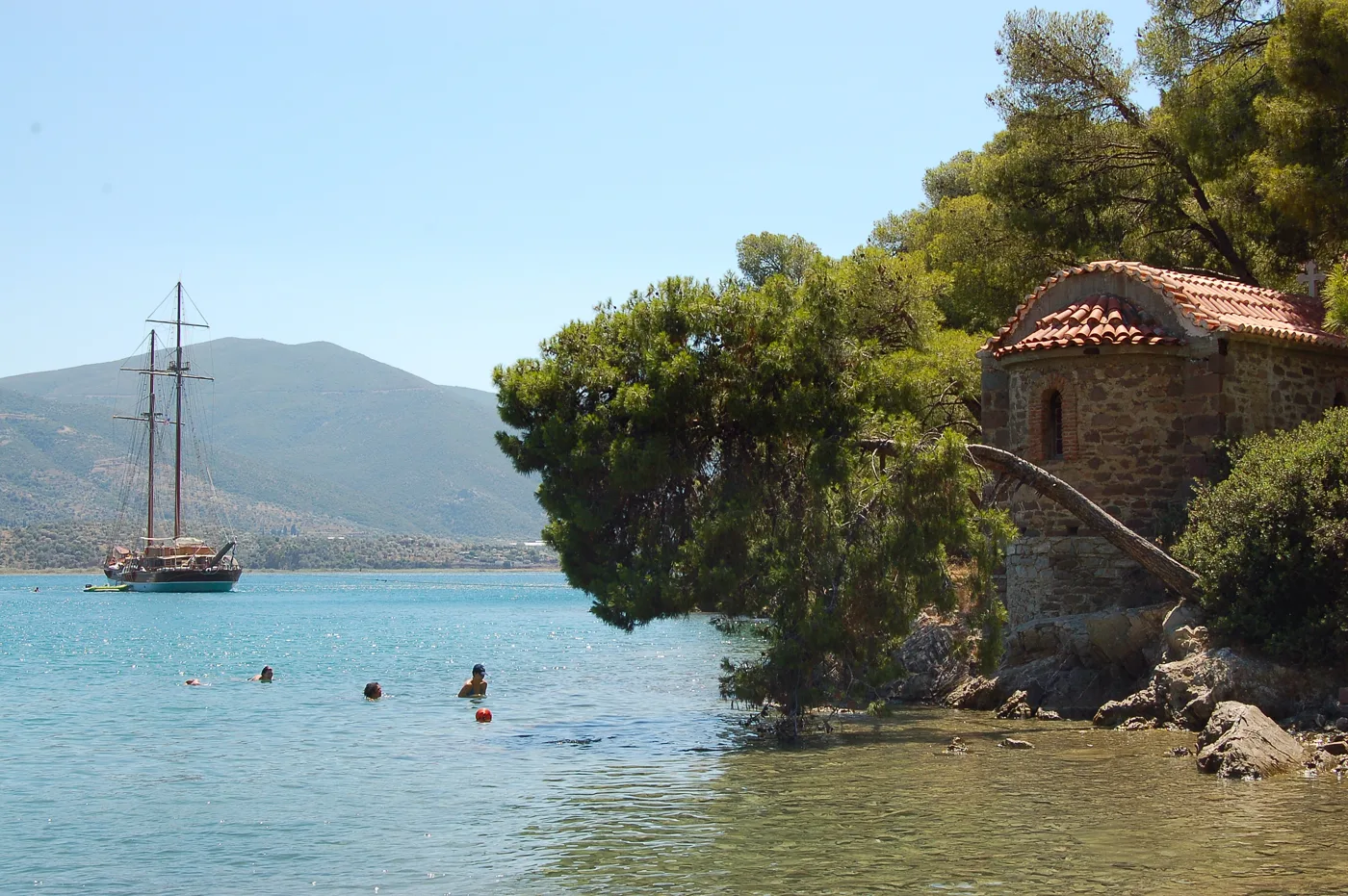
Pines down to the sea.
Photos: Vlahos Vaggelis (CC BY 3.0), Юкатан (CC BY-SA 3.0), Michael Paraskevas (CC BY-SA 3.0) · Wikimedia Commons
🫏 Hydra: the island without cars
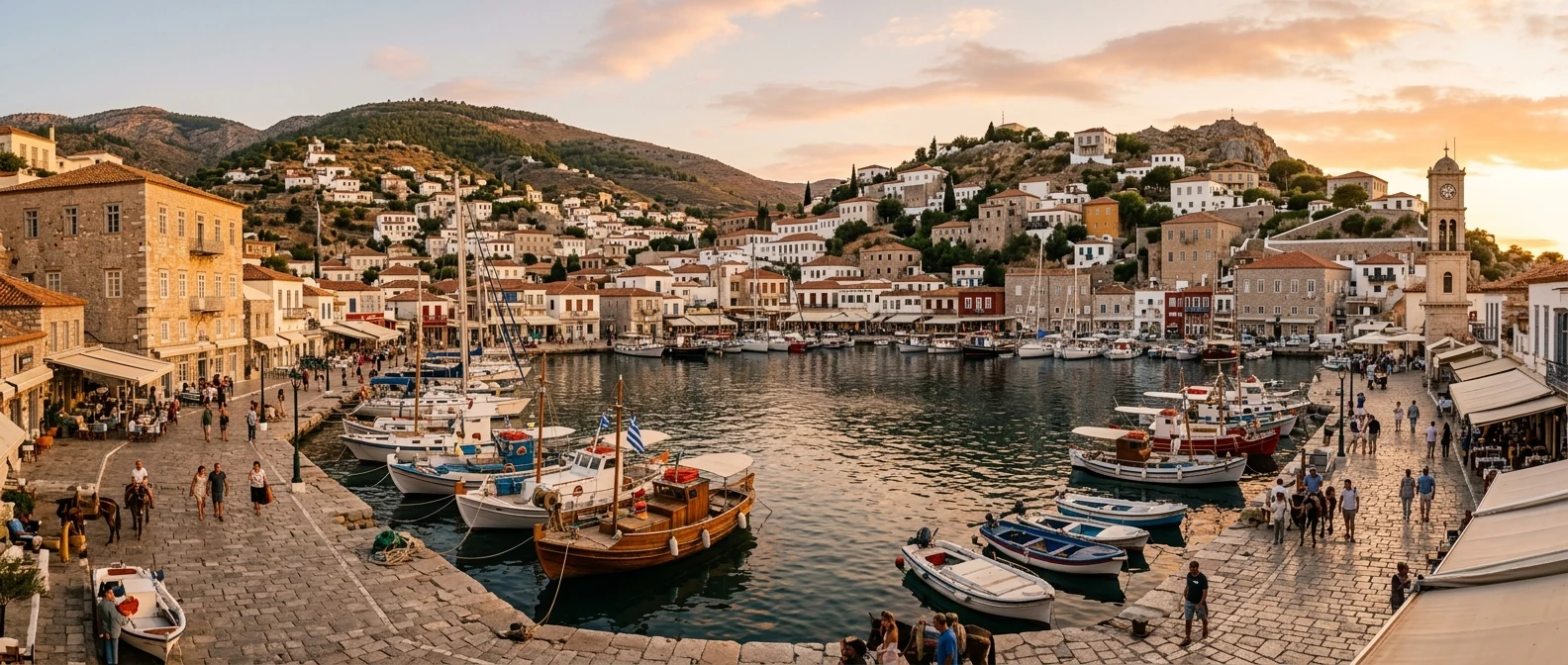
Hydra is the most photogenic island of the Saronic Gulf. Its town of stone sea captains’ mansions climbs like an amphitheatre from the harbour to the bare mountains. There are no cars on the island: you get around on foot, by donkey or by water taxi. This gives Hydra a calm and an atmosphere you won’t find anywhere else so close to Athens.
Walk the cobbled lanes, visit one of the mansion museums, such as that of Lazaros Kountouriotis, and follow the coastal path west to the fishing village of Kamini and to Vlychos, or east to Mandraki. Most “beaches” are rocks with steps into the sea. Artists and writers have lived on Hydra, among them Leonard Cohen in the 1960s.
🗺️ Hydra
Hydra is long and mountainous, with all life centred on the harbour on the north coast. The red dashed line shows the coastal path you can walk from Mandraki to Kamini and Vlychos.
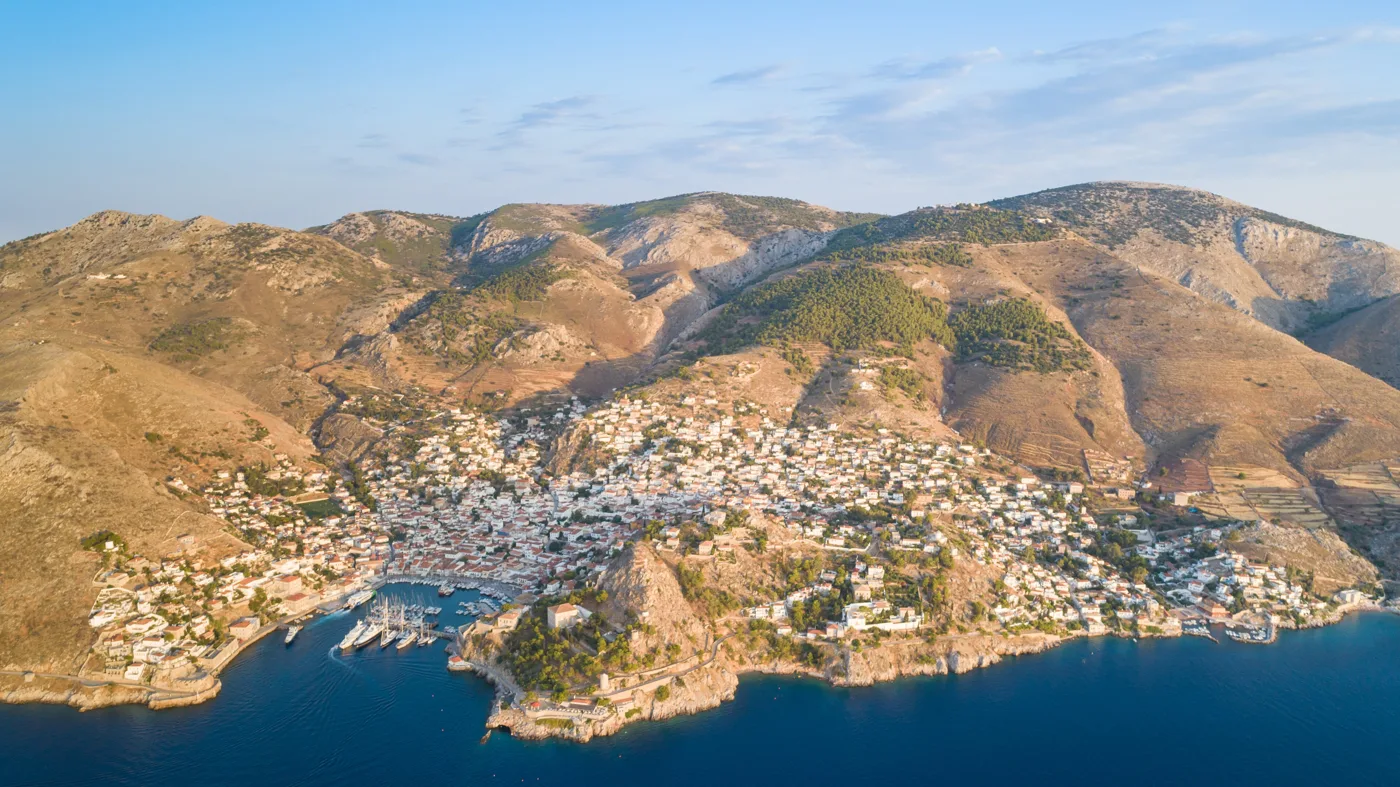
A stone town like an amphitheatre.
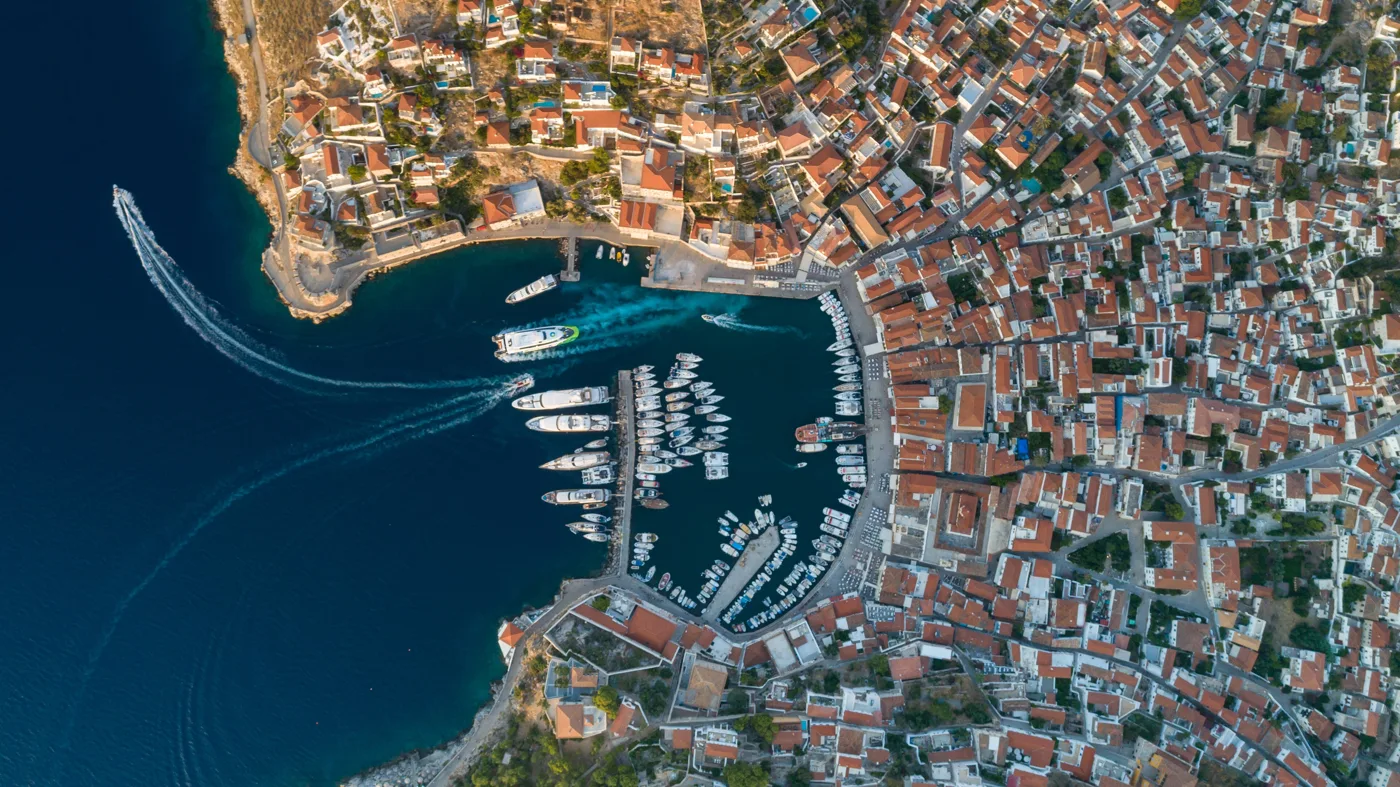
The heart of the island.
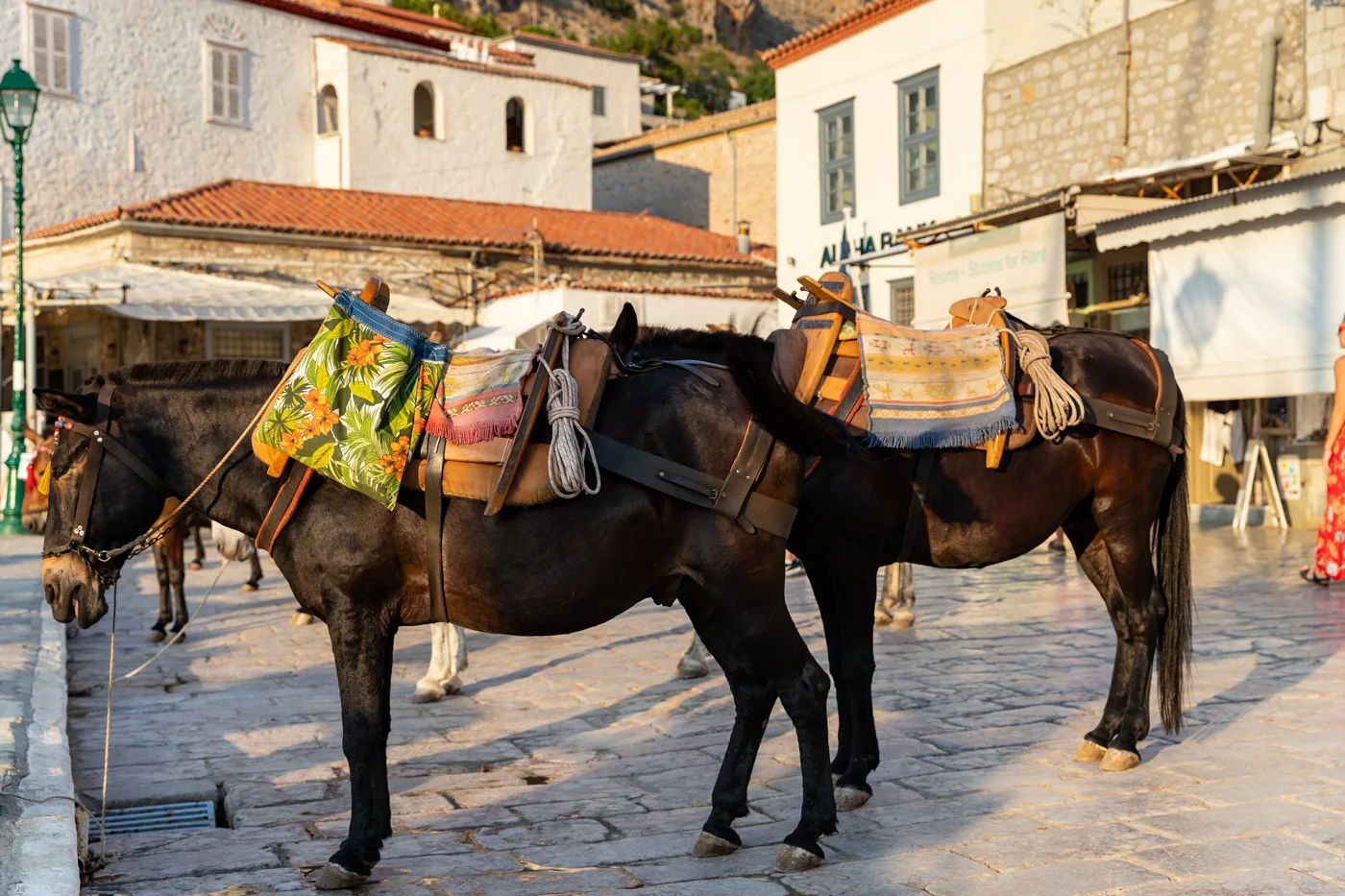
No cars here.
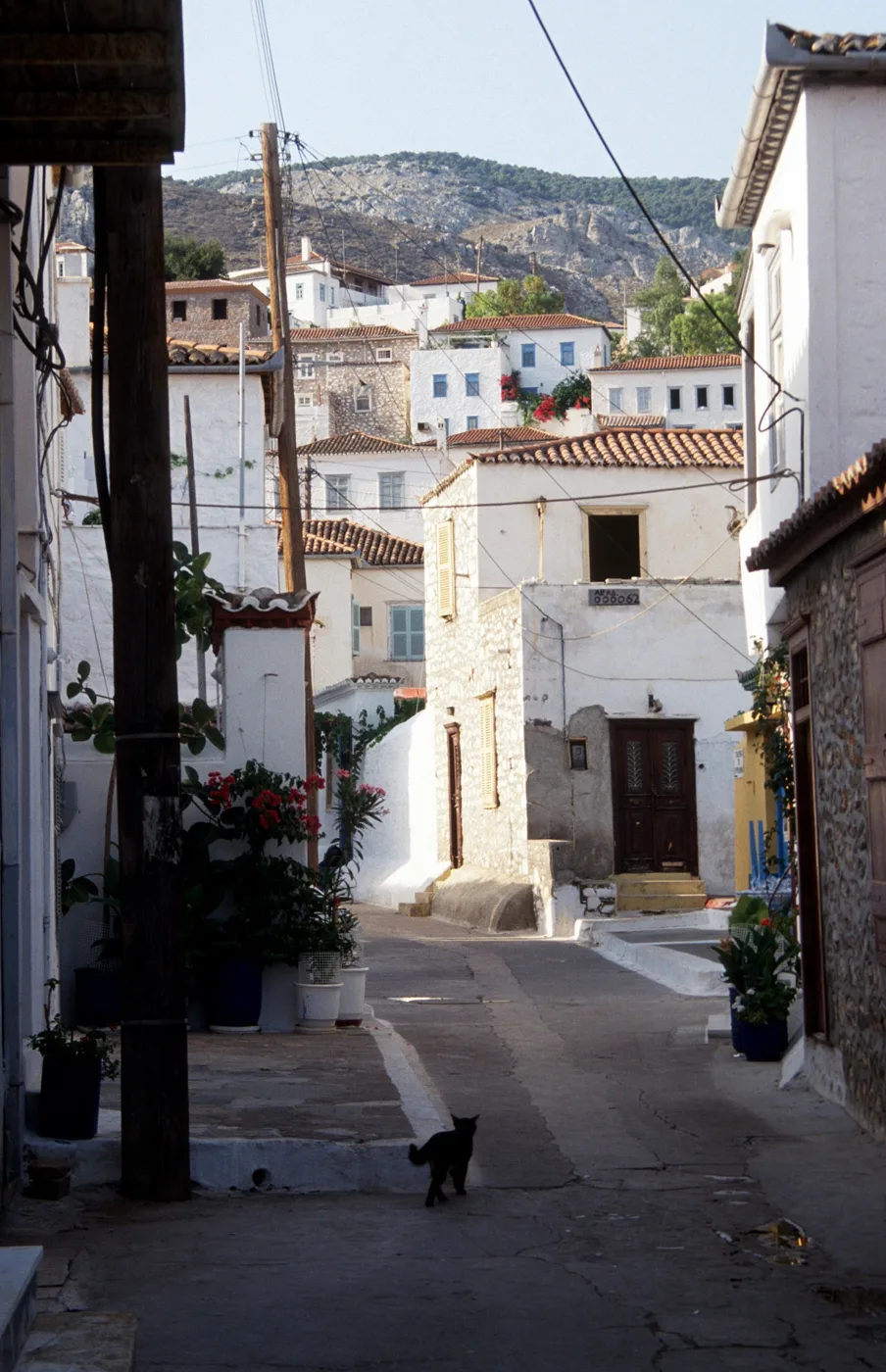
Steps and slopes, on foot only.
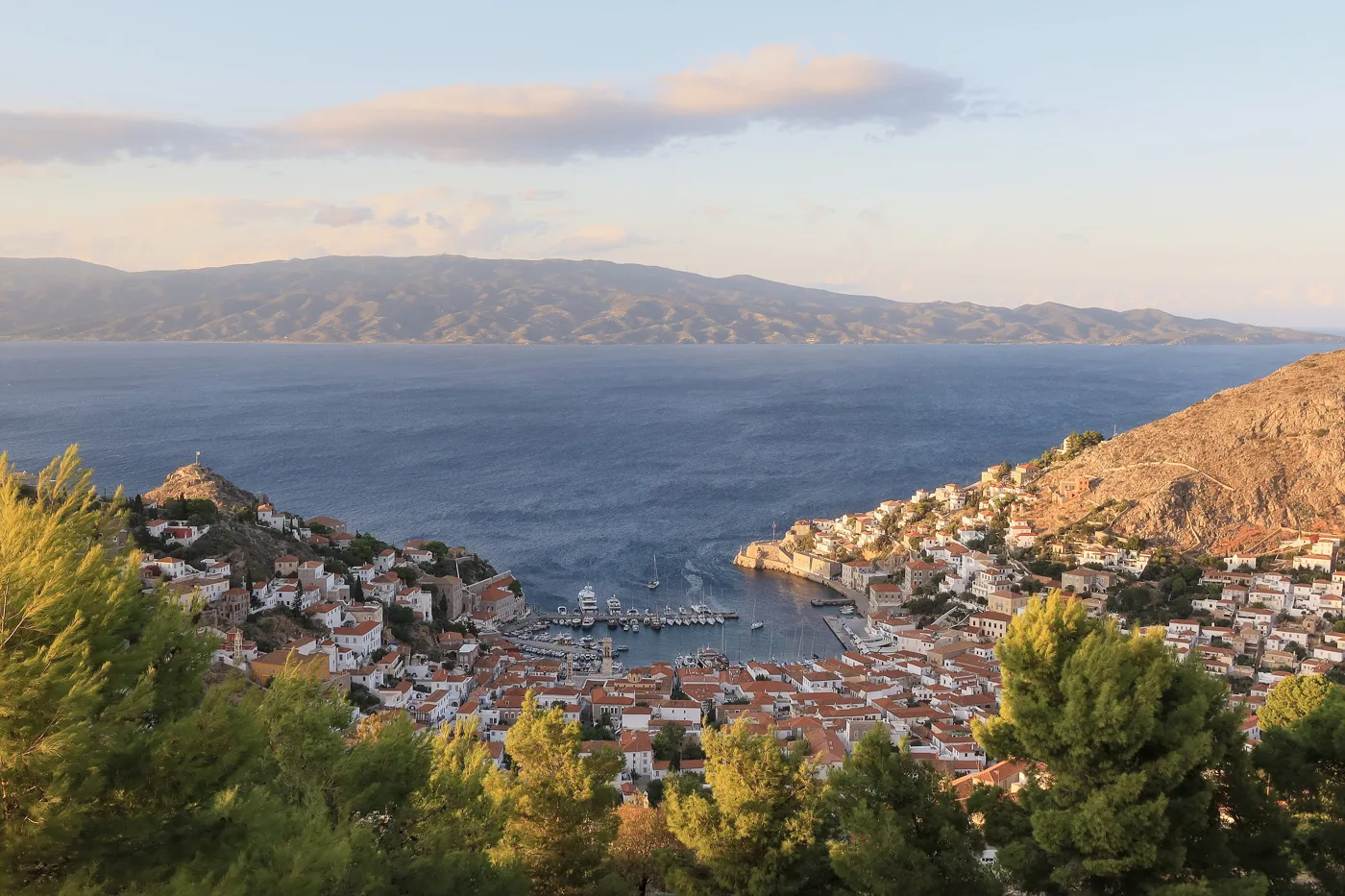
The view from the path.
Photos: dronepicr (CC BY 2.0), Herbert Ortner (CC BY 3.0), Julien Seguinot (CC BY-SA 2.0) · Wikimedia Commons
The town is full of steps and shiny cobblestones. Wear shoes with a good grip and leave the heels at home. If you have a suitcase, you will find porters with donkeys at the harbour.
⚓ Spetses: mansions and Bouboulina
Spetses is the furthest of the Saronic Islands, and the most aristocratic. The town stretches along the coast from the Dapia, the old fortified quay with its cannons, to the Old Harbour, with its boats and the boatyards where wooden caiques are still built. Cars are few: most people get around by scooter and bicycle.
Don’t miss Bouboulina’s mansion, which is now a museum. Every September, at the Armata, the island celebrates the naval battle of 1822 with a re-enactment and the burning of a replica Ottoman flagship at sea. A road circles the island, with pine forests and coves such as Zogeria, Agia Paraskevi and Agioi Anargyroi.
🗺️ Spetses
The town stretches along the north-east coast, from the Dapia to the Old Harbour. A road circles the island and leads down to the pine-fringed coves.
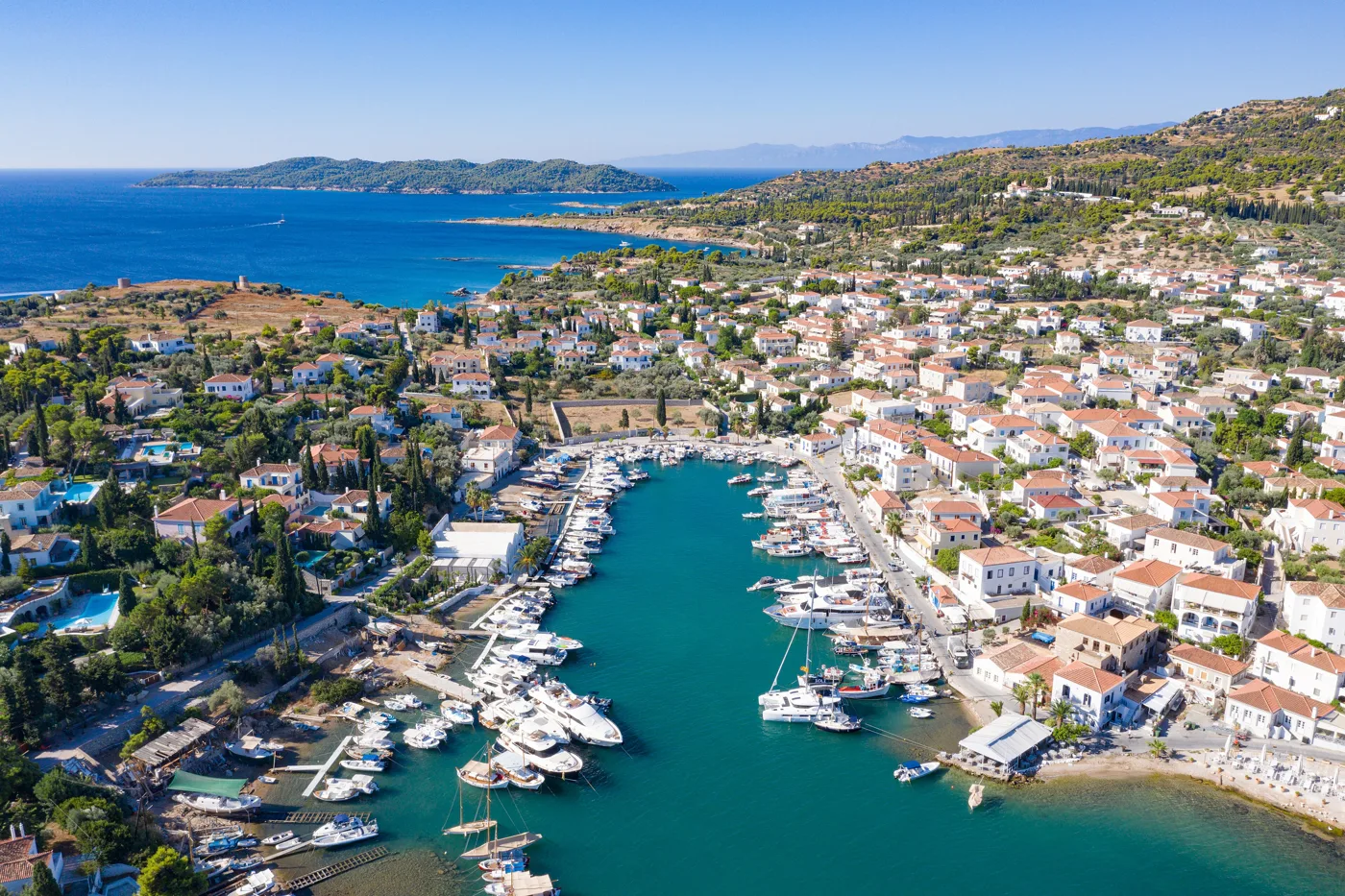
Boats and boatyards.
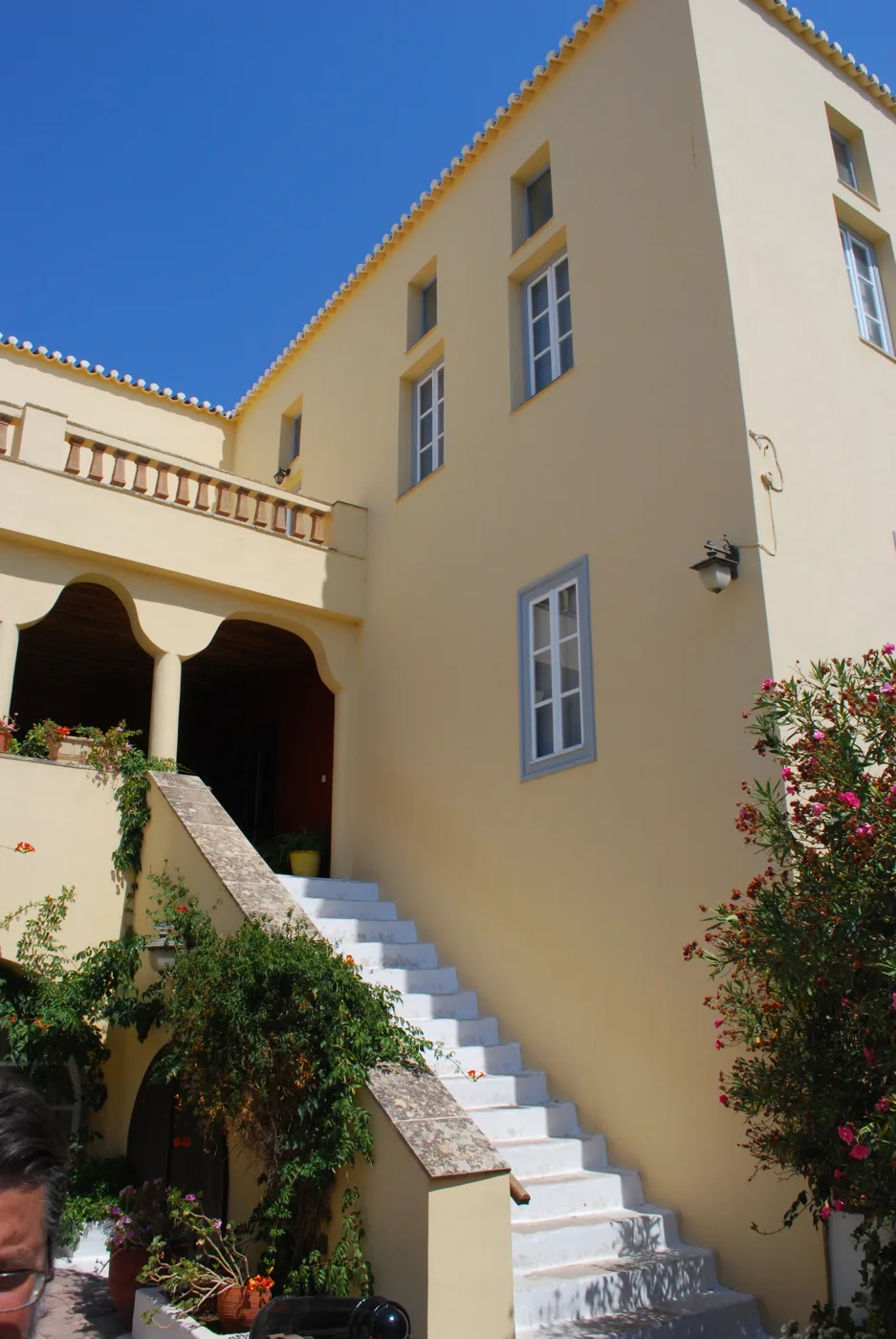
Now a museum.
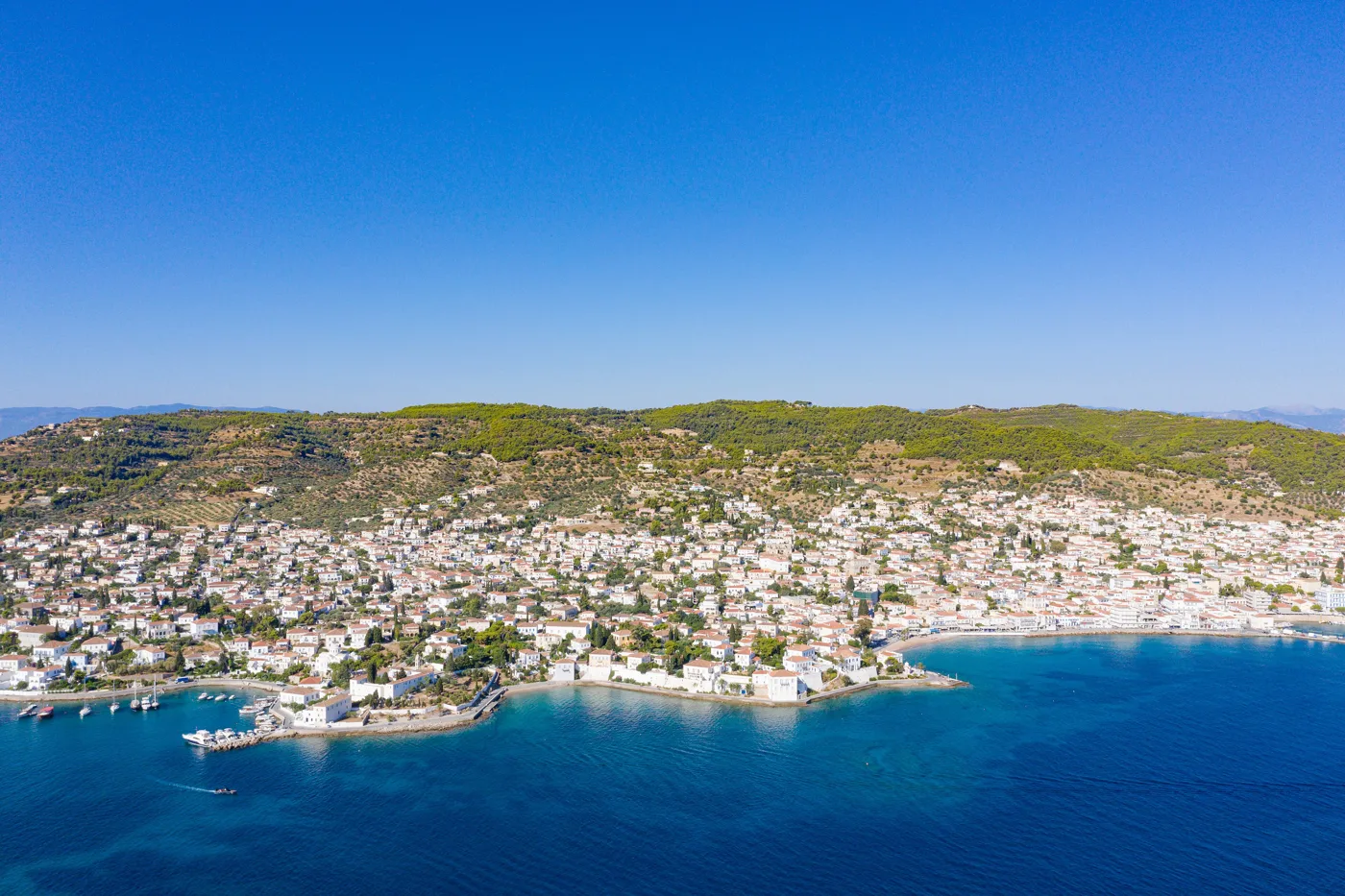
The town and the pines.
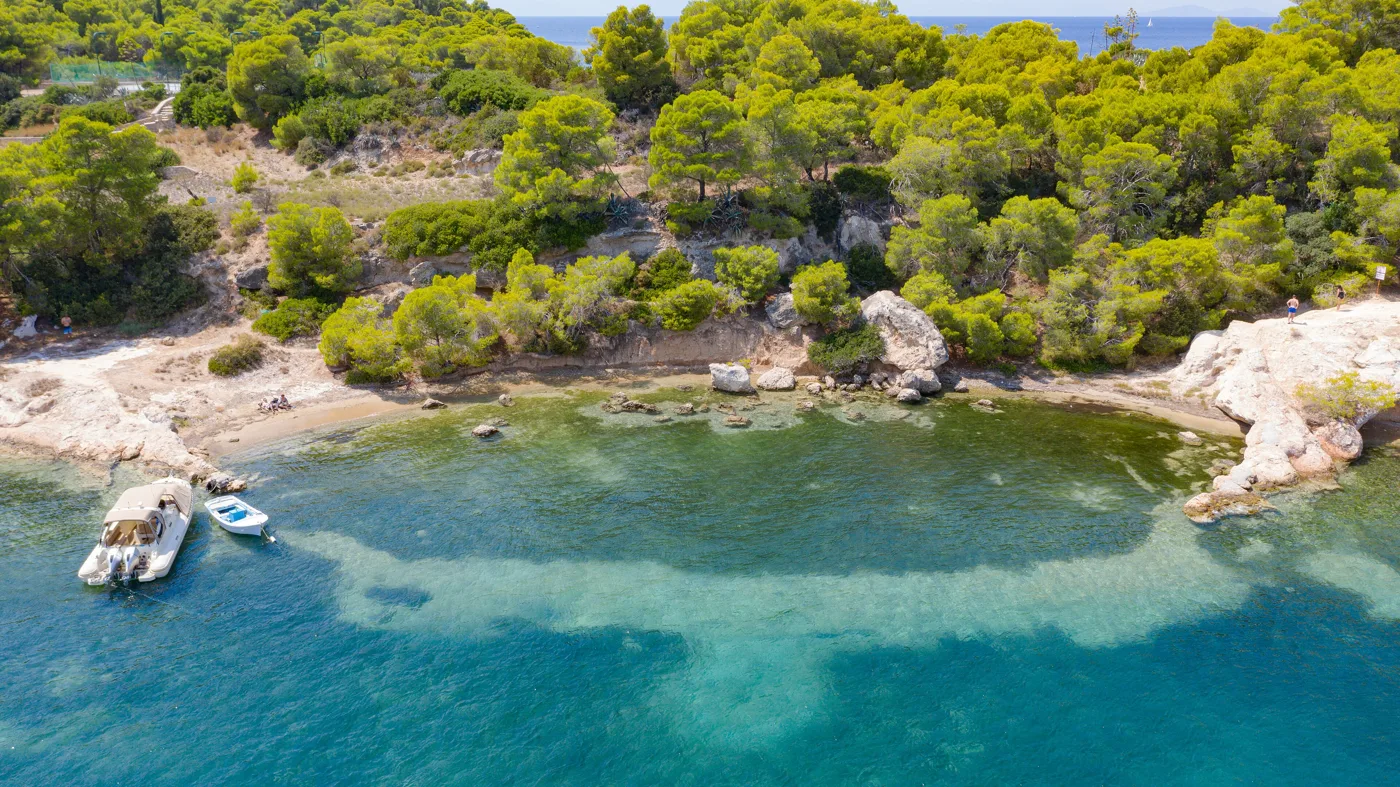
A cove with pines in the west.
Photos: dronepicr (CC BY 2.0), Jean Housen (CC BY 3.0) · Wikimedia Commons
🍽️ What to eat
- Aegina: pistachios in every form, fresh fish and octopus in Perdika and at the little harbour in town.
- Hydra: amygdalota, sweets made from almonds and orange blossom water.
- Spetses: fish “a la Spetsiota”, baked with tomato, garlic and breadcrumbs.
- Poros and Agistri: fish tavernas by the water and meze with a view of the pines.
Fast ferries fill up on Fridays, Saturday mornings and Sunday afternoons, so book tickets in advance. In strong winds, especially in August with the meltemi, fast ferries may be cancelled: conventional ferries to Aegina and Poros usually still sail.
📅 When to go
The Saronic Islands are alive all year round, and ferries run every day. May, June, September and October are ideal. In July and August it is hot and weekends get crowded. In winter a day trip to Aegina or Hydra is quiet and very beautiful, but many shops are closed and there are fewer ferries.
⛴️ How to get there from Ioulianou 50
All ferries to the Saronic Islands leave from Piraeus. From Ioulianou 50, take Line 1 from Victoria to the end of the line, no change. The quays for the Saronic Islands are close to the station. There are fast ferries, quicker and more expensive, and conventional ferries to Aegina, Agistri and Poros, slower, cheaper and with a deck where you can sit outside. For all the ports and ferries, see our guide to ferries from Piraeus.
🗓️ Four ideas for one or two days
Aegina
Morning fast ferry, taxi or bus to the Temple of Aphaia, a stop at Agios Nektarios, lunch and a swim in Perdika, and back in the afternoon.
Hydra
A stroll around the harbour and the lanes, the path to Kamini and Vlychos, a swim off the rocks and the sunset before the last fast ferry.
Aegina and Agistri
One night on Aegina and one on Agistri: ancient sites, pistachios and fish tavernas, then pines and clear water at Aponisos and Dragonera.
Poros or Spetses
On Poros, the town, the clock tower and pine-fringed beaches, with a trip across to Galatas. On Spetses, the Bouboulina museum, the Old Harbour and a scooter ride around the island.
Frequently asked questions
Which island is best for a day trip?
Aegina, because it is the closest and has the most ferries. If you want something more special and don’t mind two hours on a fast ferry, Hydra.
Can I see two islands in one day?
Yes, Aegina and Agistri, which are linked by a small boat. There are also organised cruises that stop at Aegina, Poros and Hydra on the same day, but the time on each island is short.
Do I need a car?
No. Cars are banned on Hydra, and the other islands have buses, taxis, bicycles and scooters. To Aegina and Poros you can also take your own car on the conventional ferry.
Are the beaches nice?
They are good, with pines and clean water, especially on Agistri, Poros and Spetses. But you won’t find the long sandy beaches of the Cyclades.
— Kathy