
🪪 The island at a glance
📍 Where it is
Mykonos lies in the centre of the Cyclades, in the South Aegean. Tinos is to the northwest, Syros to the west, Naxos and Paros to the south. The municipality of Mykonos also includes Delos and Rhenia, two uninhabited islands just to the southwest. Delos is about 2 kilometres off the coast of Mykonos.
📍 Where Mykonos is
Mykonos lies in the centre of the Cyclades, east of Tinos and north of Naxos and Paros. In red you can see the shape of the island, together with Delos and Rhenia to its southwest. Ferries leave from Piraeus and Rafina.
🗺️ The map of the island
Mykonos is small: about 85 square kilometres of low granite hills, dry-stone walls and very few trees. The coast is cut by deep bays. On the west side is Chora, the main town, and a little further north the new port at Tourlos. In the middle of the island is the only large inland village, Ano Mera. The south coast is sheltered from the north wind, which is why the best-known beaches are there. The north coast takes the full force of the meltemi and is wilder, with fewer houses.
🗺️ The map of Mykonos
Chora is on the west coast, with the new port and the airport a few kilometres away. The busy beaches are on the south coast, the wilder ones on the north. Delos is shown in purple. Tap each number to see what it is.
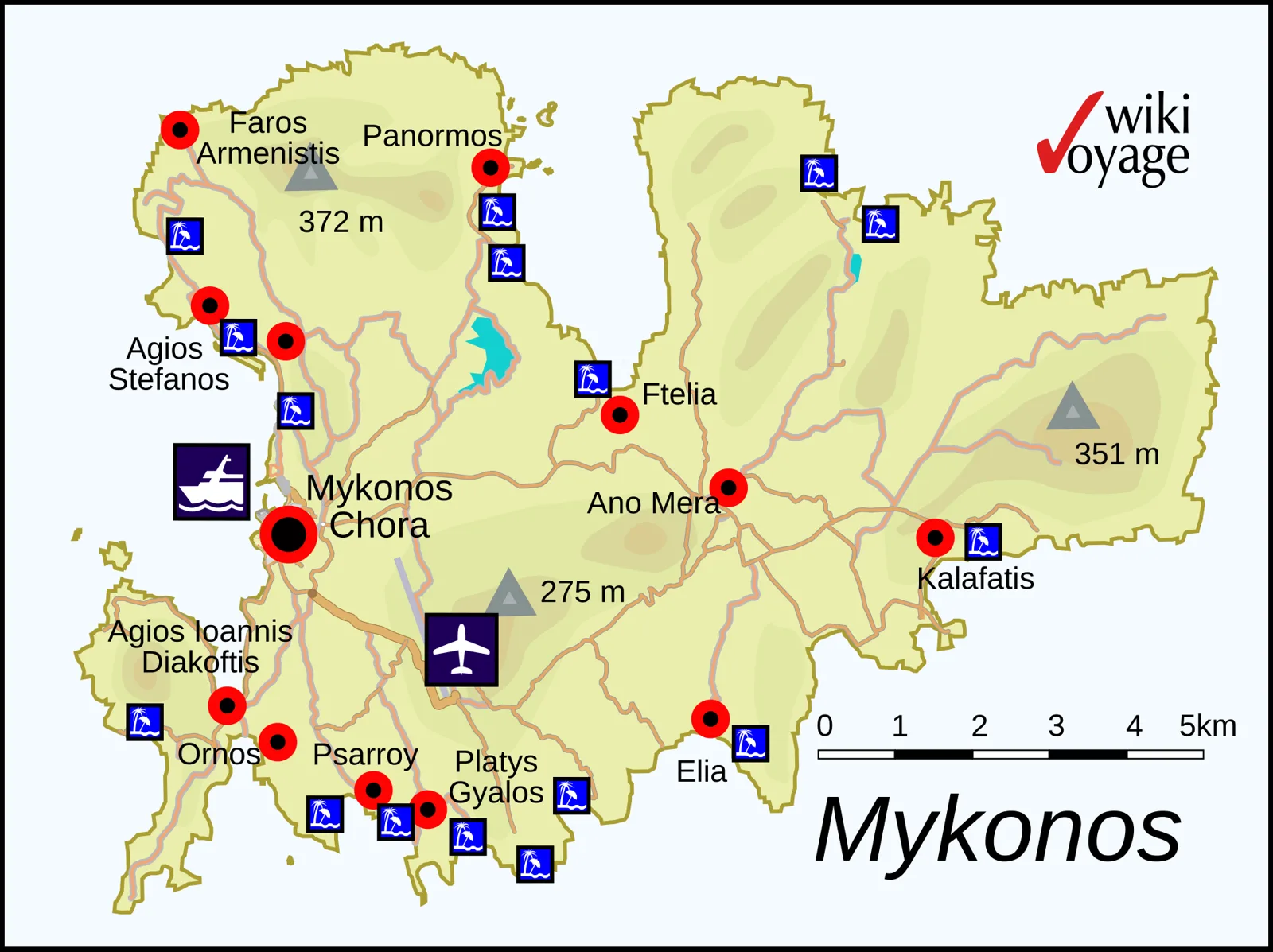
Map: Bgabel / Wikivoyage (CC BY-SA 3.0) · Wikimedia Commons
⚖️ Is it worth it? The pros and cons
Mykonos is not for everyone, and the cost is the first thing you need to know. Here is an honest picture.
📊 At a glance, from 1 to 5
👍 The pros
- Chora, with its alleys, Little Venice and the windmills.
- Delos, one of the most important archaeological islands in Greece, half an hour away by boat.
- Lots of beaches close together, with the southern ones sheltered from the north wind.
- The liveliest nightlife in the Cyclades.
- Easy to reach: flights all year round and ferries from Piraeus and Rafina.
👎 The cons
- One of the most expensive islands: rooms, sunbeds, food and taxis.
- Big crowds and cruise ships in July and August.
- Strong meltemi wind in summer, especially on the north coast.
- Few taxis, traffic on the roads and difficult parking.
- A dry landscape with a lot of building, few trees and little shade.
📜 A little history
In antiquity Mykonos was a poor island, in the shadow of its neighbour Delos, the sacred island where, according to myth, Apollo and Artemis were born. In the Middle Ages it passed to the Venetians and later to the Ottomans. The islanders lived from the sea: sailors, merchants and, when needed, corsairs.
In the War of Independence of 1821, Manto Mavrogenous, a woman from Mykonos, gave her whole fortune to the cause. The island’s airport bears her name. Tourism began in the middle of the 20th century, with artists and travellers who came for Delos and stayed for Chora. Around the same time, in the late 1950s, a wounded pelican was found on the island. Petros became the island’s mascot. Today’s Petros is his successor.
🏘️ Chora
Chora is a maze of white alleys, little stairways and small squares. The narrow, winding lanes broke the wind and, as the islanders say, confused the pirates. You will get lost, and that is part of the walk. Cars cannot enter. Go early in the morning or late in the evening, when the alleys empty out.
At the edge of Chora, above the old port, stands Panagia Paraportiani: five churches built on top of and next to each other, four on the ground floor and the fifth above them. They were built in stages between the 16th and 17th centuries, and from outside they look like one brilliant white sculpture. Nearby in Chora you will find the Archaeological Museum, the Folklore Museum and the Aegean Maritime Museum, which keeps the old mechanism of the Armenistis lighthouse.
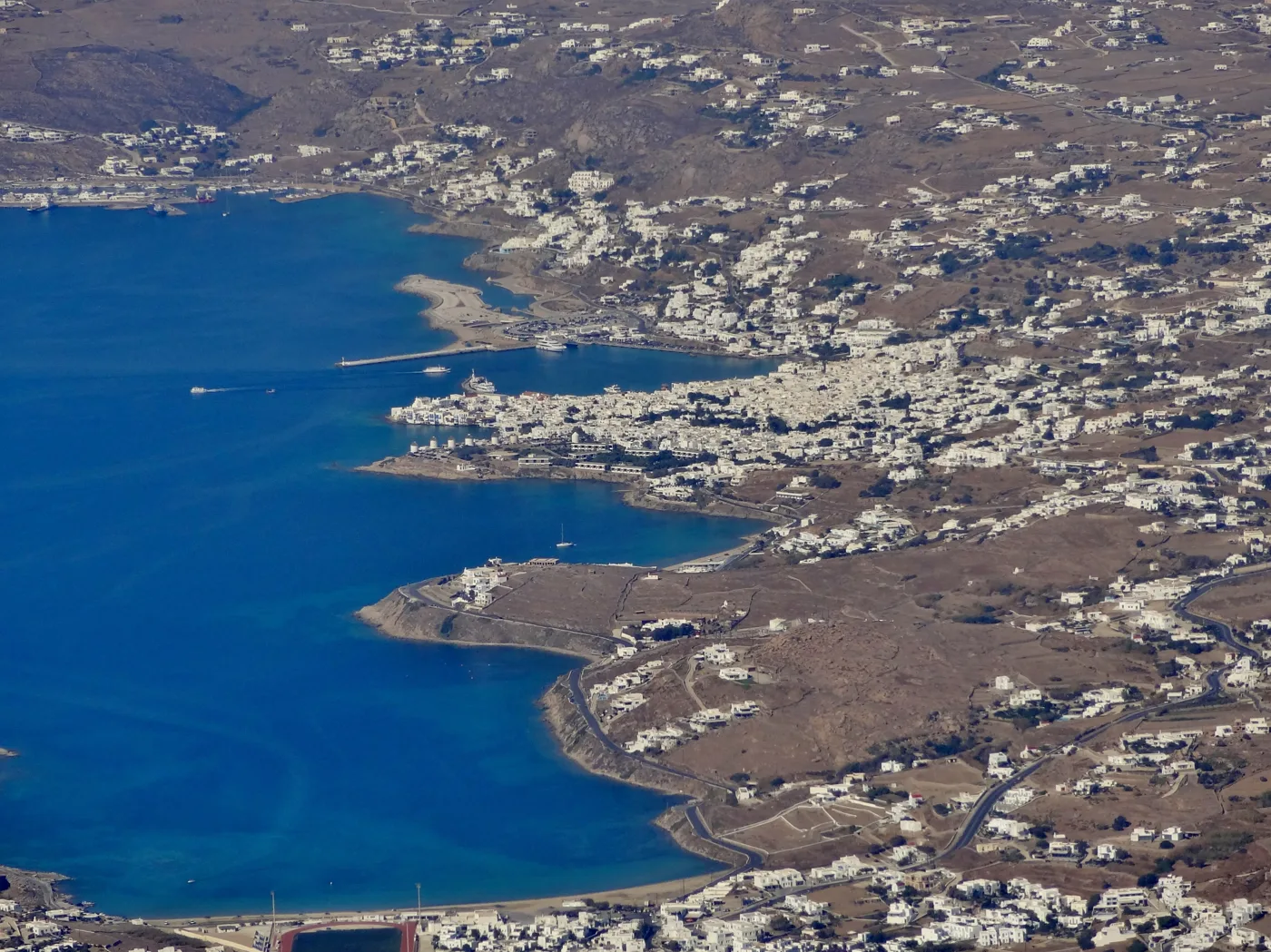
White houses around the old port.
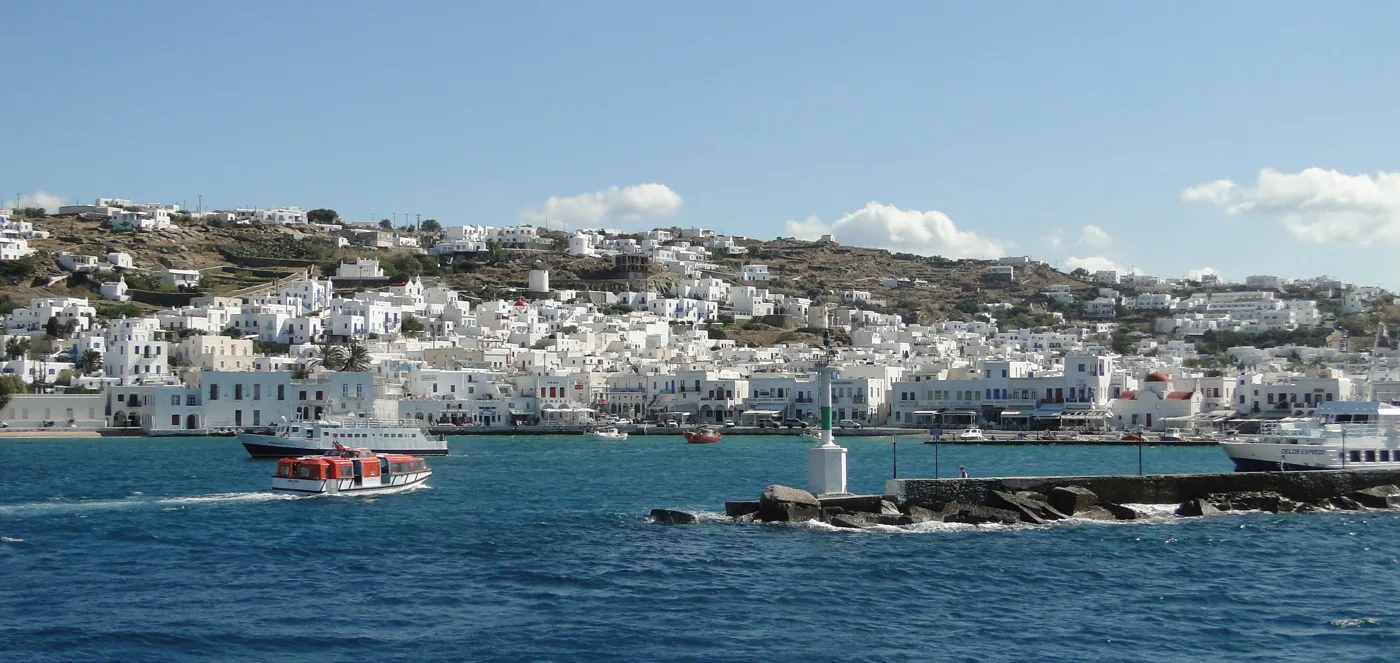
The boats to Delos leave from here.
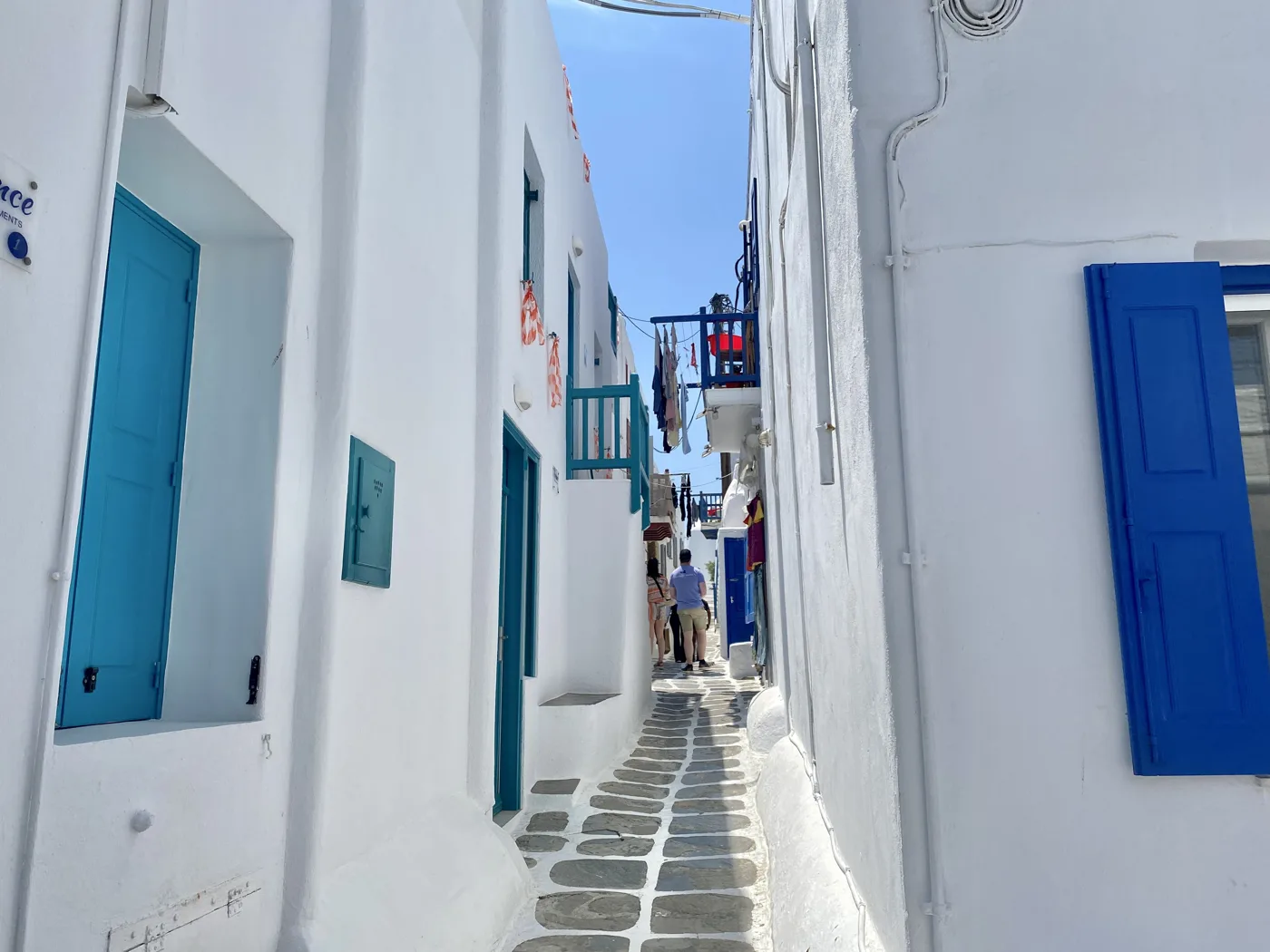
A maze that breaks the wind.
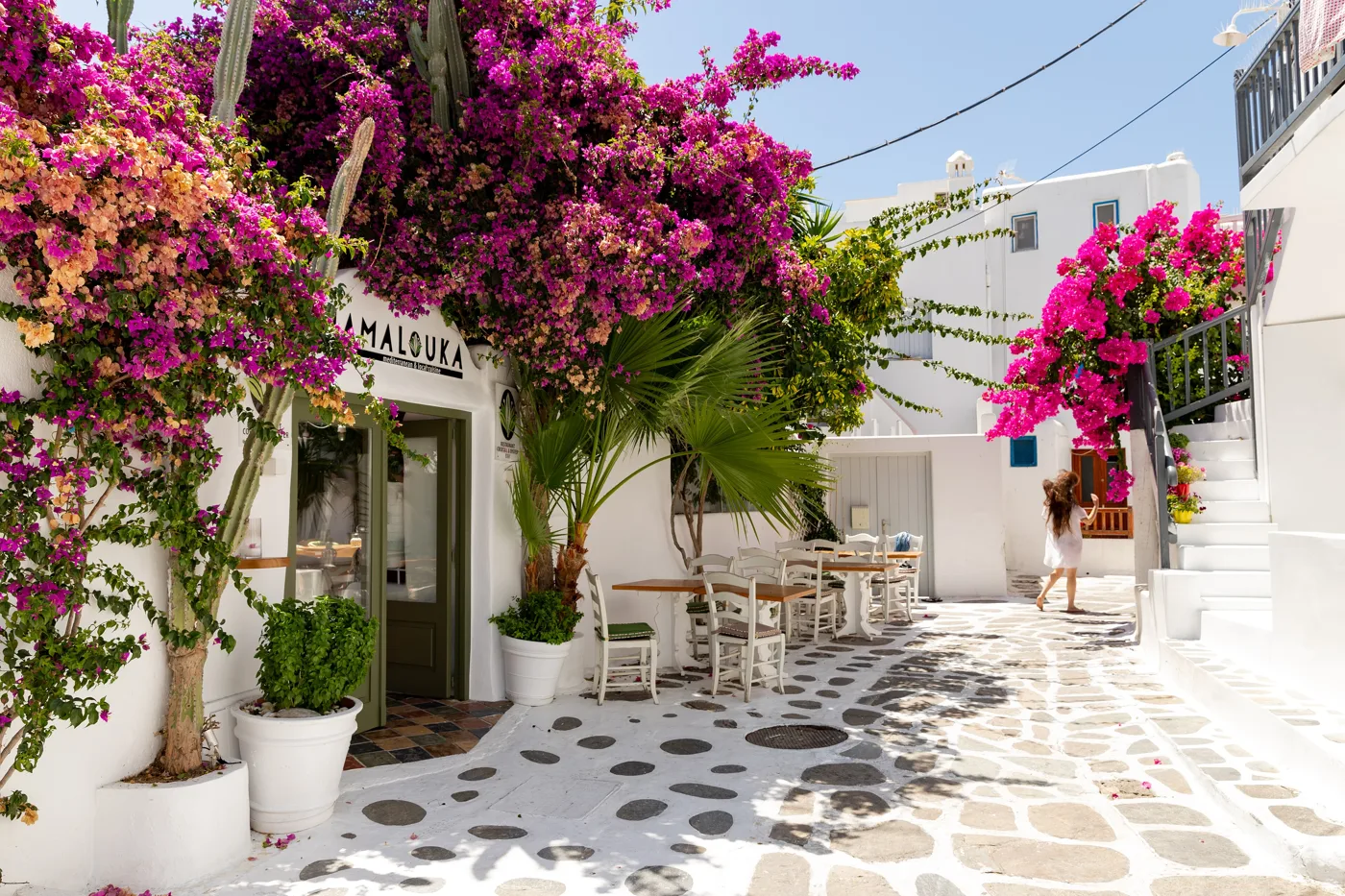
Flowers, little steps and whitewashed paving.
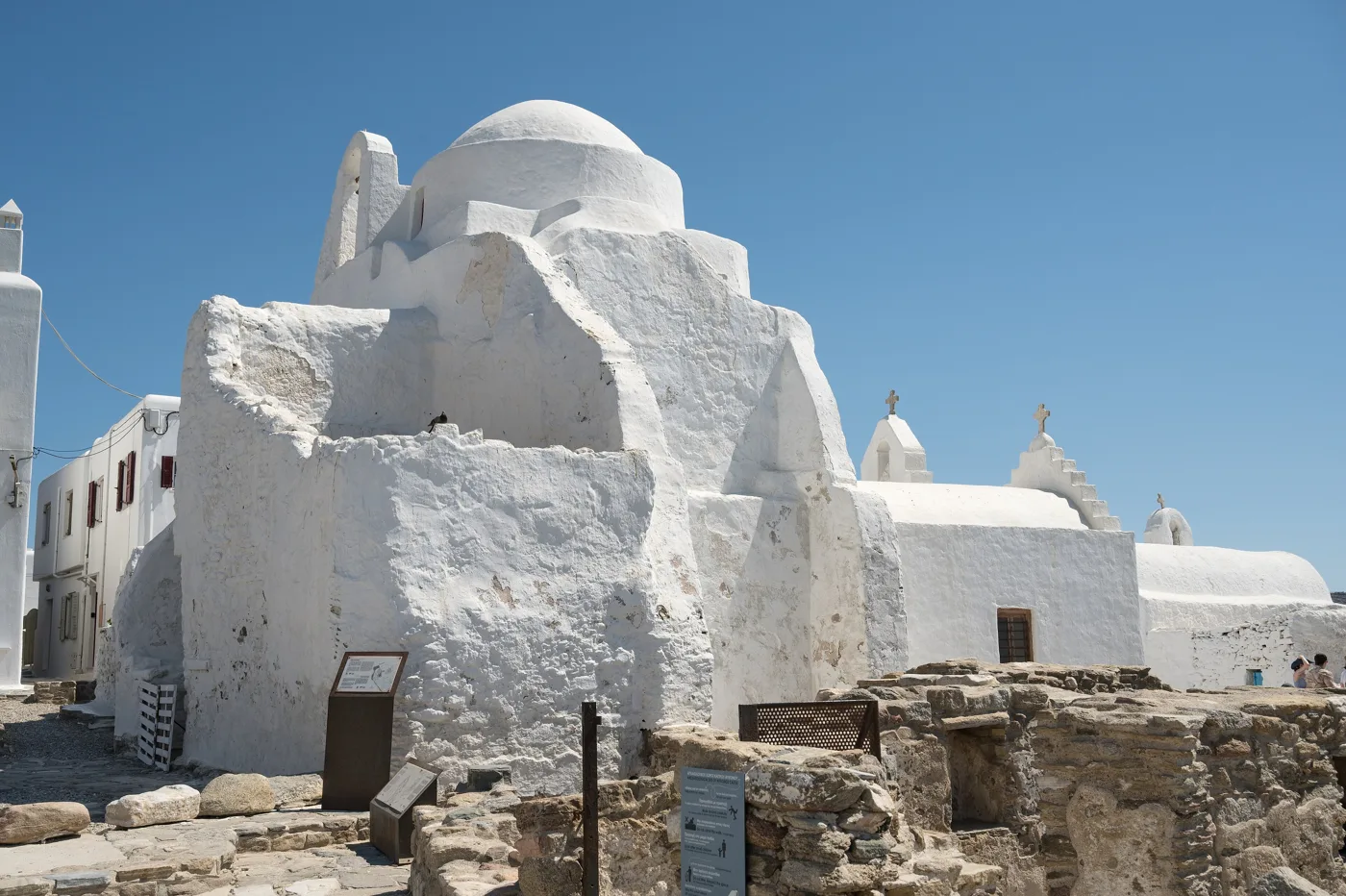
Five churches in one building.
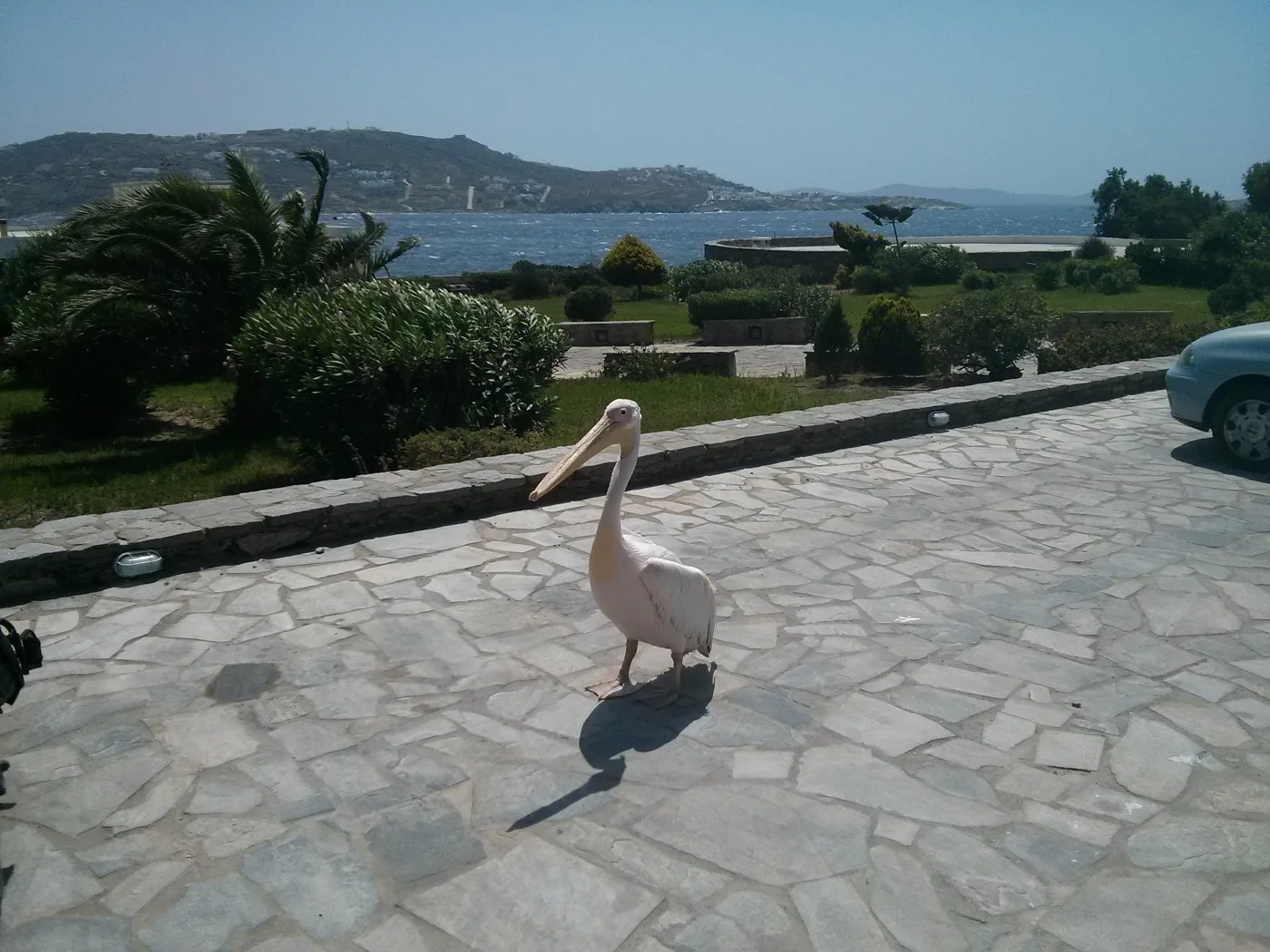
The pelican, the island’s mascot.
Photos: Olaf Tausch (CC BY 3.0), Bernard Gagnon (CC BY-SA 3.0), Warren LeMay (CC BY-SA 2.0), dronepicr (CC BY 2.0), Zde (CC BY-SA 4.0), Zigomitros Athanasios (CC BY-SA 4.0) · Wikimedia Commons
🌅 Little Venice and the windmills
Little Venice, the old Alefkandra quarter, is a row of houses built at the very edge of the sea, with wooden balconies hanging over the waves. Today the ground floors are bars and restaurants, and at sunset the place fills up. When the wind blows, the waves splash right up to the tables.
On the hill above Little Venice stand the Kato Mili, the windmills of Mykonos. They were built from the 16th century onwards, in Venetian times, to grind wheat. The flour was baked into rusks for passing ships. From the windmills you can watch the sun set over Little Venice.
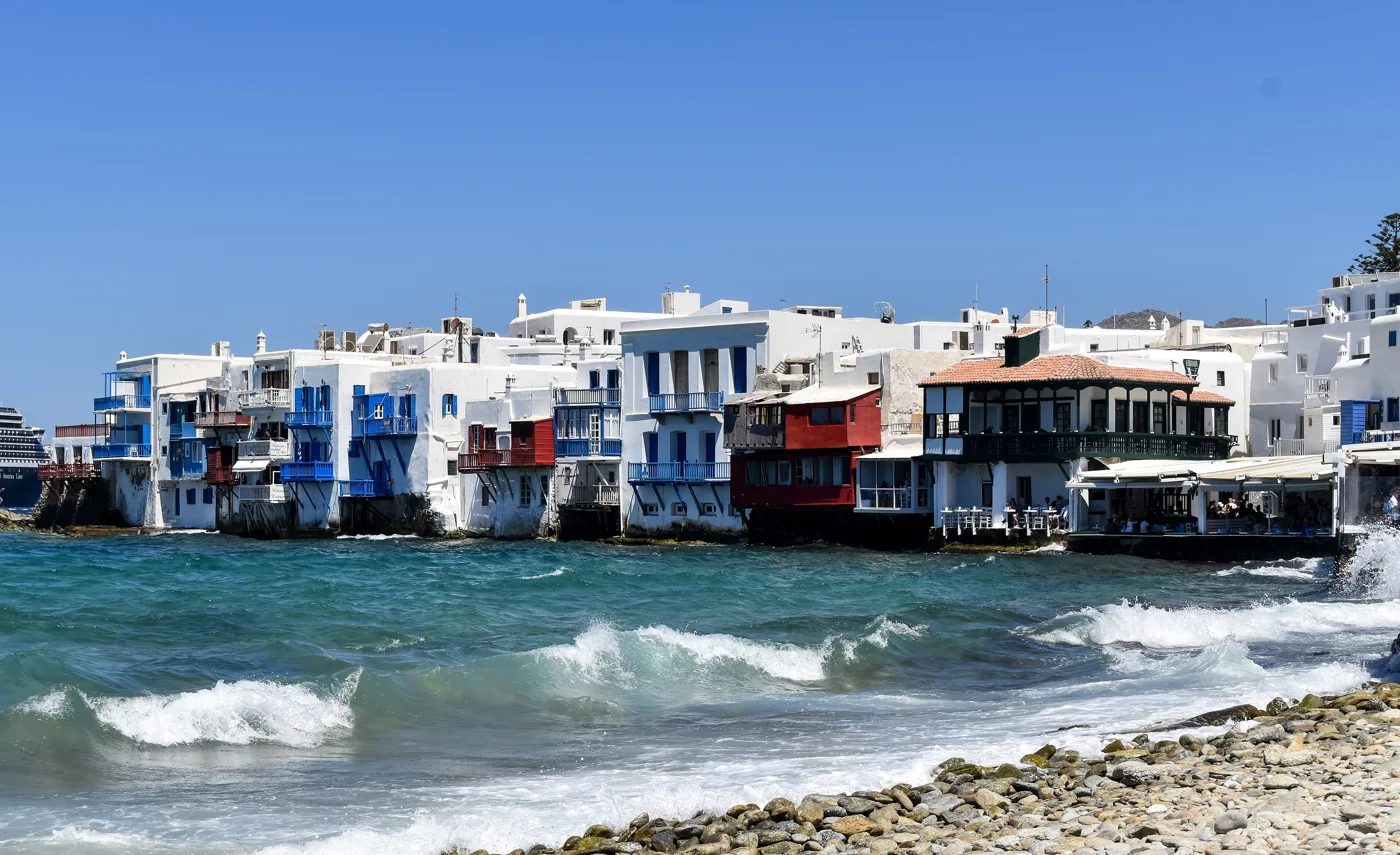
Houses built right on the waves.
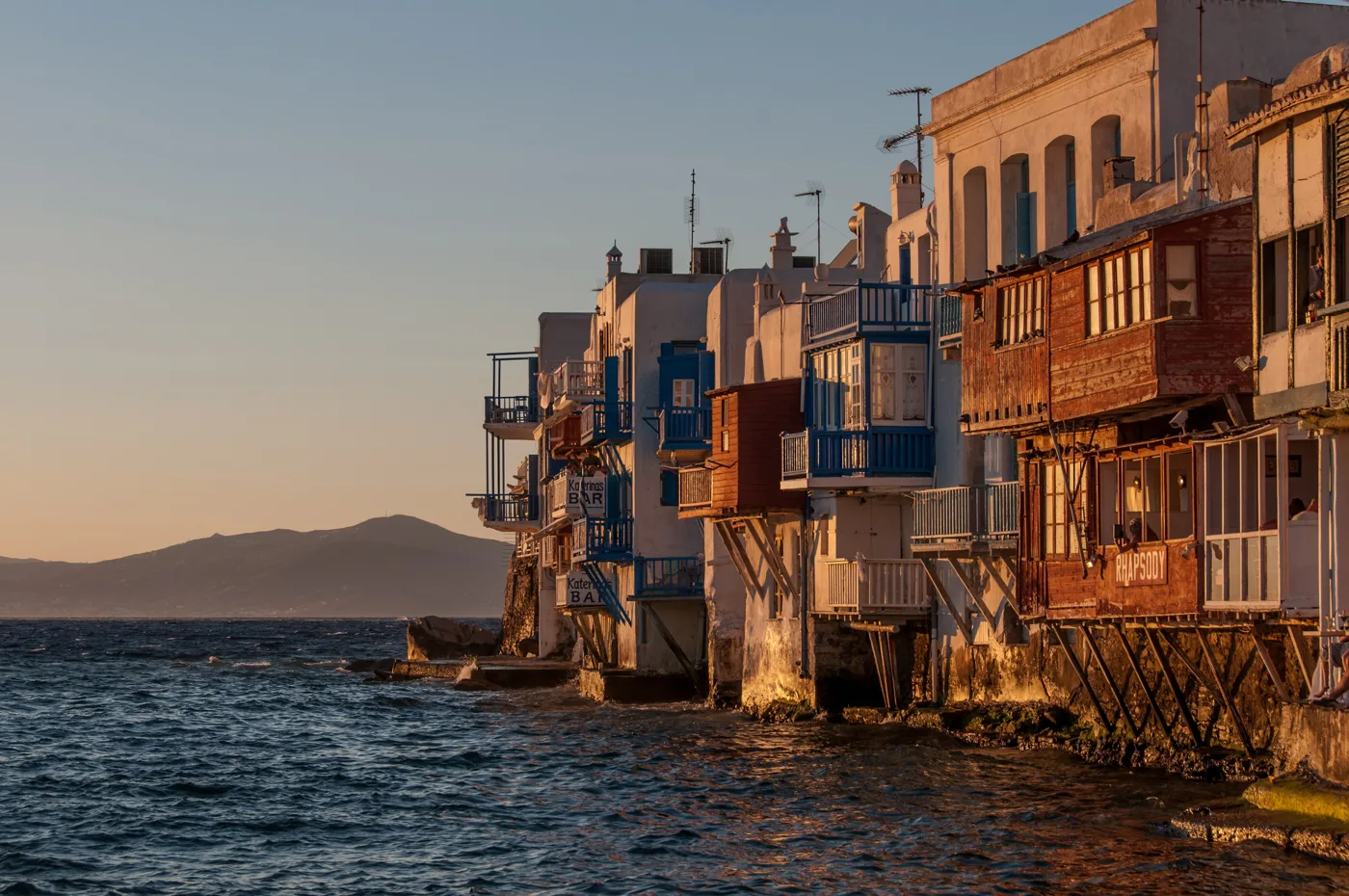
The hour when the bars fill up.
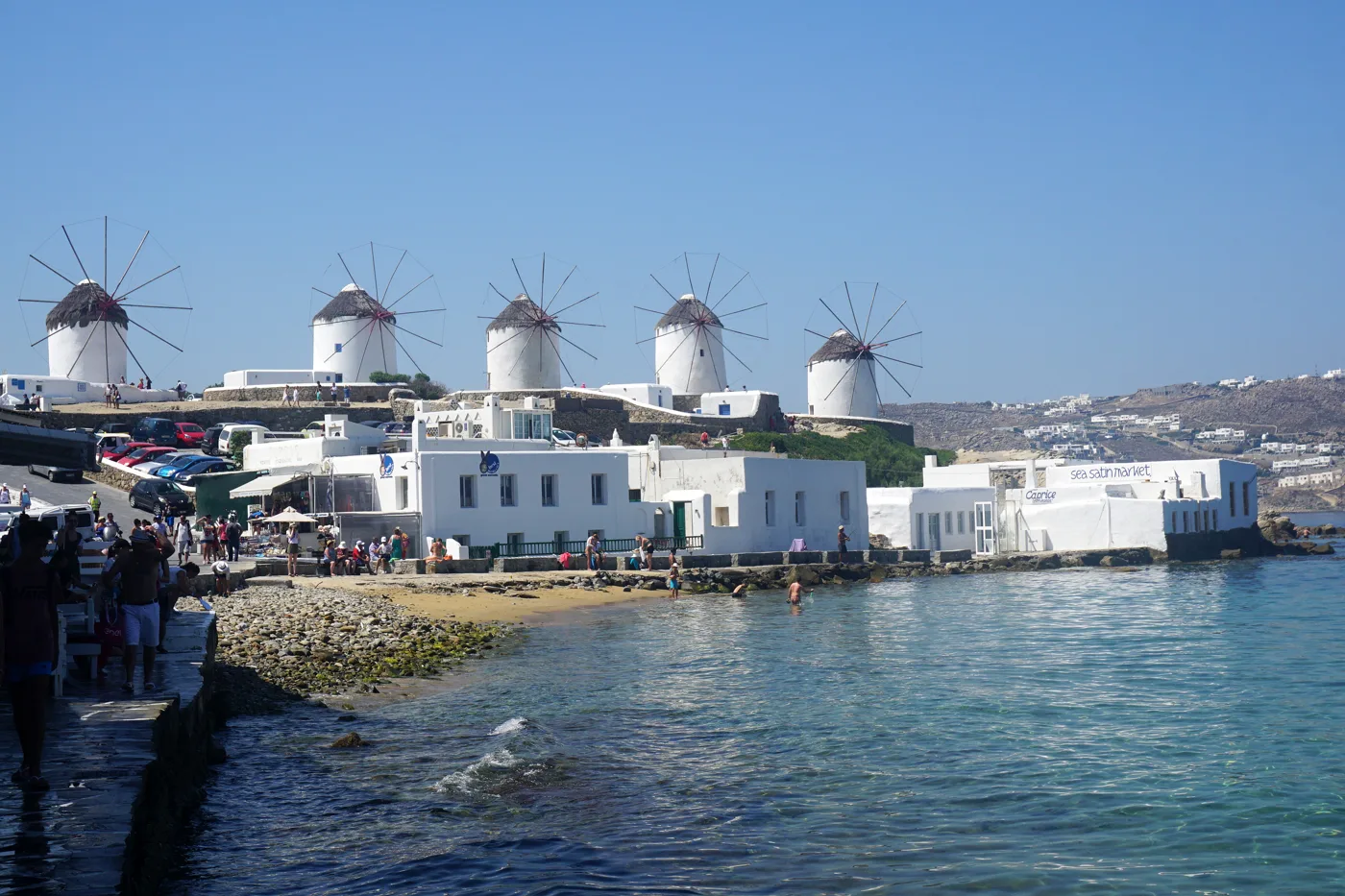
The windmills above Little Venice.
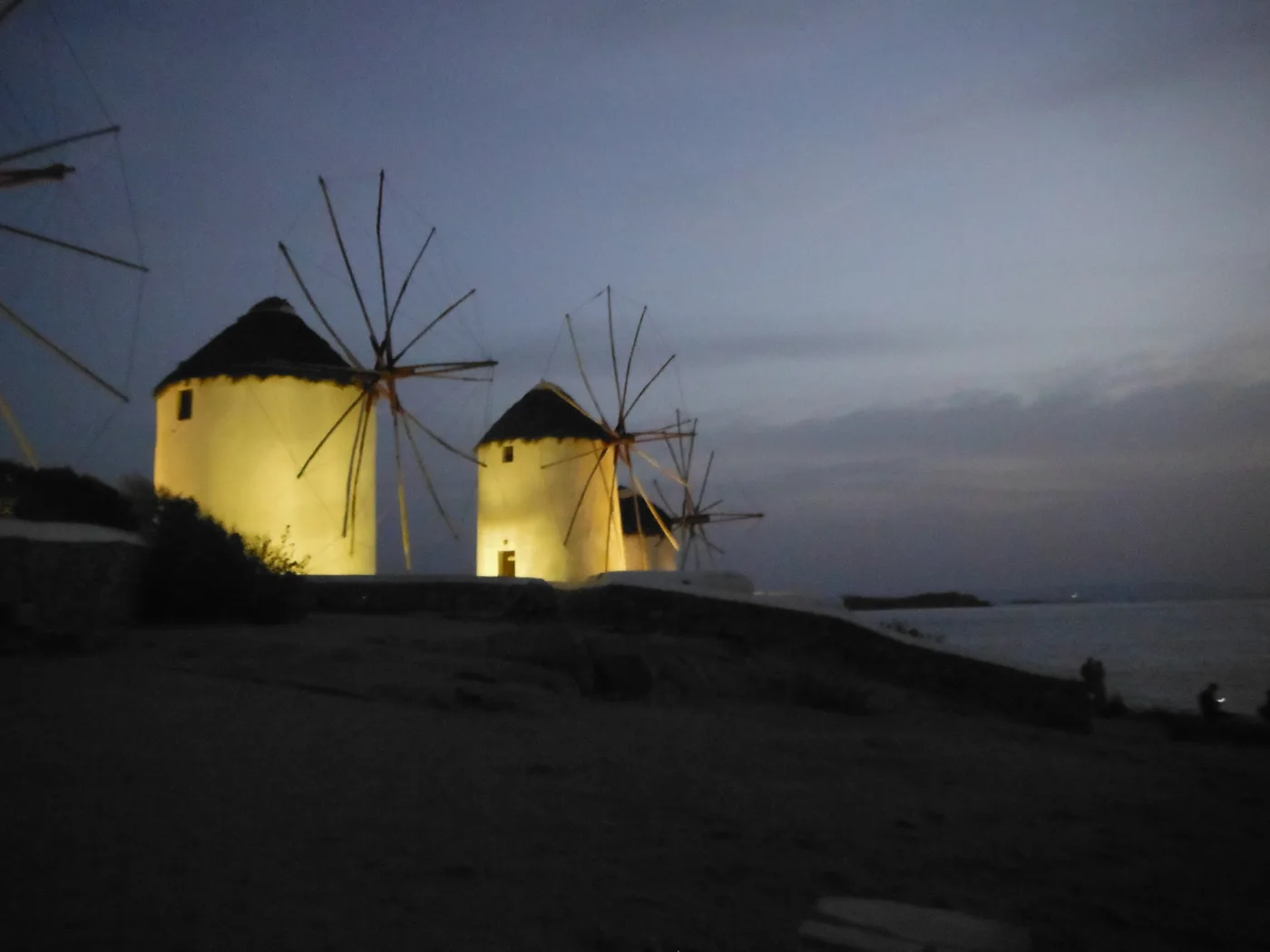
The windmills light up when the sun goes down.
Photos: Julian Lupyan (CC0), Roberto Faccenda (CC BY-SA 2.0), Mariordo (CC BY-SA 4.0), Zigomitros Athanasios (CC BY-SA 4.0) · Wikimedia Commons
🏛️ Delos
Delos is the most important reason to come to Mykonos, even if archaeology is not really your thing. According to myth, Apollo and Artemis were born here, and for centuries the island was one of the great sanctuaries of the Greeks. Later it became a free port and a major trading centre, with residents from all over the Mediterranean. In 88 BC the soldiers of Mithridates sacked it, and the city never again became what it had been. Since 1990 Delos has been a UNESCO World Heritage Site.
You will see a whole city: the sanctuary of Apollo, the famous lions dedicated by the Naxians in the 7th century BC, the theatre, houses with mosaic floors such as the House of the Dolphins and the House of the Masks, and the museum. The lions you see outside are copies; the originals are inside the museum. If you have the energy, climb Mount Kynthos, the island’s hill. From the top you can see the Cyclades all around you.
🏛️ Map of Delos: the route of the visit
The dashed line shows a circular walk of about three hours: from the harbour to the sanctuary of Apollo and the lions, then to the museum, the houses with the mosaics and the top of Mount Kynthos, returning through the theatre quarter. Tap each number to see what it is.
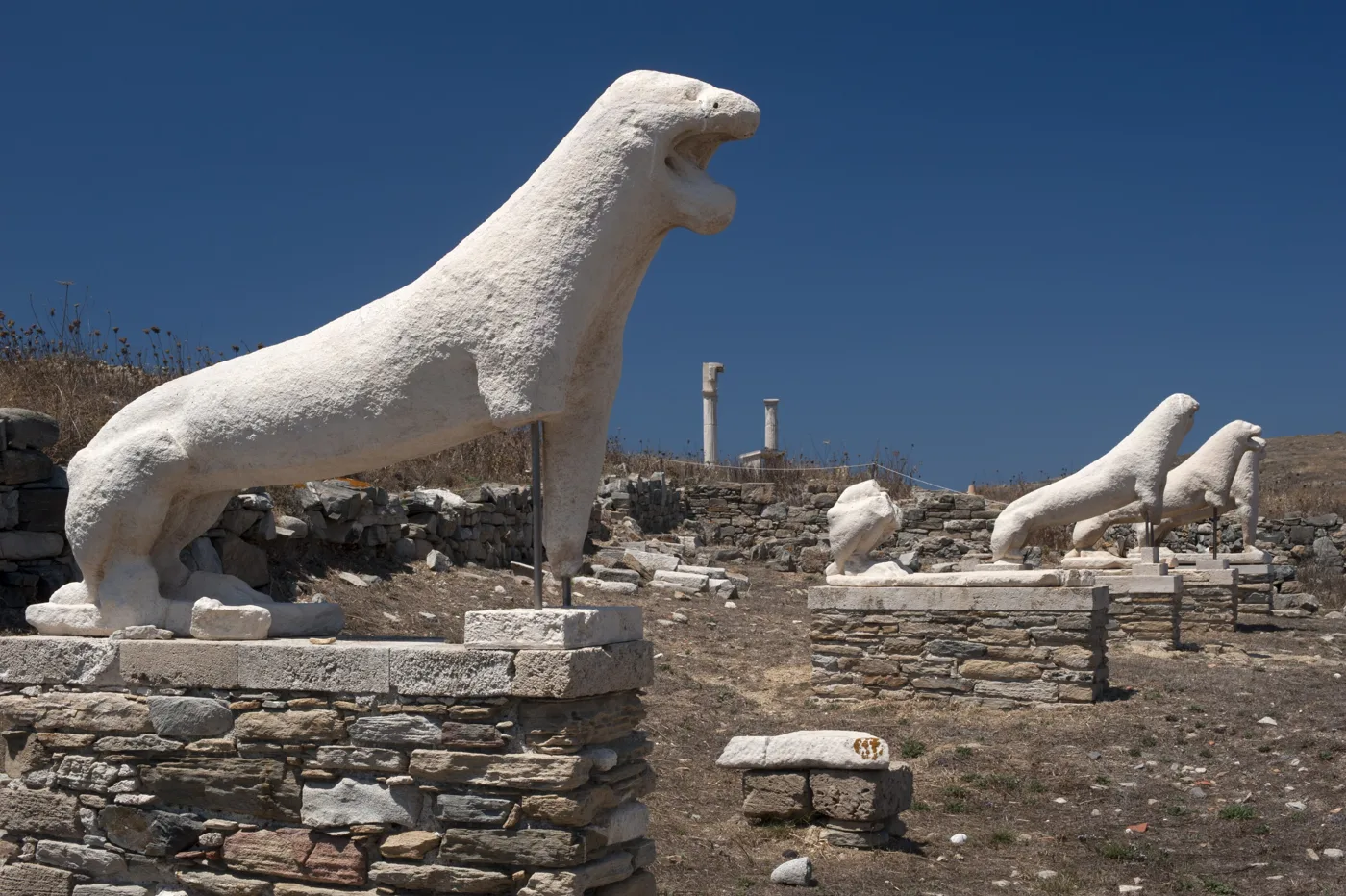
Copies in place, the originals in the museum.
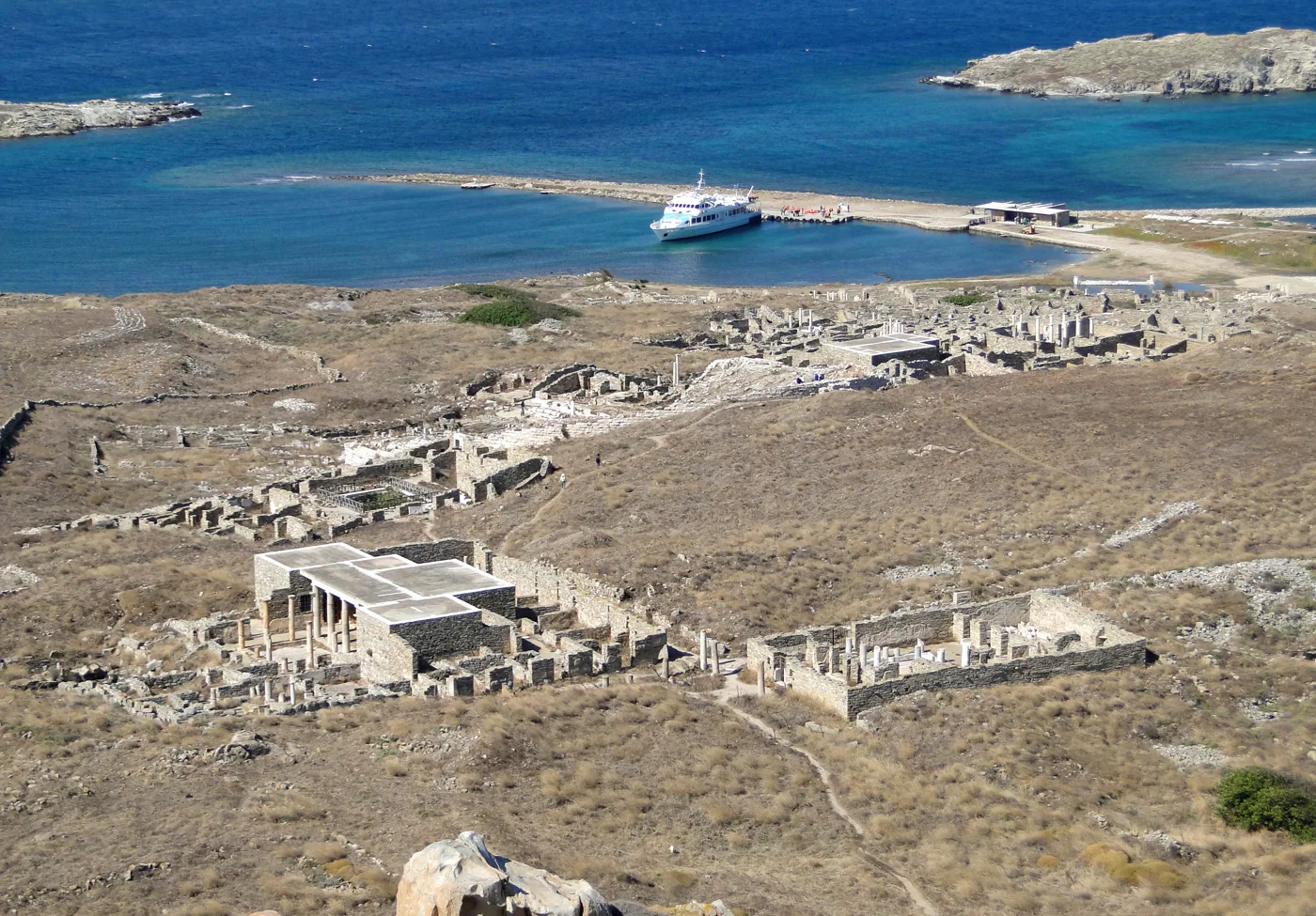
Houses, streets and cisterns of a whole city.
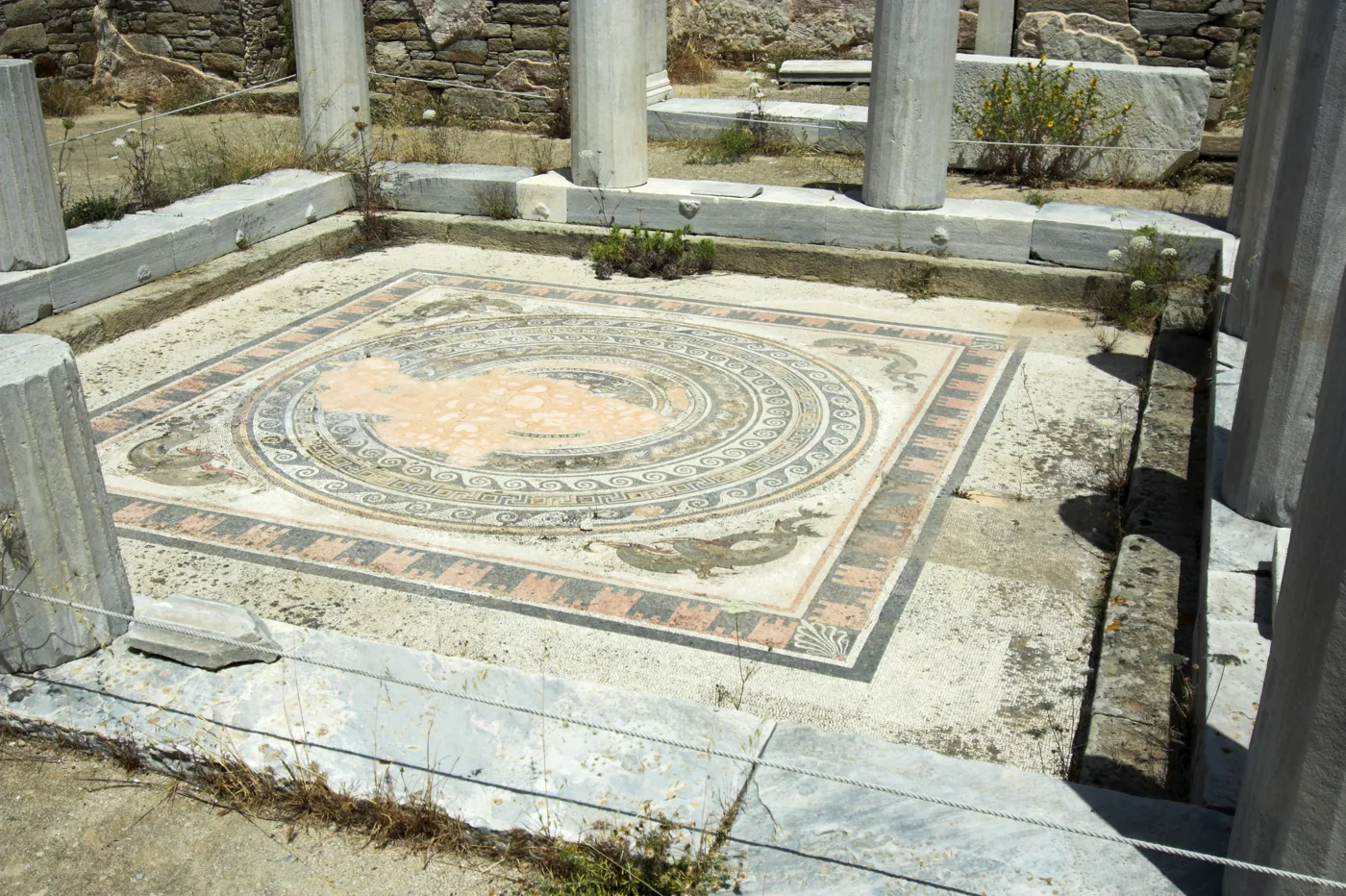
Floors made of tesserae in the courtyards of the houses.
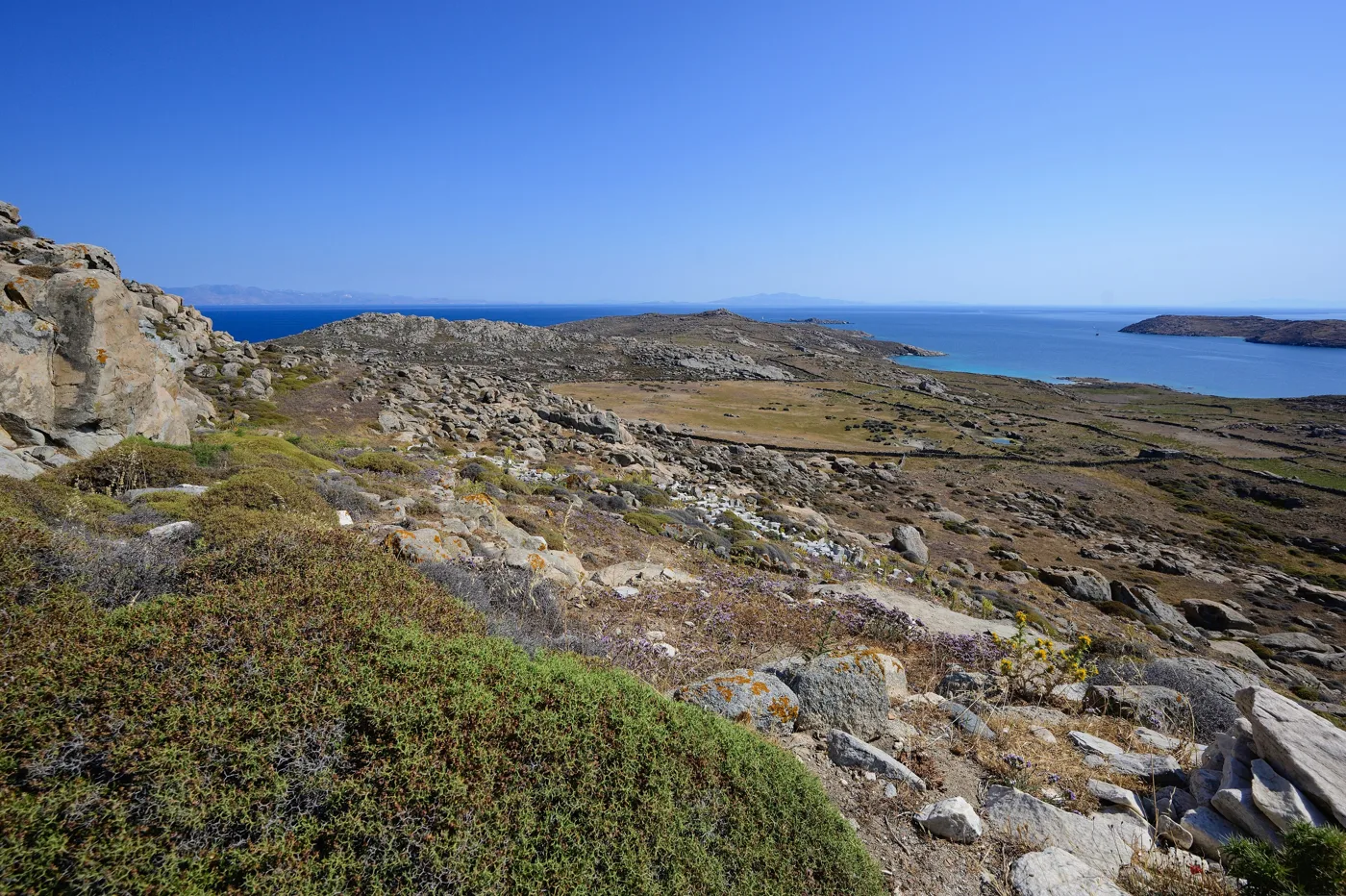
The view from the top of the island.
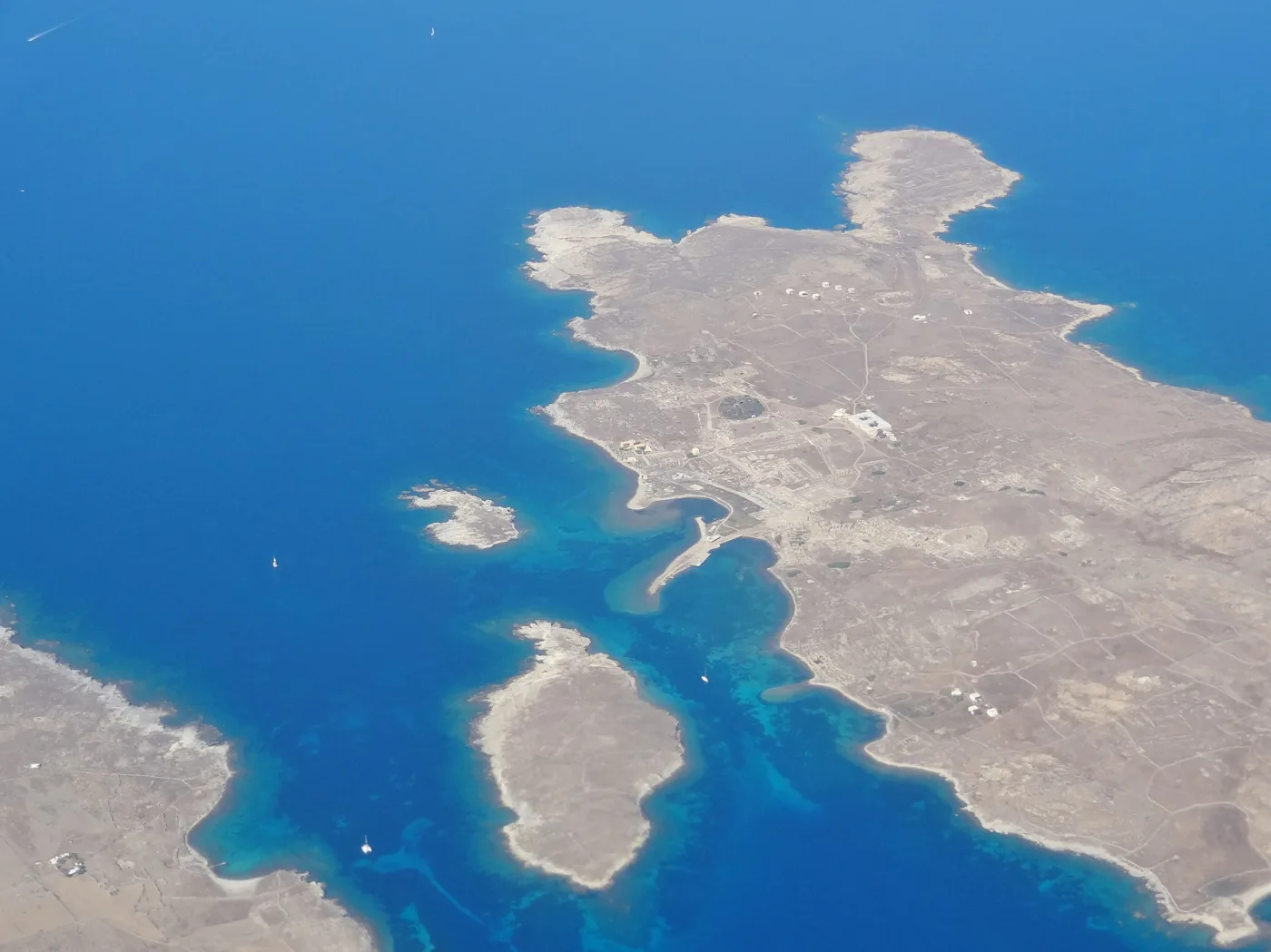
Delos and, next to it, Rhenia.
Photos: Ggia (CC BY-SA 3.0), Bernard Gagnon (CC BY-SA 3.0), Zde (CC BY-SA 4.0), Olaf Tausch (CC BY 3.0) · Wikimedia Commons
The boats leave from the old port of Chora, mostly in the morning, and the crossing takes about half an hour. Nobody is allowed to stay on Delos overnight, so all visits are day trips. The ticket for the archaeological site is separate from the boat ticket. There is almost no shade anywhere: take water, a hat and closed shoes, and check the schedule the day before, because sailings can be cancelled in strong wind.
⛪ Ano Mera and Armenistis lighthouse
Ano Mera is the only large village inland and the other, quieter Mykonos. On its square stands the Monastery of Panagia Tourliani, founded in 1542 and given its present form in the 18th century. Around the square there are tavernas where the food is not priced like a show. Nearby, at the bay of Ftelia, archaeologists found a settlement from the Neolithic period.
At the northwest tip of the island stands Armenistis lighthouse. It was built in 1891, a few years after the British steamship “Volta” was wrecked on the north coast in 1887. The road there is narrow, but the sunset with a view of Tinos is worth it, and it is far less crowded than Little Venice.
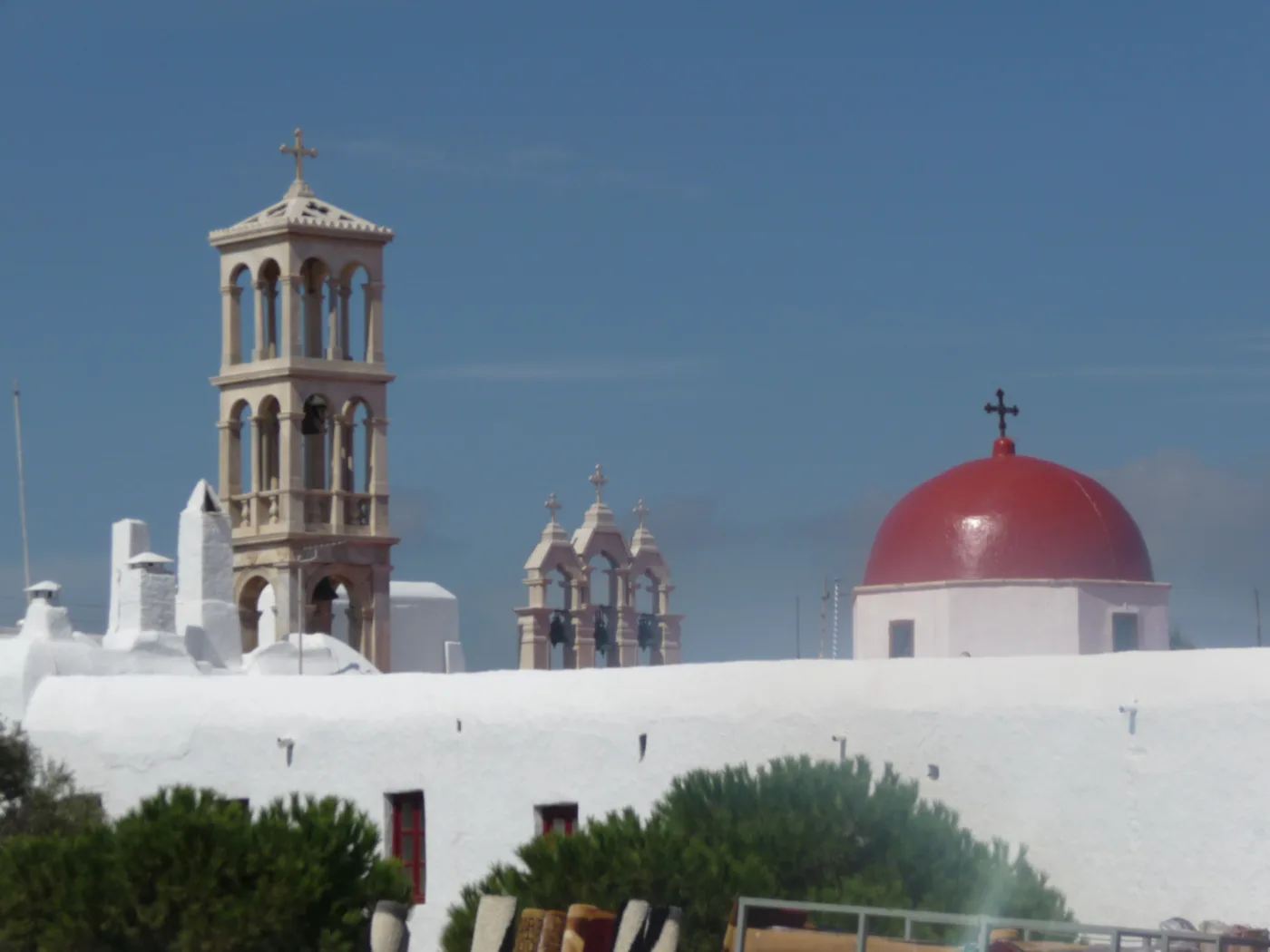
The monastery on the square of Ano Mera.
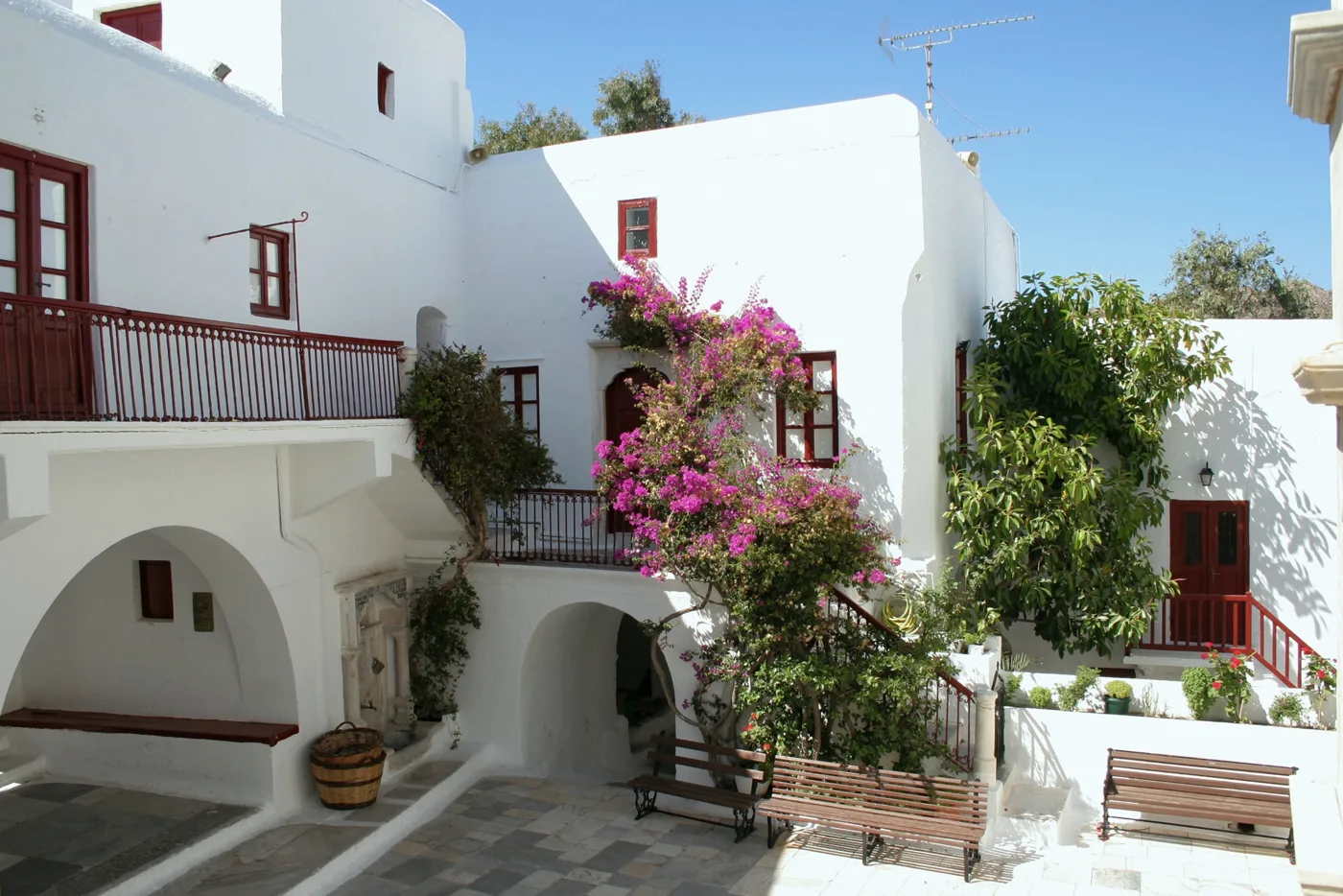
White cells and flowers.
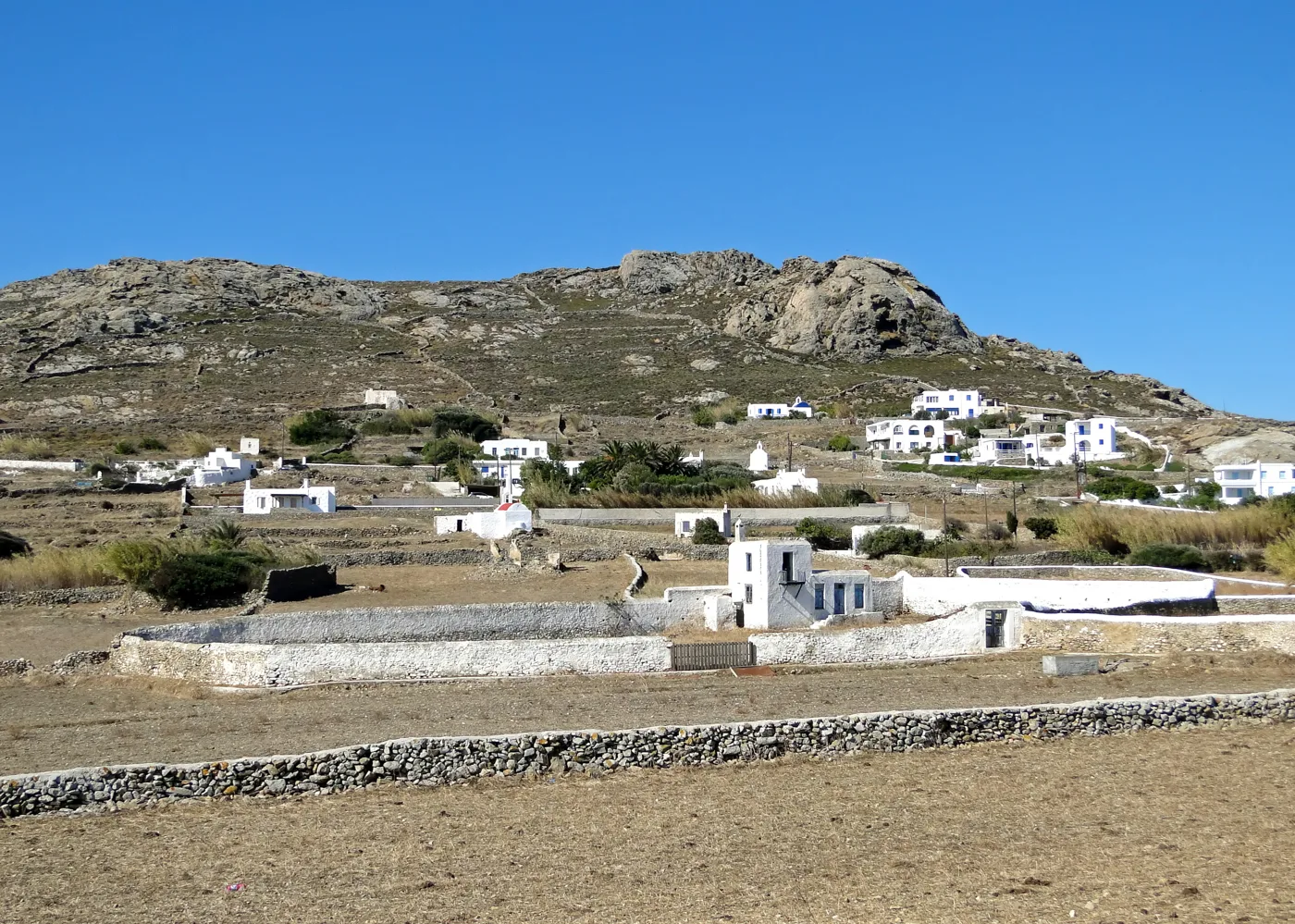
The inland village.
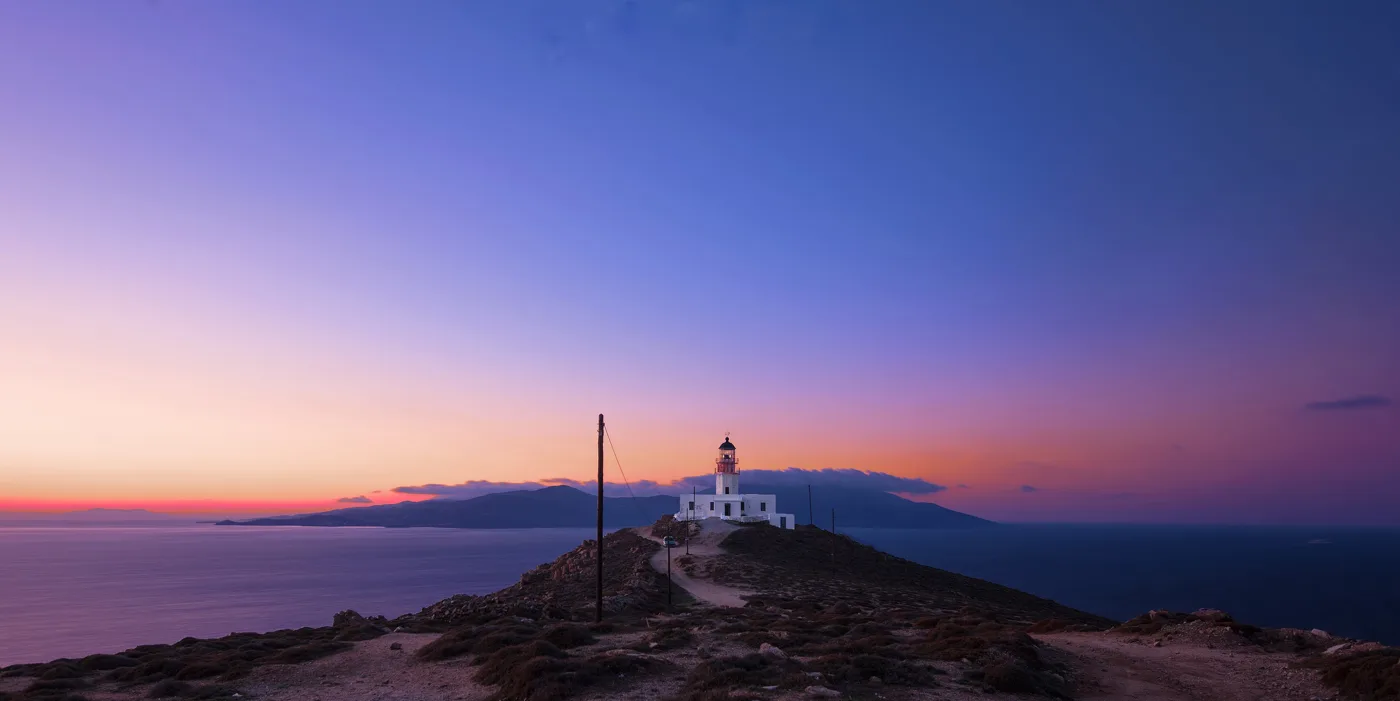
A sunset without the crowds.
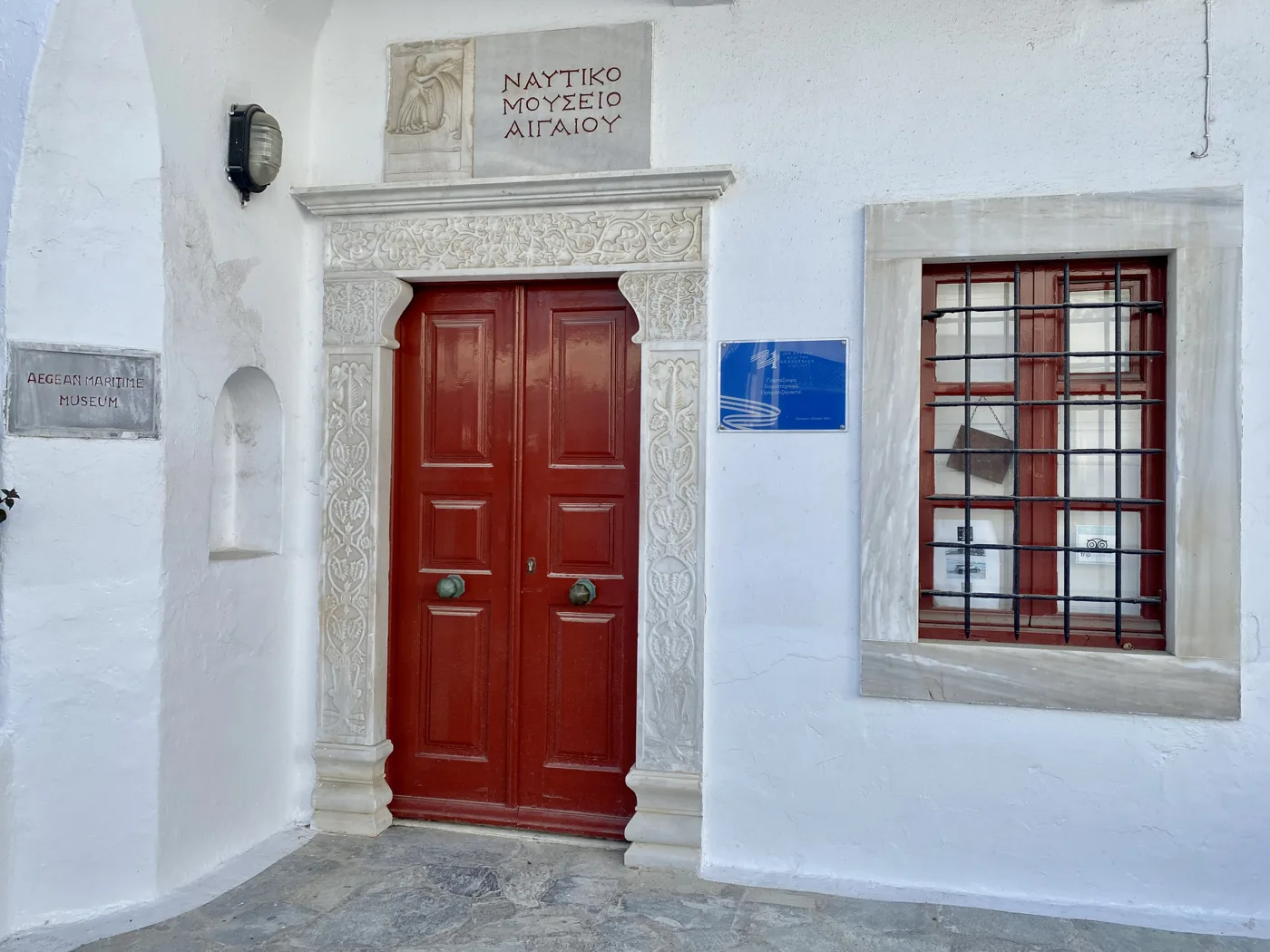
The old mechanism of the lighthouse is kept here.
Photos: giggel (CC BY 3.0), Zde (CC BY-SA 4.0), Bernard Gagnon (CC BY-SA 3.0), Mateus Pabst (CC BY 2.0), Warren LeMay (CC BY-SA 2.0) · Wikimedia Commons
🏖️ The beaches
On Mykonos the wind decides where you swim. In summer it usually blows from the north, the meltemi, and then the southern beaches are calm while the northern ones have waves. On the rare days with a south wind it is the other way round.
- Ornos and Agios Ioannis: close to Chora, with shallow water and families. Agios Ioannis has a lovely sunset with a view of Delos.
- Psarou and Platis Gialos: organised beaches with many restaurants. Boats leave Platis Gialos for the other southern beaches.
- Paradise and Super Paradise: the beaches with the music and the beach clubs. Big crowds, high prices.
- Elia and Agrari: Elia is the longest sandy beach on the south coast; Agrari next to it is calmer.
- Kalo Livadi and Kalafatis: large bays on the southeast coast. Kalafatis is a favourite for windsurfing and kitesurfing.
- Panormos, Agios Sostis, Fokos, Ftelia: on the north coast, wilder, with few or no sunbeds. Ideal when the wind is down. Ftelia is popular with windsurfers.
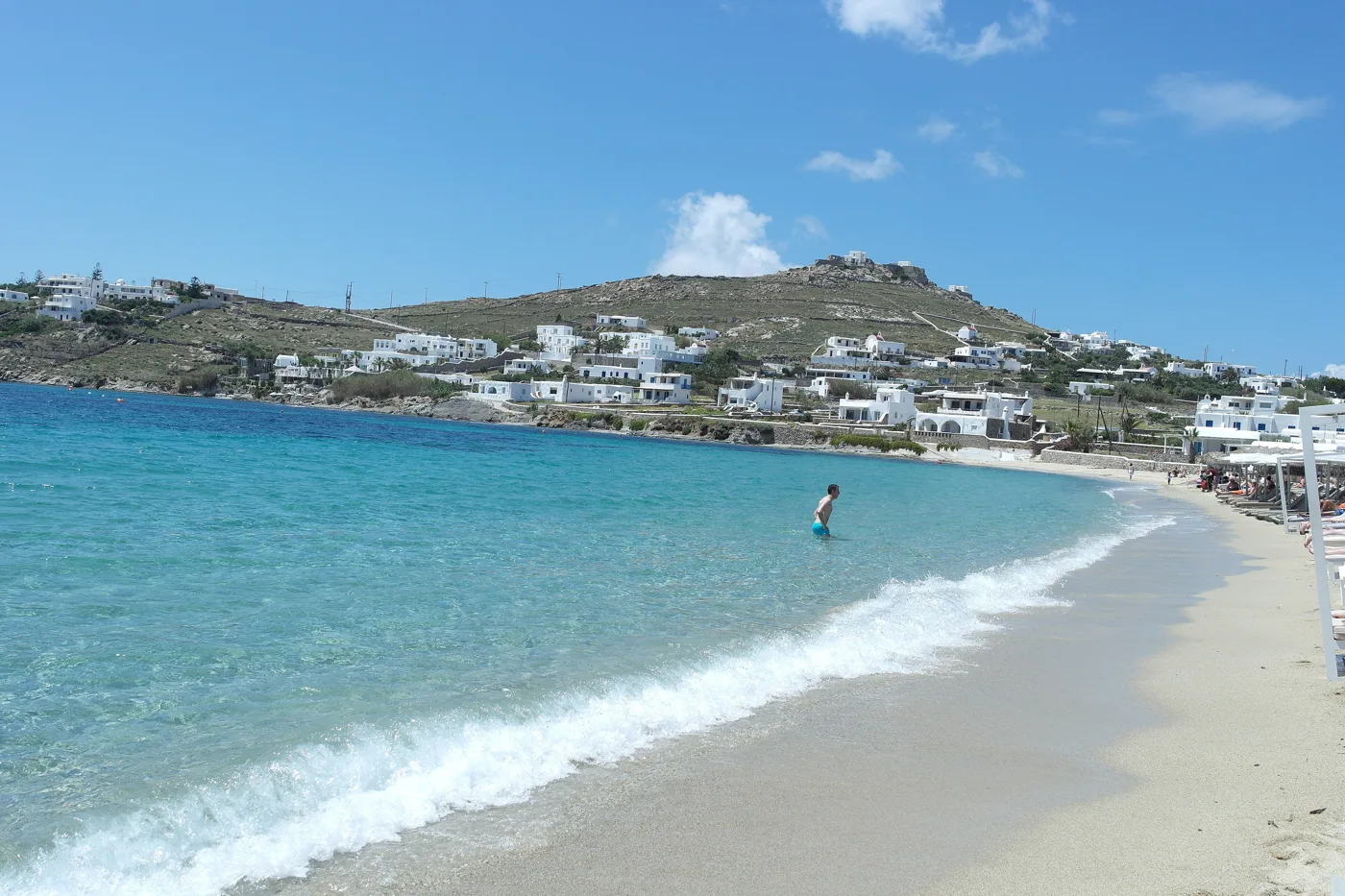
Shallow water, close to Chora.
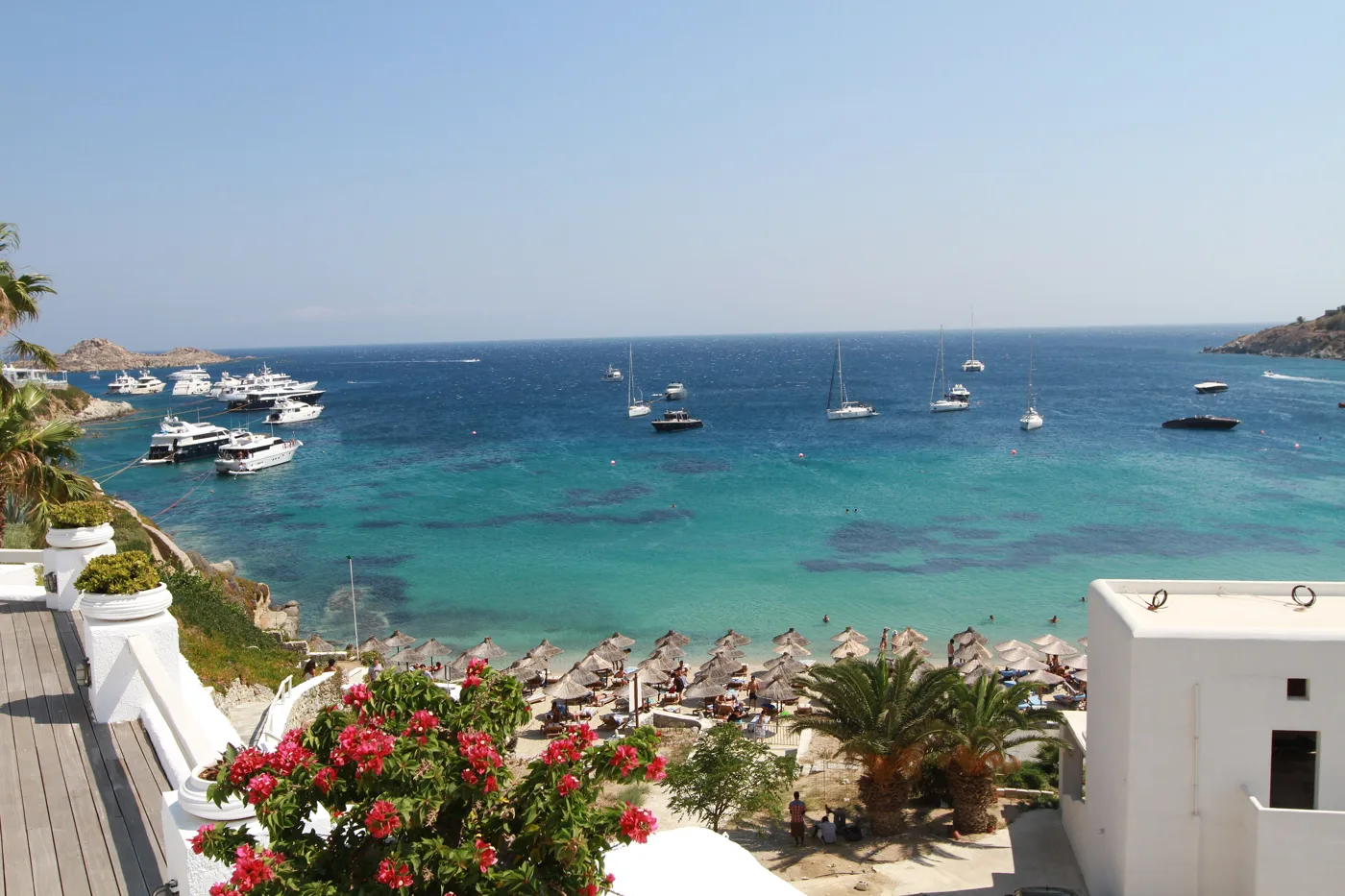
A small bay full of boats.
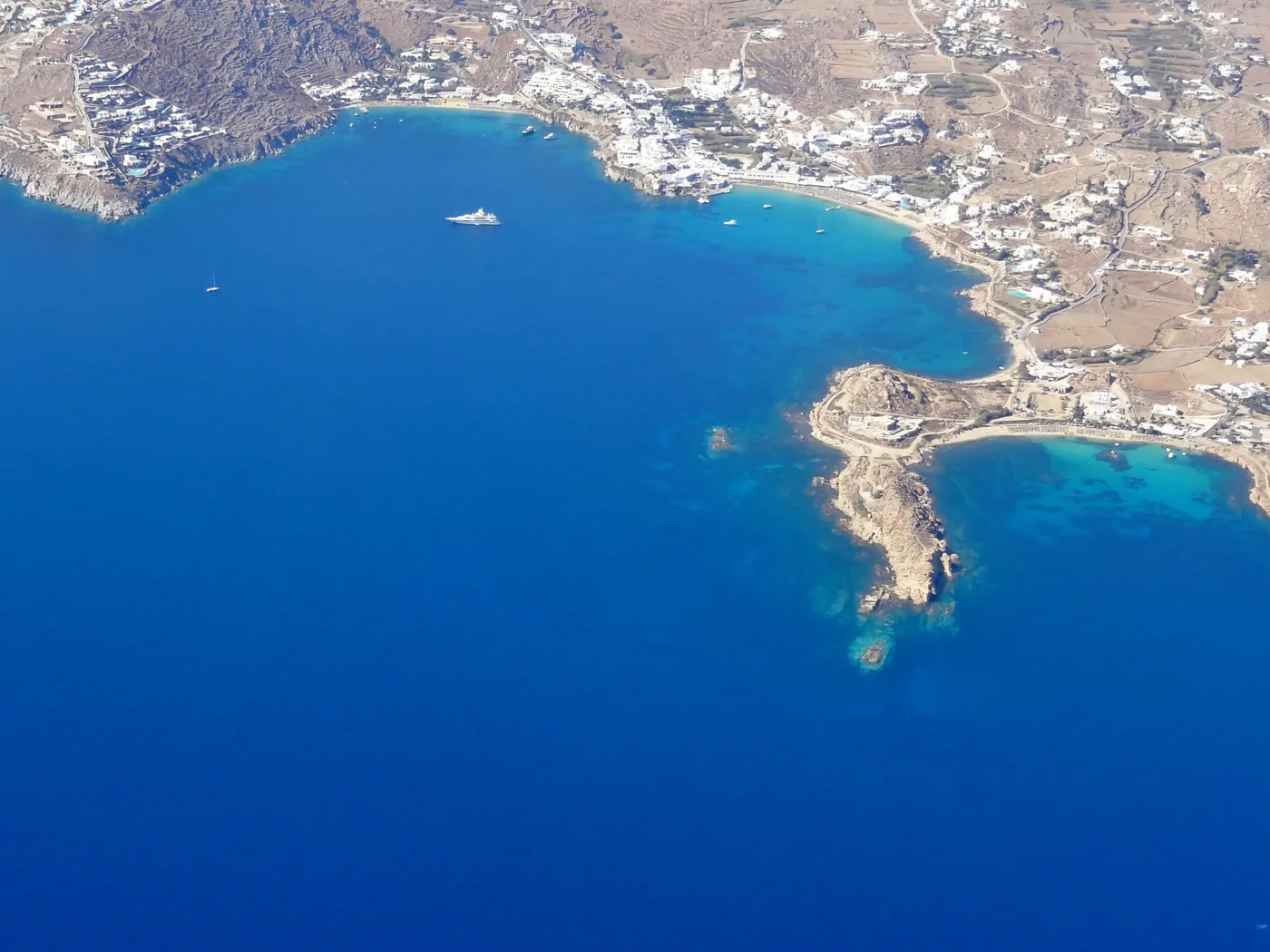
The two bays of the south coast.
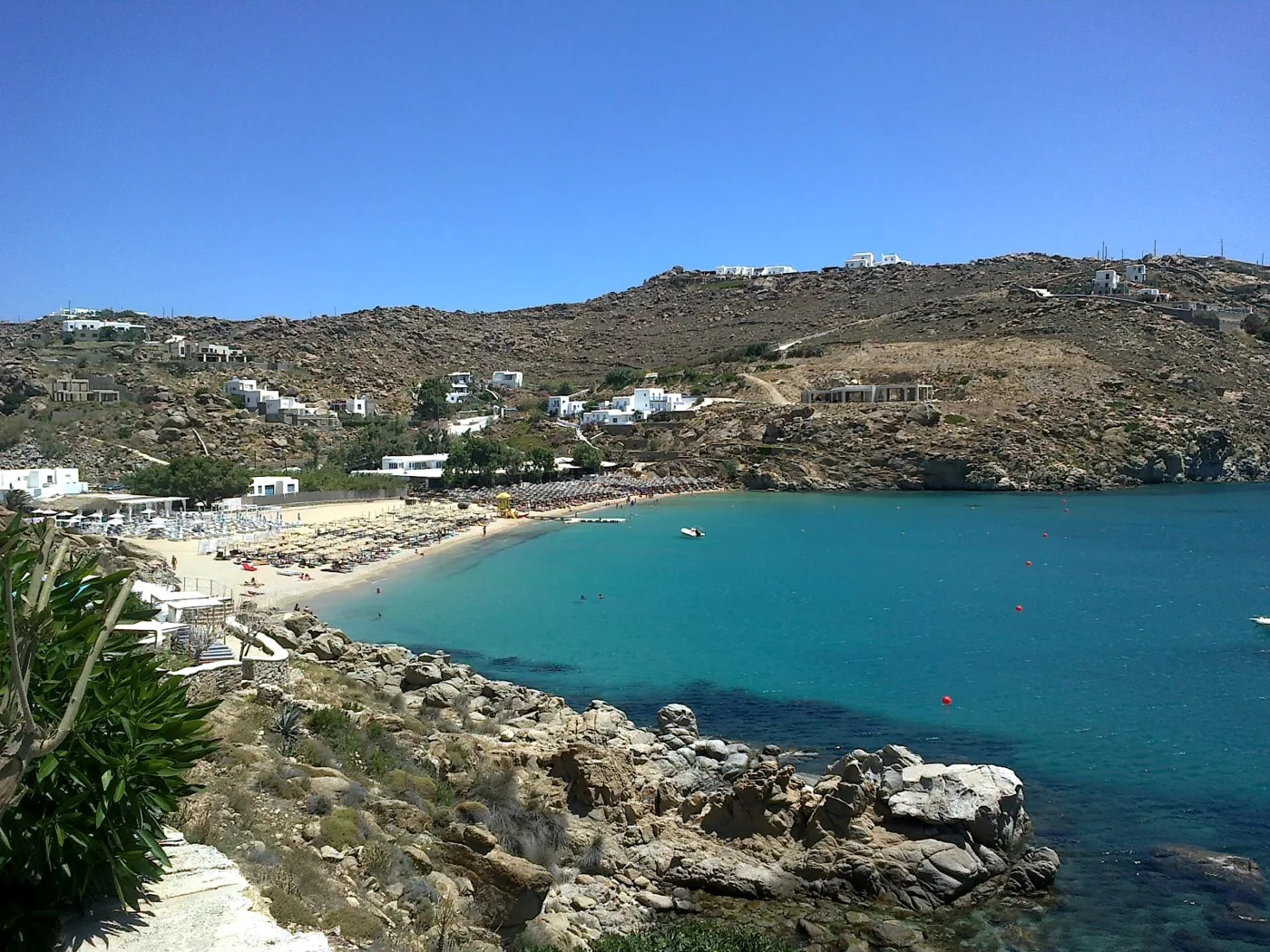
Music and crowds in summer.
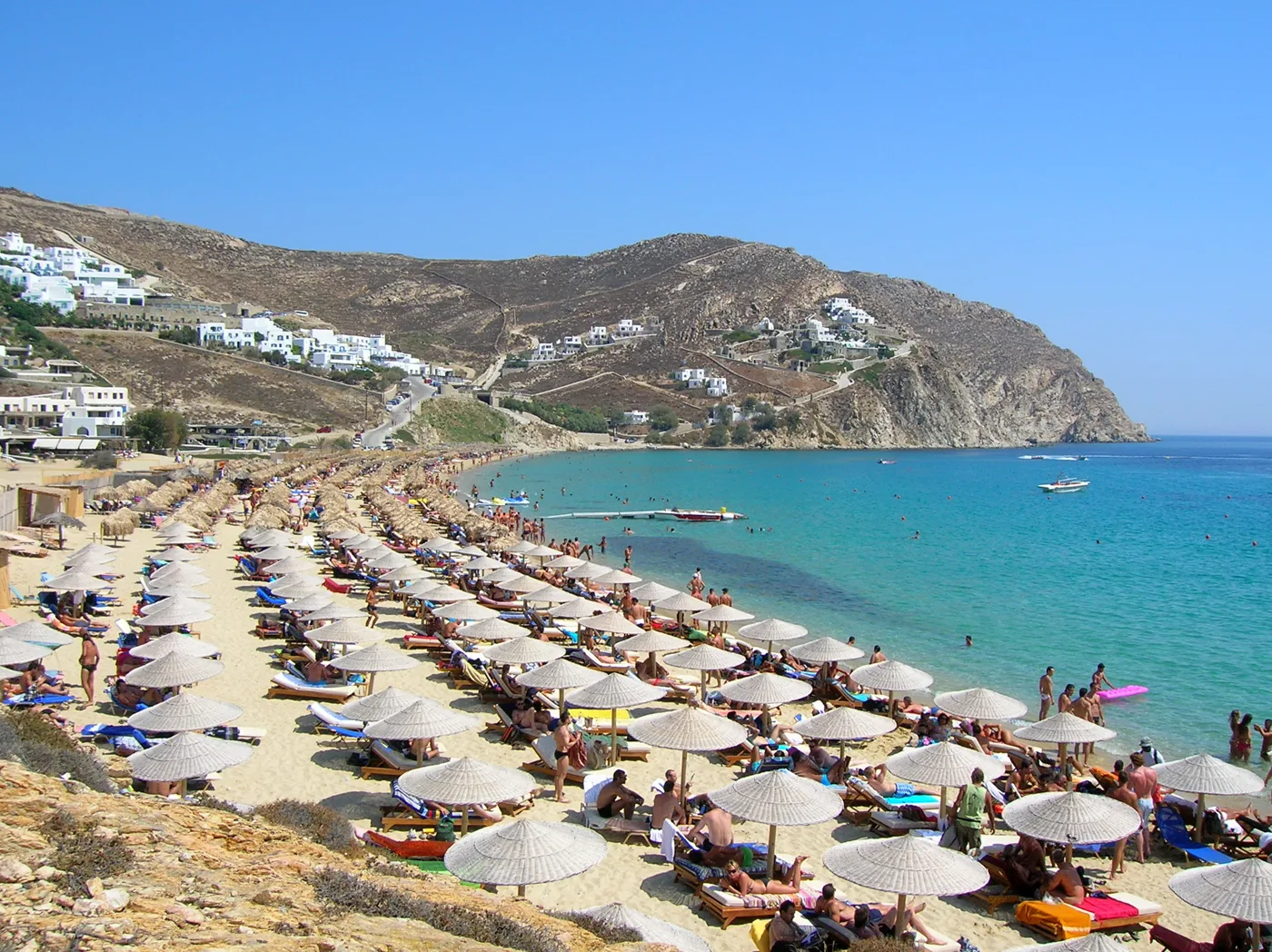
The longest sandy beach on the south coast.
Photos: Marco Monelli (CC BY-SA 3.0), 7777777kz (CC BY 3.0), Olaf Tausch (CC BY 3.0), rene boulay (CC BY-SA 3.0), Squirmy2000 (Public domain) · Wikimedia Commons
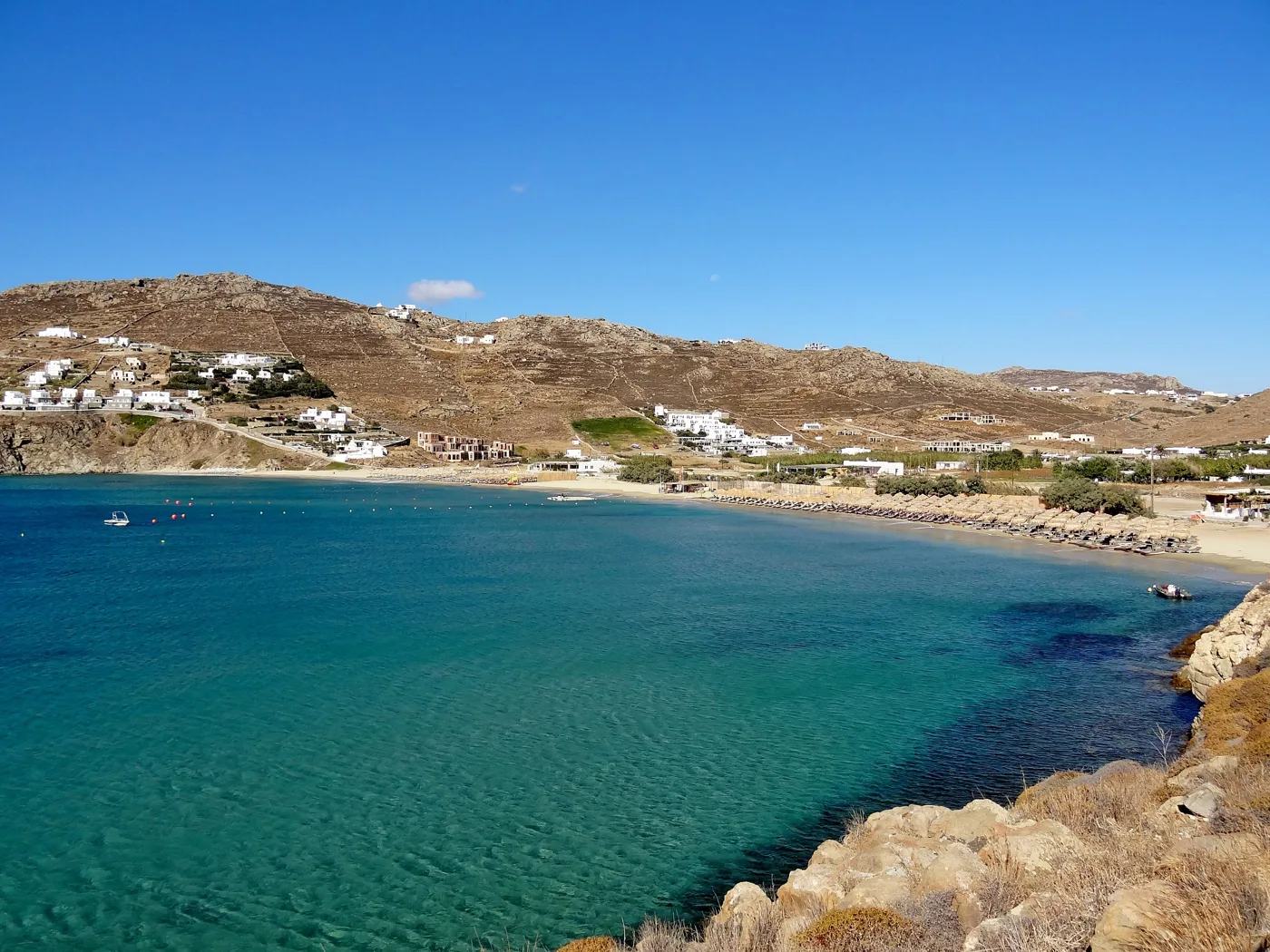
A big sandy beach on the southeast coast.
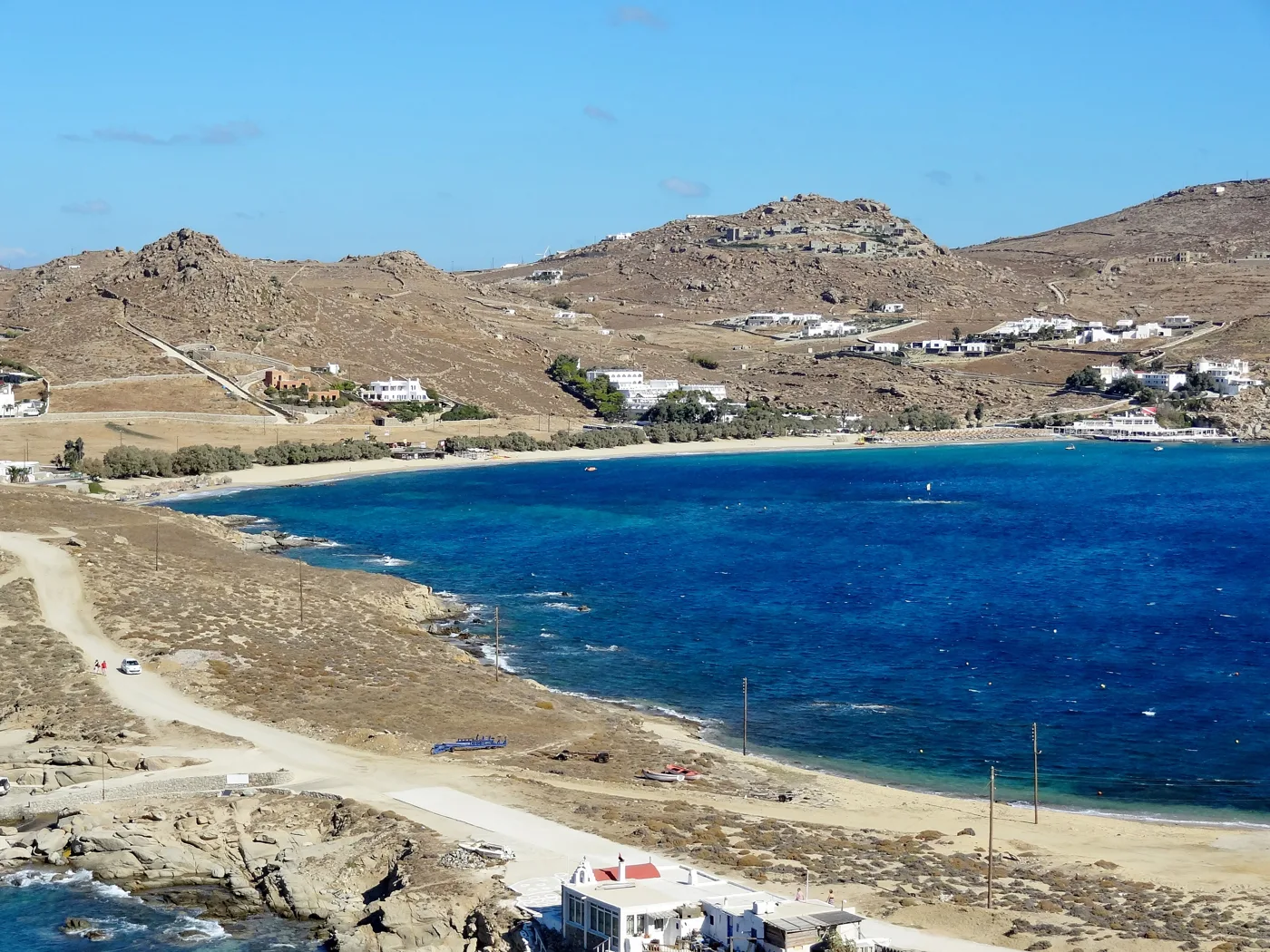
The windsurfers’ favourite.
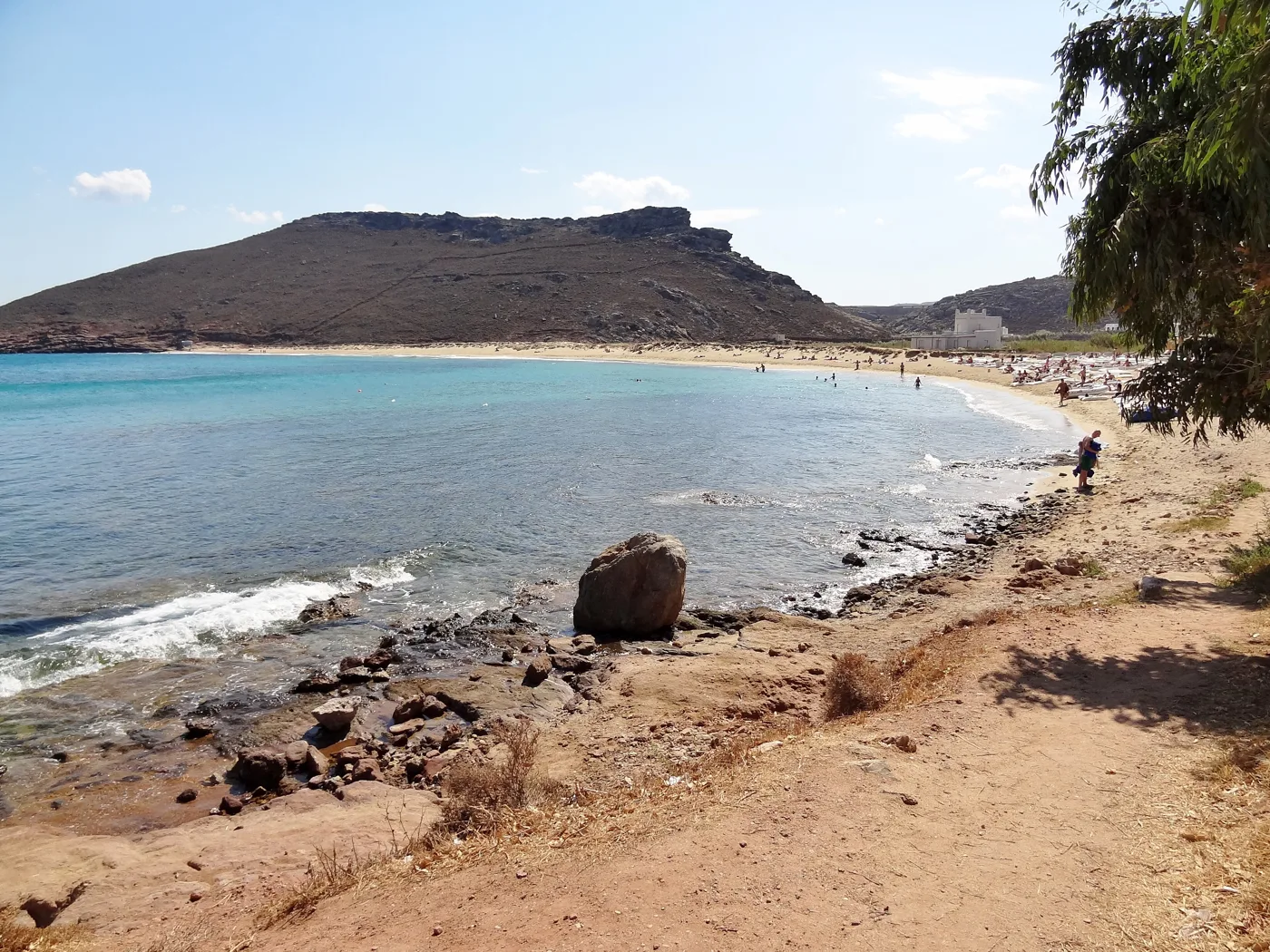
On the north coast, where the wind blows.
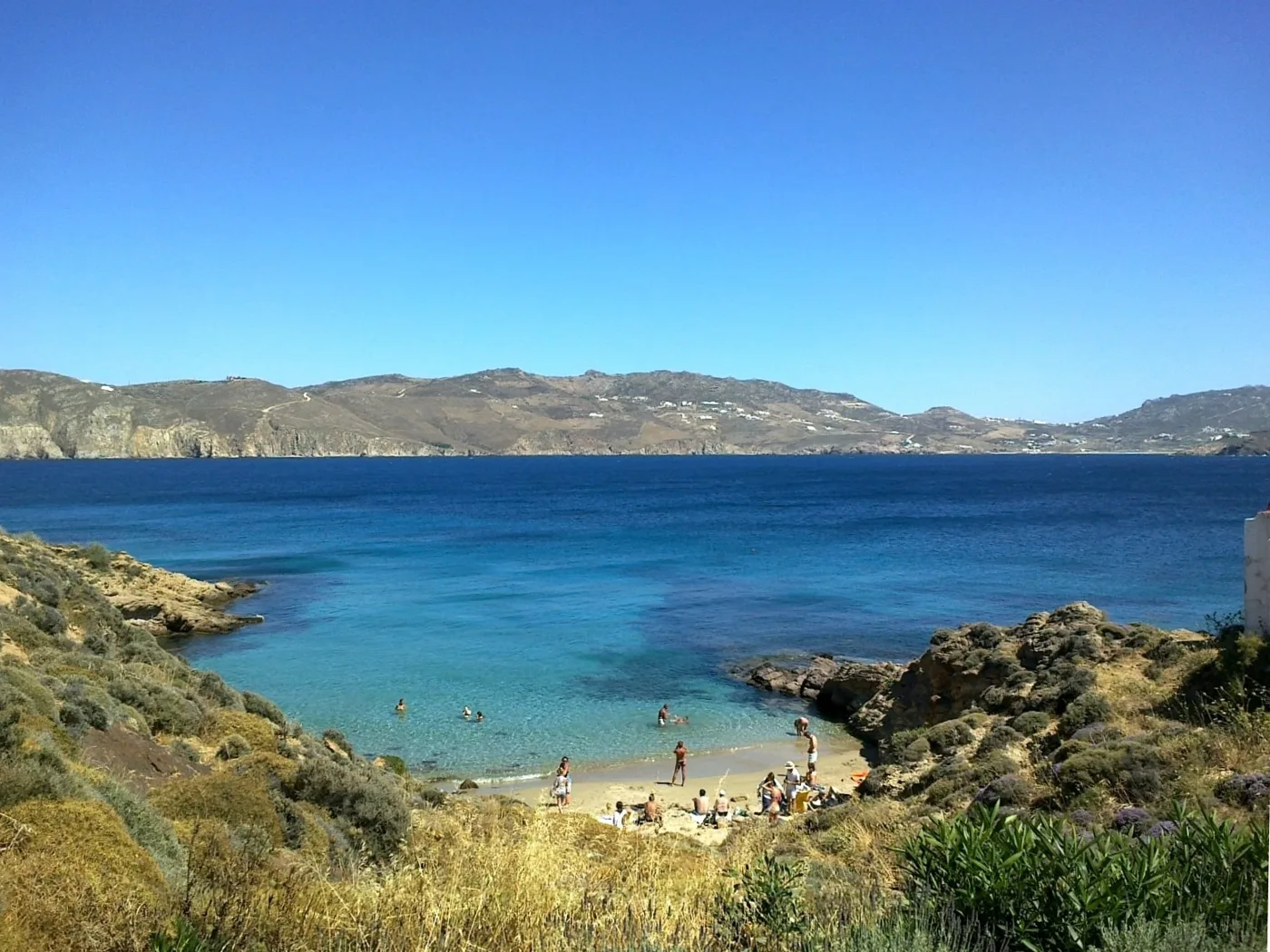
No sunbeds, the way it used to be.
Photos: Olaf Tausch (CC BY 3.0), rene boulay (CC BY-SA 3.0) · Wikimedia Commons
🍸 Nightlife
A Mykonos night starts with a drink in Little Venice at sunset. Then the bars of Chora fill up until late. The big beach clubs on the south coast get going in the afternoon. For most of them you need a booking in July and August, and the prices of drinks and sunbeds are among the highest in Greece. Mykonos has been a favourite destination of the LGBTQ+ community for decades.
🧀 What to eat
Try kopanisti, a soft, spicy cheese made in the Cyclades. Kopanisti is a PDO product and is eaten on bread or rusks. Try louza too, cured pork with spices, cut into thin slices, and the local sausages. You will find them in small shops in Chora and Ano Mera, much cheaper than in the beach restaurants.
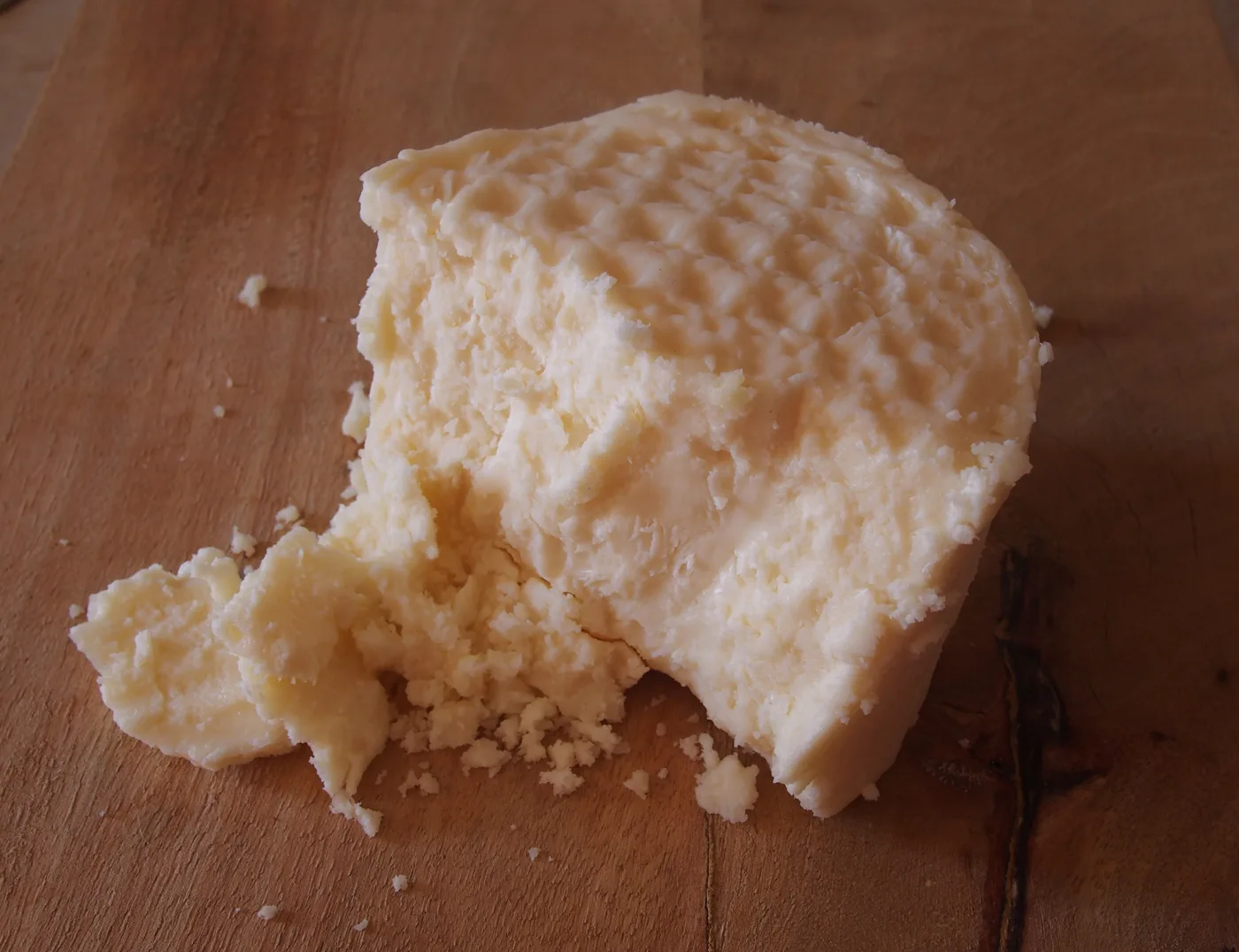
Photo: C messier (CC BY-SA 4.0) · Wikimedia Commons
📅 When to go
The best time is June and September: the sea is warm, the island is lively and prices are a little more reasonable. In July and August Mykonos is at its most expensive and most crowded, and the meltemi blows hard. May and October are quiet months, ideal for Chora and Delos, but the sea is cooler. From November to March most hotels and shops close.
On days when many cruise ships arrive, Chora is packed from morning to afternoon. Since 2025 cruise passengers pay a fee of 20 euros to go ashore on Mykonos in the summer months. If you can, see Chora early in the morning or after sunset.
⛴️ How to get there from Athens
| How | Duration | From | Notes |
|---|---|---|---|
| ✈️ Plane | About 40–45 minutes | Athens airport | Flights all year round, many in summer. |
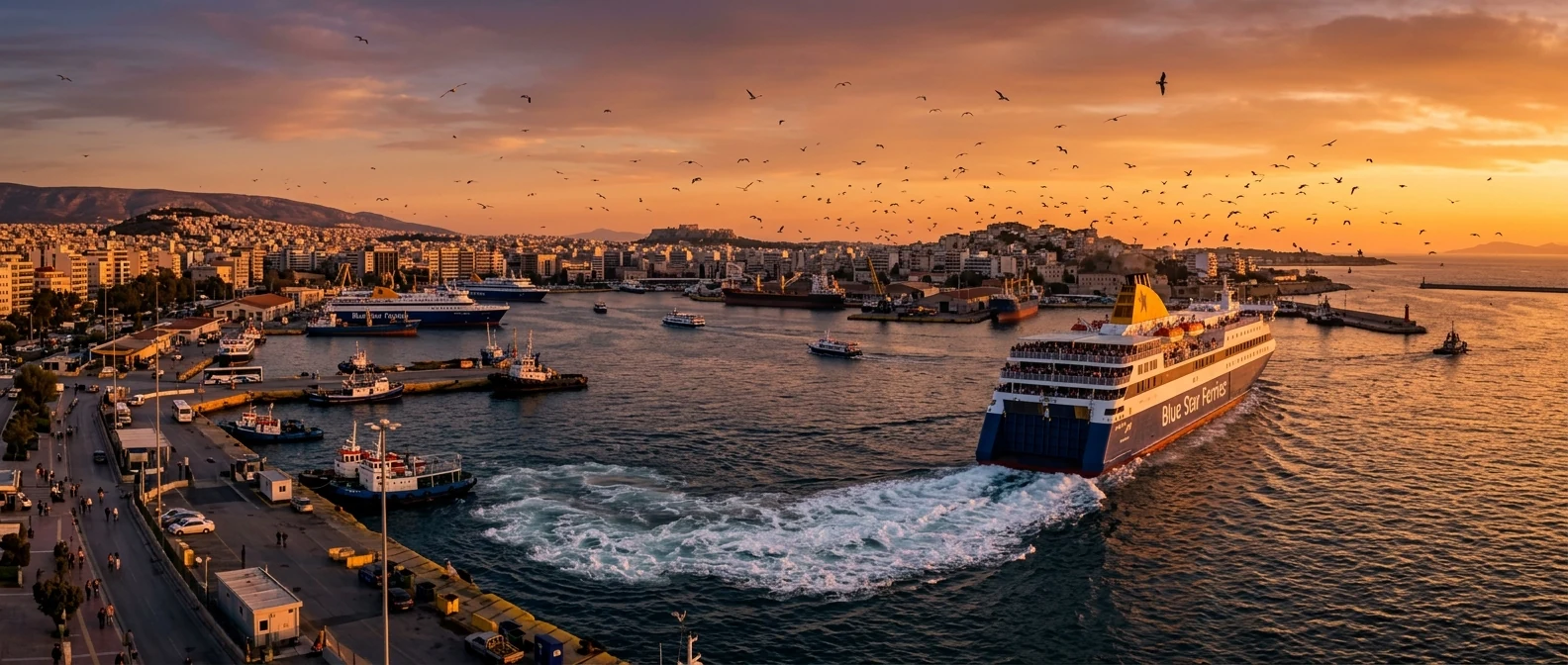
| 🚤 Fast ferry | 2.5–3.5 hours | Piraeus | The simplest option from the centre; it rolls when the wind blows. |
| ⛴️ Conventional ferry | 4.5–5.5 hours | Piraeus | Cheaper and more stable, with stops at Syros and Tinos. |
| 🚤 Fast ferry | About 2–2.5 hours | Rafina | The shortest sea crossing. |
From Ioulianou 50, Piraeus is easy: Line 1 from Victoria to the end of the line, no changes. For Rafina, the KTEL Attica buses leave from Mavromateon Street at Pedion tou Areos, a few minutes’ walk from the apartment, and take about an hour. For the airport, take Line 1 to Monastiraki and then Line 3 towards the Airport. Ferries arrive at the new port at Tourlos, about 2 kilometres from Chora. See our guide to ferries from Piraeus.
🚌 Getting around the island
- KTEL buses: leave Chora for Ornos, Platis Gialos, Paradise, Elia, Ano Mera and the new port. They are cheap, but full in August.
- Beach boats: from Platis Gialos and Ornos to the southern beaches. An easy way to avoid the roads.
- Car or scooter: needed for the north coast, Ano Mera and the lighthouse. Cars cannot enter Chora, and parking around it is difficult.
- Taxis: there are few for so many people. Book a transfer in advance for the port and the airport.
🛏️ Where to stay
| Region | For whom | Good to know |
|---|---|---|
| Chora | First visit, no car, nights out | Everything on foot, but noisy until late. |
| Ornos, Agios Ioannis | Families, sunsets | Shallow water, bus to Chora. |
| Platis Gialos, Psarou | Beach and boats to the southern beaches | Organised, expensive in summer. |
| Agios Stefanos | Near the port, quieter | A small beach, a few minutes from Chora. |
| Ano Mera, Kalo Livadi | Peace and quiet, car | Away from the noise, you need transport. |
🗓️ A three-day itinerary
Chora and the sunset
Get lost in the alleys in the morning, before the cruise passengers arrive. See Paraportiani and one of the museums. In the afternoon go to Little Venice and climb up to the windmills for the sunset.
Delos and the southern beaches
Take the first boat to Delos and stay three to four hours. In the afternoon swim at Ornos or Platis Gialos and take the beach boat to the other southern beaches.
Ano Mera, the east and the lighthouse
Morning in Ano Mera and at the Tourliani Monastery, lunch on the square. Swim at Kalo Livadi or, if there is no wind, at Fokos. End the day with the sunset at Armenistis lighthouse.
Frequently asked questions
How many days do I need?
Three days are enough for Chora, Delos and a few beaches. With four or five days you also have time for the north coast without rushing.
Is Mykonos only for partying?
No. Chora in the morning, Delos, Ano Mera and the northern beaches show a completely different island. Just skip the southern beaches with the music if they are not your thing.
Can I go for a day from Athens?
By fast ferry from Rafina or by plane, technically yes, but it is not worth it. The journey takes many hours and you will not have time for Delos. Stay at least two nights.
When is it cheapest?
In May, early June and October. In August prices can be double or even more.
Is it suitable for children?
Yes, if you choose the right area. Ornos, Agios Stefanos and Platis Gialos have shallow, calm water. Older children enjoy Delos, if you go early before the heat.
— Kathy